
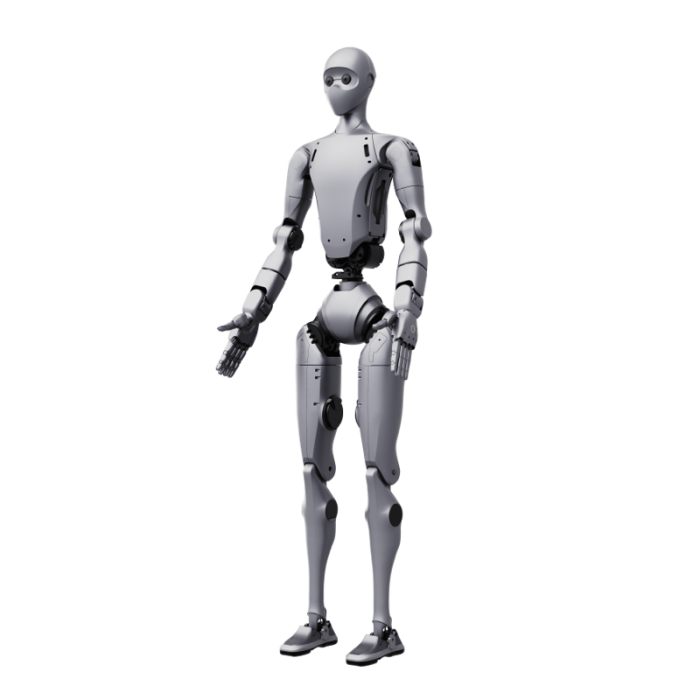
Unitree H2 Plus Humanoid Robot
In stock
- BRAND:
- UNITREE ROBOTICS
- MODEL:
- H2 Plus
- ORIGIN:
- China
- Warranty:
- 12 MONTHS
- AVAILABILITY:
- SUBJECT TO AVAILABILITY
- SKU:
- Unitree-H2-Plus
Unitree H2 Plus Humanoid Robot
Teaching a robot to pick up a cup is easy to describe and hard to do. The Unitree H2 Plus Humanoid Robot is aimed at exactly that gap, pairing a human-scale body with dexterous hands and a very large onboard computer, so that policies trained in simulation can be tried on real objects in the real world.
The product is available through this page, by quotation.
Background
Unitree Robotics and the H2 lineage
Unitree Robotics is a world-renowned civilian robotics company. Its humanoid line is built around the H2 chassis, which stands nearly 6 feet tall and weighs 150 pounds, with 31 degrees of freedom across the body for human-scale testing. That chassis is the starting point for the H2 Plus.
The H2 Plus family has several versions, and this page covers the H2 Plus Humanoid Robot as the fact sheet describes it. If you are comparing configurations, the Unitree H2 Plus category brings the family together, and the individual versions are linked later in this article.
A reference design on the NVIDIA Isaac GR00T platform
Unitree announced the H2 Plus as its first humanoid reference design built on the NVIDIA Isaac GR00T development platform. In practical terms, this means the robot is meant to sit inside a complete workflow: simulation and training in NVIDIA Isaac Sim and Isaac Lab, then Isaac ROS middleware to move trained policies onto the robot.
The hardware matches that goal. Onboard compute is an NVIDIA Jetson AGX Thor T5000 with an NVIDIA Blackwell GPU, delivering 2,070 FP4 teraflops of AI performance. Alongside it sit a 14-core Arm CPU, 128GB of unified memory and a configurable 40- to 130-watt power range. For teams that want to run large models on the robot itself instead of a tethered workstation, this is the heart of the offer.
Technical Specifications
| Specification | Value |
|---|---|
| Chassis | Unitree H2 humanoid chassis, nearly 6 feet tall, 150 pounds |
| Body degrees of freedom | 31 across the body |
| Hands | Dual Sharpa Wave tactile five-finger hands |
| Hand degrees of freedom | 22 active DOF in the hands |
| Total degrees of freedom | 75 total body-and-hand DOF |
| Arm torque | Up to 120 Newton-meters |
| Leg torque | Up to 360 Newton-meters |
| Arm payload | 7 kilograms rated, 15 kilograms peak |
| Onboard compute | NVIDIA Jetson AGX Thor T5000 |
| GPU | NVIDIA Blackwell, 2,070 FP4 teraflops |
| CPU | 14-core Arm |
| Memory | 128GB unified memory |
| Power range | Configurable, 40 to 130 watts |
| Head camera | Stereo, 140 degrees horizontal, 102 degrees vertical |
| Other sensing | Wrist cameras, inertia measurement unit |
| Connectivity | Ethernet, Wi-Fi 6, Bluetooth 5.2, USB |
| Voice interaction | Array of microphones and speakers |
| Battery | 15Ah, 0.972kWh, about three hours of life |
| Safety | On-remote emergency stop |
| Software | NVIDIA Isaac Sim, Isaac Lab, Isaac ROS |
Specifications as published by the manufacturer; confirmed against the datasheet at quotation.
The manufacturer has not published the top speed, the IP rating, the operating system, the charger and in-the-box contents or the operating temperature range; they are confirmed at quotation.
What makes the H2 Plus different from a standard humanoid chassis?
The answer begins with the hands. A humanoid that can walk but cannot grip is a demonstration. The H2 Plus carries dual Sharpa Wave tactile five-finger hands with 22 active degrees of freedom, and the tactile sensing gives a manipulation policy something to feel as well as see. Together with the body, the robot reaches 75 degrees of freedom across the body and hands, which is what the manufacturer points to for advanced dexterous manipulation.
The second difference is the computing. Many research humanoids lean on an external machine for heavy inference. Here the Jetson AGX Thor T5000 is onboard, with 128GB of unified memory and a power range that can be configured between 40 and 130 watts. That lets a team trade performance against battery use depending on the task.
The third is perception built for close work. A head-mounted stereo camera with a wide field of view, 140 degrees horizontal and 102 degrees vertical, handles the scene, while wrist cameras cover close-range manipulation and an inertia measurement unit tracks motion. The result is a sensor layout that follows how a person works: look at the room, then look at the hands.
How strong is the Unitree H2 Plus?
Strength matters when a robot has to lift and move things, not only point at them. Arm torque reaches up to 120 Newton-meters and leg torque up to 360 Newton-meters. The arms carry a rated payload of 7 kilograms, with a peak payload of 15 kilograms. The legs carry the heavier burden of balance and locomotion, which is why their torque figure is three times that of the arms.
Power comes from a 15Ah, 0.972kWh battery that gives about three hours of life. For a lab session, that is a useful working block, and an on-remote emergency stop function lets the operator quickly and safely disengage the robot when something goes wrong.
Who is the Unitree H2 Plus for?
University and corporate research groups are the clearest fit. They want a human-scale platform for embodied AI, and they already work, or plan to work, in the NVIDIA simulation tools. The path from Isaac Sim and Isaac Lab to the physical robot through Isaac ROS is the reason to choose this model.
System integrators will value the connectivity: Ethernet, Wi-Fi 6, Bluetooth 5.2 and USB make it straightforward to connect to a lab network, peripherals and custom payloads. Teams working on human-robot interaction will use the microphones and speakers for voice interaction.
If you need a different configuration, the family has other versions. The Unitree H2 Plus Standard Humanoid Robot and the Unitree H2 Plus SMART Humanoid Robot are the natural next pages to compare, and the Unitree H2 Plus ULTIMATE A Humanoid Robot is there for buyers who want to look further up the line. Figures on those pages belong to those versions, not to this one.
What is the Unitree H2 Plus used for?
- Embodied AI research. Train policies in simulation and test them on a body of human scale.
- Dexterous manipulation studies. Use the tactile five-finger hands to work on grasping and in-hand tasks.
- Human-robot interaction. Combine the microphones, speakers and cameras to study voice and gesture exchange.
- Vision and perception development. Build on the wide-field stereo head camera and the wrist cameras.
- Locomotion and balance work. Explore walking and whole-body control with high leg torque and an inertia measurement unit.
- Teaching and demonstration. Give students and visitors a full-size humanoid that works with industry-standard tools.
Pricing and Availability
We do not print prices on this page. Please ask for a quotation, and tell us your intended use, the number of units and your destination. Delivery, customs and support are arranged with the quotation. The Unitree H2 Plus Humanoid Robot is available on this page.
Frequently Asked Questions
What compute does the Unitree H2 Plus carry?
It carries an NVIDIA Jetson AGX Thor T5000 with an NVIDIA Blackwell GPU and 2,070 FP4 teraflops of AI performance. It also has a 14-core Arm CPU and 128GB of unified memory.
How many degrees of freedom does it have?
The body has 31 degrees of freedom, and the hands add 22 active degrees of freedom. The manufacturer states 75 total body-and-hand DOF.
How long does the battery last?
The 15Ah, 0.972kWh battery gives about three hours of life.
What can the arms lift?
The rated arm payload is 7 kilograms and the peak payload is 15 kilograms. Arm torque reaches up to 120 Newton-meters.
How does it connect to other equipment?
It offers Ethernet, Wi-Fi 6, Bluetooth 5.2 and USB, plus microphones and speakers for voice interaction.
Which software tools does it work with?
It is built on the NVIDIA Isaac GR00T development platform. Simulation and training use Isaac Sim and Isaac Lab, and Isaac ROS middleware moves trained policies onto the robot.
Where can I buy the Unitree H2 Plus Humanoid Robot and what does it cost?
You can request a quotation on this page. The cost depends on your configuration, quantity and destination, so we give it in the quotation instead of printing it here.
Summary
The question behind the Unitree H2 Plus Humanoid Robot is how a policy trained in simulation behaves with a real cup, door or tool. The answer it offers is a human-scale body with 75 degrees of freedom, tactile five-finger hands, wide-field and wrist cameras, strong joints and a Jetson AGX Thor T5000 on board, all tied to the NVIDIA Isaac workflow. For a lab or integrator ready to close that gap, this page is the starting point.


