
Unitree H2 Plus ULTIMATE-B Humanoid Robot
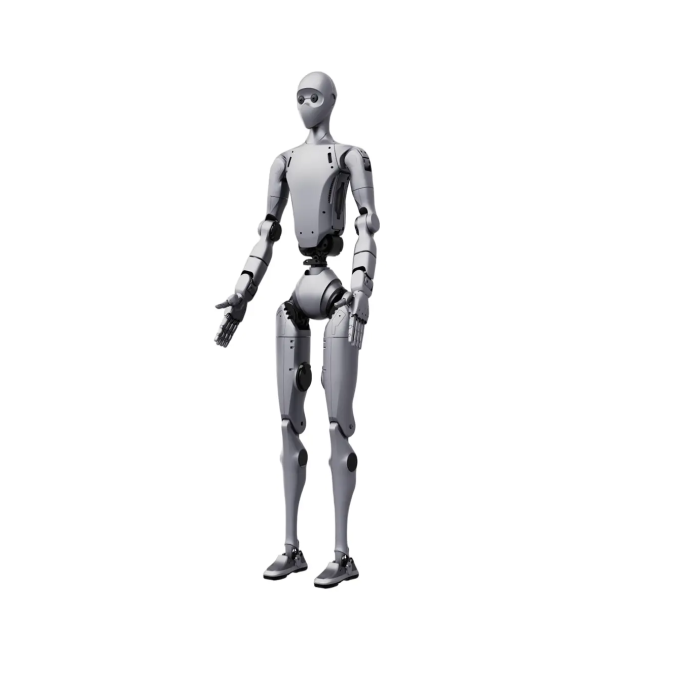
In stock
- BRAND:
- UNITREE ROBOTICS
- MODEL:
- H2-PLUS-ULTIMATE-B
- PART #:
- H2-PLUS-ULTIMATE-B
- ORIGIN:
- China
- Warranty:
- 12 MONTHS
- AVAILABILITY:
- SUBJECT TO AVAILABILITY
- SKU:
- Unitree-H2-PLUS-ULTIMATE-B
Unitree H2 Plus ULTIMATE-B Humanoid Robot
Most of what makes a humanoid useful happens before a single joint moves: in the cameras that read the room, the processors that interpret it and the software that turns a decision into a motion. The Unitree H2 Plus ULTIMATE-B Humanoid Robot is a platform built with that order of events in mind. It pairs a full-size bipedal body with a Jetson Thor AI module, a wide-view stereo camera and two three-finger Dex3-1 hands, so that a team can spend its time on behavior rather than on assembling hardware.
This humanoid robot is available through this page, by quotation.
Background
Unitree and the H2 Plus line
Unitree Robotics is known for legged machines, and the H2 Plus family carries that experience into a full-size humanoid. The family is offered in several versions that share one body and differ mainly in the computing and hand packages they carry. The sources name H2 Plus SMART, H2 Plus STANDARD and a lettered ULTIMATE series, from ULTIMATE A with Dex1-1 Plus through ULTIMATE F with Revo 2 Basic. Each letter points to a different hand option, which tells you something about how the family is meant to be used: the body is the constant, and the hand is the choice you make for your application.
The ULTIMATE-B version uses the Dex3-1 hand, a three-finger design with 7 DoF per hand and wrist RGB cameras. It has no tactile feedback. Tactile variants exist elsewhere in the lineup, so a buyer who needs touch sensing should look at the other letters. You can compare the whole family on the Unitree H2 Plus category page.
Positioning and key technology
The H2 Plus ULTIMATE-B is positioned as a development platform for embodied AI, manipulation research and human-robot interaction. Its software foundation is NVIDIA Isaac GROOT, and secondary development is supported, which means a team can build its own behaviors on top of what the platform provides.
The computing is split in two. An Intel Core i5 handles platform functions, while an Intel Core i7 is left for user development. Separating the two keeps a researcher's experiments away from the processor that looks after the robot itself. The AI work is done by an NVIDIA Jetson Thor T5000 module, rated up to 2070 TFLOPS sparse FP4, with 128 GB of LPDDR5X memory on a 256-bit bus at 273 GB/s.
Perception comes from a head-mounted stereo camera with a wide field of view, wrist cameras and an IMU. The body is built from aerospace-grade aluminium, titanium alloy and high-strength engineering plastics.
Technical Specifications
| Specification | Value |
|---|---|
| Software platform | NVIDIA Isaac GROOT |
| Standing dimensions | 1820 × 456 × 218 mm |
| Weight with battery | Approximately 70 kg, excluding hand configuration |
| Body degrees of freedom | 31 |
| Hands | 2 × Dex3-1, three fingers, wrist RGB cameras |
| Hand specifications | 7 DoF per hand, 650 g per hand, no tactile feedback |
| Maximum arm joint torque | 120 Nm |
| Maximum leg joint torque | 360 Nm |
| Arm payload | Approximately 7 kg nominal, up to 15 kg peak |
| Base computing | Intel Core i5 for platform functions + Intel Core i7 for user development |
| AI computing module | NVIDIA Jetson Thor T5000 |
| AI performance | Up to 2070 TFLOPS sparse FP4 |
| Memory | 128 GB LPDDR5X, 256-bit bus, 273 GB/s |
| Head stereo camera | HFOV 140° ±3°, VFOV 102° ±3°, global shutter, depth of field from 0.4 m to infinity |
| Wireless connectivity | Wi-Fi 6 and Bluetooth 5.2 |
| Interfaces | USB 3.0 ×3, USB + DisplayPort ×3, GMSL ×4, Gigabit Ethernet ×4, USB 2.0 ×2, RS-485 ×4, CAN ×2 |
| Battery | 15 Ah, 0.972 kWh, removable smart battery |
| Runtime | Approximately 3 hours |
| Main materials | Aerospace-grade aluminium, titanium alloy, high-strength engineering plastics |
| Secondary development | Yes |
Specifications as published by the manufacturer; confirmed against the datasheet at quotation.
The manufacturer has not published the top speed, the IP rating, the operating system, the box contents, the charger specifications or the noise level; they are confirmed at quotation.
What makes the ULTIMATE-B different from the other H2 Plus versions?
The difference is in the hands. Every H2 Plus version shares a body with 31 degrees of freedom, and the ULTIMATE-B fits that body with two Dex3-1 hands. Each has three fingers, 7 DoF and a wrist RGB camera, and weighs 650 g. Three-finger grasping is versatile for a wide range of everyday objects, and the wrist cameras give the robot a close view of whatever it is about to pick up. The hands have no tactile feedback, so the robot sees its grasp but does not feel it.
That trade-off is the main thing to weigh. If your work depends on contact sensing, one of the tactile versions in the family is the more natural fit. If your work is about vision-guided manipulation, teleoperation or learning from demonstration, the ULTIMATE-B gives you a capable pair of hands built around cameras.
The Unitree H2 Plus Standard and the Unitree H2 Plus SMART are the other versions to compare when you are deciding how much hand and how much computing you need.
How much can the ULTIMATE-B lift and for how long can it work?
The arm payload is approximately 7 kg nominal, up to 15 kg peak. Maximum joint torque is 120 Nm in the arms and 360 Nm in the legs. The larger leg figure reflects the job the legs do, carrying approximately 70 kg of robot and whatever it holds.
Runtime is approximately 3 hours from a 15 Ah, 0.972 kWh removable smart battery. Because the pack can be removed, a session does not have to end when the charge does; a team with a spare pack can keep working.
Who is the Unitree H2 Plus ULTIMATE-B for?
University and corporate research labs are the clearest fit. The Isaac GROOT foundation, the split Intel computing, the Jetson Thor module and the open interfaces suit groups that want to write and test their own policies. Integrators building demonstration cells or pilot projects will find the interface set, with Gigabit Ethernet, CAN, RS-485, GMSL and USB, useful for adding sensors and peripherals.
Organizations evaluating physical AI will value the robot's size, since it stands 1820 mm tall and is large enough to work at human heights and in human spaces. Teams that need a different hand can start from the Unitree H2 Plus ULTIMATE A, which the sources list with the Dex1-1 Plus hand. A team that only needs the body and the computing, without a specialized hand, may find the Standard version closer to its brief.
What is the Unitree H2 Plus ULTIMATE-B used for?
- Manipulation research. Two three-finger hands with wrist cameras suit grasping studies and vision-guided pick-and-place work.
- Embodied AI development. The Jetson Thor module and Isaac GROOT foundation give teams a platform for training and running models on the robot.
- Human-robot interaction studies. A full-size humanoid body with a wide-view head camera lets researchers test how people respond to a robot at human scale.
- Teleoperation and demonstration data. The wrist cameras and stereo head camera supply the views needed to record and replay tasks.
- Systems integration. Ethernet, CAN, RS-485, GMSL and USB ports allow additional sensors and devices to be connected.
- Teaching and demonstrations. A walking humanoid with open secondary development is a strong teaching tool for advanced robotics courses.
Pricing and Availability
No price is shown on this page, because the configuration, the quantity and the destination all shape the offer. Quotation is the way to proceed: tell us what you plan to do with the robot and we will respond with an offer. Delivery, customs and support are arranged together with the quotation. Everything you need to begin the request is available on this page.
Frequently Asked Questions
How many degrees of freedom does the robot have?
The body has 31 degrees of freedom. Each Dex3-1 hand adds 7 DoF.
Do the hands have tactile sensing?
No. The Dex3-1 hands on this version have no tactile feedback, though each has a wrist RGB camera.
What computing does it carry?
An Intel Core i5 handles platform functions and an Intel Core i7 is available for user development. AI work runs on an NVIDIA Jetson Thor T5000 with 128 GB of memory.
How long does the battery last?
Runtime is approximately 3 hours from the 15 Ah, 0.972 kWh removable smart battery. Because the pack is removable, it can be swapped between sessions.
Can I develop my own software for it?
Yes, secondary development is supported. The platform is built on NVIDIA Isaac GROOT.
What connections does it offer?
It has Wi-Fi 6 and Bluetooth 5.2 wirelessly, plus USB, DisplayPort, GMSL, Gigabit Ethernet, RS-485 and CAN ports for adding devices.
Where can I buy the Unitree H2 Plus ULTIMATE-B and what does it cost?
You can request a quotation through this page. The cost depends on configuration, quantity and destination, so it is given in the quotation and not listed here.
Summary
The ULTIMATE-B is the H2 Plus for teams whose work starts with seeing and deciding. It brings a Jetson Thor module, a wide-view stereo camera, wrist cameras and two Dex3-1 hands to a 1820 mm body with 31 degrees of freedom and a removable battery. It leaves out tactile sensing, which is the trade a vision-led project can accept. If that balance matches your project, this page is the starting point.


