
BrainCo Revo 3-21 Basic Robot Hand
In stock
- BRAND:
- BRAINCO
- MODEL:
- REVO 3-21 BASIC
- ORIGIN:
- China
- Warranty:
- 12 MONTHS
- AVAILABILITY:
- SUBJECT TO AVAILABILITY
- SKU:
- BrainCo-Revo-3
BrainCo Revo 3-21 Basic Robot Hand
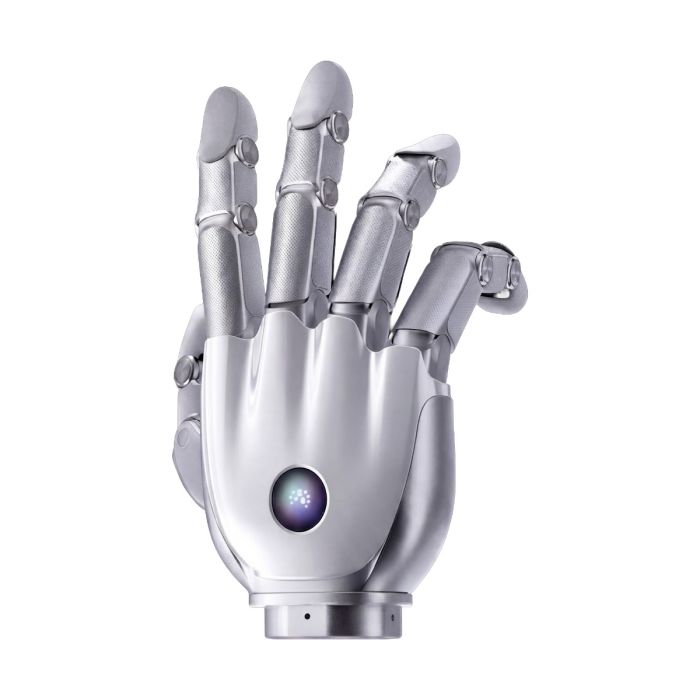
A pianist never thinks about individual tendons, yet every note depends on each finger being free to move on its own. The BrainCo Revo 3-21 Basic Robot Hand brings that principle to machines: every joint has its own motor, so a grasp can be composed one finger at a time instead of being a single squeeze. It is a hand for people who want to write the movement themselves.
The product is available through this page, by quotation.
Background
BrainCo and the Revo 3 generation
BrainCo was founded in 2015 and offers three robotic products today. Its Revo line began with simpler dexterous hands, and the Revo 3 is the generation that gives every joint an active drive. The sources name several versions of the family: Revo 3 U21, U21F, U21T and U21VT in the manufacturer's material, and Basic, Touch and Vision in other listings. This page covers the Basic version, and the figures below are labeled by the version they belong to so that nothing is mixed up.
Earlier hands in the line, such as the BrainCo Revo 1 Intelligent Dexterous Bionic Hand and the Revo 2 models, have their own pages. The whole generation is gathered in the BrainCo Revo 3 category.
Biomimetic design and direct drive
The Revo 3 is a biomimetic dexterous hand designed for industrial automation, scientific research and advanced robotics manipulation. It has 21 fully active, independently driven degrees of freedom: five in the thumb and four in each of the index, middle, ring and pinky fingers. Having 21 motors means the hand does not rely on shared linkages to move several joints at once.
The joints are direct-driven and backdrivable. Direct drive gives rapid response and high control density across all finger segments, and backdrivability means a joint can be moved by an outside force instead of resisting it. For a research team, that matters when the hand meets an unexpected object or when someone wants to guide the fingers by hand.
The hand is rated for over 1,000,000 joint flex cycles. On the software side, BrainCo provides cross-platform C/C++ and Python SDKs for Linux and Windows, so development and integration can start in the language a lab already uses.
Technical Specifications
The manufacturer's table covers the Revo 3 U21 and states that its hand dimensions are the same for all four U21 models. The Basic column comes from a separate listing for the Revo 3 Basic. A dash means that source gives no figure for that line.
| Specification | Revo 3 U21 (manufacturer table) | Revo 3 Basic (reseller listing) |
|---|---|---|
| Degrees of freedom | 21 active, independently driven | 21 active, independently driven |
| Hand dimensions | 216 × 108 × 50 mm | 215 × 105 × 50 mm (overall) |
| Supply voltage | 16–85 V | 12–80 V |
| Max current | 10 A (24 V) | — |
| Active grip force | ≥100 N (max active grip force) | >70 N (active grasping force) |
| Max fingertip pinch force | ≥25 N | — |
| Total hand payload | 20 kg | — |
| Four-finger payload | 5 kg | — |
| Repeatability | 0.1° | — |
| Joint open/close time | 0.33 s | — |
| Max grasping diameter | 150 mm | — |
| Communication interfaces | EtherCAT / CAN FD / RS-485 | — |
| Communication frequency | 500 Hz | — |
| Onboard sensors | IMU (mainboard), temperature (mainboard) | — |
| Tactile sensors | — | Not included |
| Control modes | — | Position / MIT Force-Position / Admittance / Zero-Torque |
| Joint flex cycle rating | Over 1,000,000 | Over 1,000,000 |
Specifications as published by the manufacturer; confirmed against the datasheet at quotation.
The manufacturer has not published the weight, the box contents, the IP rating, the operating temperature range or the power consumption; they are confirmed at quotation.
What makes the Revo 3 Basic different from a simple gripper?
A two-jaw or three-finger gripper is built around one job: close on an object and hold it. That is the right tool for a fixed part on a fixed line. It is the wrong tool when the object changes, when the approach has to curve around an obstacle, or when a researcher wants to study how a grasp forms.
The Revo 3 Basic gives the controller 21 separate joints to work with. The thumb alone has five, so it can oppose the fingers in several ways, and each of the other four fingers has four. Because each joint has its own motor, one finger can stay still while another moves, and the hand can shape itself to the object instead of forcing the object into one shape.
The listing for the Basic names four control modes: Position, MIT Force-Position, Admittance and Zero-Torque. Position control suits repeatable scripted motions. Force-position and admittance modes suit contact work, where the hand should give way instead of pushing. Zero-Torque leaves the joints free, which pairs naturally with backdrivable joints when someone wants to move the fingers by hand.
What does the Basic version leave out compared with the Touch and V-Touch?
The Basic listing states that tactile sensors are not included. On the U21 manufacturer table, the only sensors listed are an IMU and a temperature sensor, both on the mainboard. The hand therefore moves with precision, but it does not report touch at the fingertips.
For many projects that is acceptable. A team that already uses a camera, a force-torque sensor at the wrist or its own learned policy may not need touch from the hand itself. Others will want it from the first day. The BrainCo Revo 3-21 Touch Robot Hand and the BrainCo Revo 3-21 V-Touch Robot Hand belong to the same generation and are the pages to read if sensing is part of the requirement. Their figures are listed on their own pages and are not carried over here.
Who is the BrainCo Revo 3-21 Basic Robot Hand for?
Research laboratories that study manipulation, grasp planning or learning-based control will find a platform where every joint can be commanded and the SDKs are available in C/C++ and Python. Universities and institutes in the Caribbean that are building robotics programs can use one hand as a teaching and experimentation tool.
System integrators working on automation cells that handle varied parts can use the hand to prototype tasks that fixed grippers cannot do. The EtherCAT, CAN FD and RS-485 interfaces listed in the manufacturer's table suit common industrial control setups.
Humanoid and mobile-robot builders need a hand that resembles a human one in layout. The 21-motor architecture and the biomimetic form make this a fit for that work.
Buyers who need fingertip touch sensing should look at the Touch or V-Touch versions instead. Buyers who want a simpler or older hand can look at the Brainco Revo 2 Touch Biomimetic Dexterous Right Hand (XTR).
What is the BrainCo Revo 3-21 Basic Robot Hand used for?
- Dexterous manipulation research: studying how grasps form when every joint can be commanded independently.
- Industrial automation prototyping: testing handling tasks on parts of different shapes before committing to custom tooling.
- Humanoid robot development: giving a humanoid platform a hand with a thumb and four fingers that move on their own.
- Teleoperation and demonstration: guiding the hand through backdrivable joints or Zero-Torque mode to record movements.
- Control-software development: writing and testing position, force-position and admittance control through the C/C++ and Python SDKs.
- Teaching: showing students how a biomimetic hand differs from a gripper in a laboratory course.
Pricing and Availability
No price is printed on this page. Quotation is the way to buy: tell us the version you need and how you plan to use the hand, and we will prepare an offer. Delivery, customs and support are arranged together with the quotation. The BrainCo Revo 3-21 Basic Robot Hand is available on this page.
Frequently Asked Questions
How many degrees of freedom does the hand have?
It has 21 fully active, independently driven degrees of freedom. The thumb has five, and the index, middle, ring and pinky fingers have four each.
Are the joints direct-driven?
Yes. The joints are direct-driven and backdrivable, which gives rapid response across all finger segments.
Does the Basic version include tactile sensors?
No. The Basic listing states that tactile sensors are not included. Touch sensing is a reason to look at the Touch or V-Touch versions.
Which control modes are available?
The Basic listing names Position, MIT Force-Position, Admittance and Zero-Torque modes.
Which software tools are provided?
BrainCo provides cross-platform C/C++ and Python SDKs that work with Linux and Windows.
Why do some figures differ between sources?
The manufacturer's table describes the Revo 3 U21, while the Basic figures, such as supply voltage and grip force, come from a separate listing. Each figure on this page stays with its own version, and the exact values for the unit you order are confirmed at quotation.
Where can I buy the BrainCo Revo 3-21 Basic Robot Hand and what does it cost?
You can buy it through this page by requesting a quotation. The cost is given in the quotation itself, together with delivery, customs and support arrangements.
Summary
A good hand is defined by how many of its joints you are allowed to command. The BrainCo Revo 3-21 Basic Robot Hand gives you all 21 of them, with direct-driven, backdrivable joints, four control modes on the Basic listing, and C/C++ and Python SDKs. It leaves out tactile sensing, which the Touch and V-Touch versions address. For research teams, integrators and robot builders in the Caribbean who want to compose a grasp instead of accepting a preset, this page is the starting point.


