
BrainCo Revo 3-21 V-Touch Robot Hand
In stock
- BRAND:
- BRAINCO
- MODEL:
- REVO 3-21 V-TOUCH
- ORIGIN:
- China
- Warranty:
- 12 MONTHS
- AVAILABILITY:
- SUBJECT TO AVAILABILITY
- SKU:
- BrainCo-Revo-3-V-Touch
BrainCo Revo 3-21 V-Touch Robot Hand
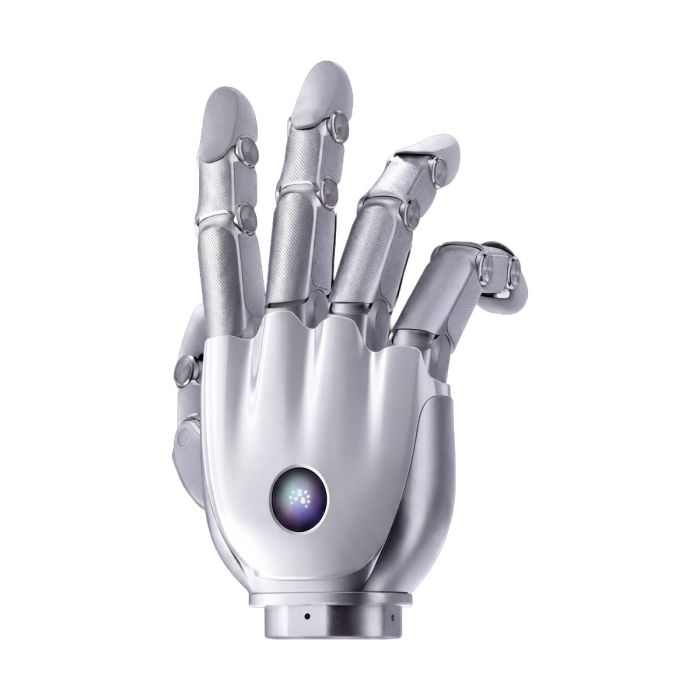
Commanding twenty-one joints is the easy half of dexterous manipulation; the hard half is knowing what each fingertip is meeting. The BrainCo Revo 3-21 V-Touch Robot Hand is aimed at that second half. It gives a controller a full set of direct-driven, backdrivable joints and then sends back touch data from the palm and from the fingertips, so the software is not working blind once the fingers close.
The product is available through this page, by quotation.
Background
BrainCo and the Revo 3 family
BrainCo is the brand behind the Revo series of biomimetic robot hands, and the Revo 3 is the generation described here. It comes in four versions: Revo 3 U21, U21F, U21T and U21VT. This page covers the U21VT, sold as the V-Touch, and every figure below belongs to that version only.
The Revo 3 is designed for industrial automation, scientific research and advanced robotics manipulation. Those are three quite different settings, yet they ask the same thing of a hand: that it can be driven precisely by a controller and that it reports something useful in return. A production cell values consistent grasps, a laboratory values data on how contact develops, and a humanoid or embodied-AI project values a hand with enough joints to attempt the variety of grasps people make every day.
Positioning and key technology
The V-Touch sits at the sensing-rich end of the Revo 3 range. Its joints are direct-driven and backdrivable, which means the fingers can be moved by outside force rather than fighting it. The distribution of freedom follows the human hand: four fingers with 4 degrees of freedom each, and a thumb with 5, for 21 in total.
On top of that mechanical base the V-Touch adds two layers of touch. A piezoresistive array in the palm covers 336 points, and the fingertips use vision-tactile sensing with 2000 markers. The tactile force range is 0–20 N with a resolution of 0.01 N. The hand is rated for over 1,000,000 joint flex cycles, which matters to anyone planning long test campaigns or repeated production cycles.
In terms of motion ability, the hand earns a full score on the Kapandji opposition test and covers 33 grasp types from the Feix GRASP taxonomy. Development is supported by cross-platform C/C++ and Python SDKs that work with Linux and Windows.
Technical Specifications
| Specification | Value |
|---|---|
| Version | Revo 3 U21VT (V-Touch) |
| Total degrees of freedom | 21 (direct-driven and backdrivable) |
| DoF distribution | Four fingers × 4 DoF, thumb × 5 DoF |
| Hand dimensions | 216 × 108 × 50 mm |
| Supply voltage | 16–85 V |
| Max current | 10 A (24 V) |
| Max active grip force | ≥100 N |
| Max fingertip pinch force | ≥25 N |
| Total hand payload | 20 kg |
| Four-finger payload | 5 kg |
| Repeatability | 0.1° |
| Joint open/close time | 0.33 s |
| Communication interfaces | EtherCAT / CAN FD / RS-485 |
| Communication frequency | 500 Hz |
| Onboard sensors | IMU (mainboard), temperature (mainboard) |
| Tactile type | Palm piezoresistive array + fingertip vision-tactile |
| Tactile points | 336 points (piezoresistive) + 2000 markers (vision-tactile) |
| Tactile force range | 0–20 N |
| Tactile resolution | 0.01 N |
| Durability | Rated for over 1,000,000 joint flex cycles |
| Grasp coverage | 33 grasp types (Feix GRASP taxonomy); full score on the Kapandji opposition test |
| SDK | Cross-platform C/C++ and Python, Linux and Windows |
Specifications as published by the manufacturer; confirmed against the datasheet at quotation.
The manufacturer has not published the weight, the IP rating, the operating temperature range, the package contents or the hand-only mass without the wrist; they are confirmed at quotation.
What makes the V-Touch different from the other Revo 3 versions?
The answer is in the sensing. Degrees of freedom, dimensions, supply voltage, grip force, payload and communication are the same across all four versions, so the mechanical hand is common ground. What changes is touch. The base U21 has no tactile force range or resolution, while the other three versions give 0–20 N and 0.01 N. The V-Touch is the version with both the palm piezoresistive array and the fingertip vision-tactile layer.
Why does that pairing matter? A piezoresistive palm array tells the controller where and how hard a large surface is being pressed, which suits broad contact such as cradling an object. Vision-tactile fingertips work differently: they follow a field of markers, 2000 of them here, so small shifts at the contact patch can be observed. Together they let software see both the overall load and the fine detail at the point of pinch, which is useful when a part begins to slip or a cable has to be guided.
If a project does not need fingertip vision, the BrainCo Revo 3-21 Basic Robot Hand and the BrainCo Revo 3-21 Touch Robot Hand are the sibling pages to compare.
How is the Revo 3-21 V-Touch powered and connected?
The hand accepts a supply voltage of 16–85 V, with a maximum current of 10 A at 24 V. For a stable result, use a stable 24V DC power supply with a power rating of at least 100W, which reduces the risk of voltage drop when several joints move together.
For control, three interfaces are available: EtherCAT, CAN FD and RS-485. Communication runs at 500 Hz. That gives integrators a choice between industrial fieldbus setups and lighter serial wiring, depending on the arm, the controller and the existing cell. On the software side, the C/C++ and Python SDKs run on Linux and Windows, so a team can prototype in Python and move to C/C++ when timing matters. The mainboard also carries an IMU and a temperature sensor.
Who is the BrainCo Revo 3-21 V-Touch Robot Hand for?
Research laboratories are the clearest fit. Contact data at 0.01 N resolution, with a 21-joint hand to produce it, supports work on grasp learning, slip detection and in-hand manipulation. Universities and institutes working on embodied AI will find the SDKs and the 500 Hz communication frequency a practical match for their pipelines.
Industrial automation teams come next, especially those with parts that vary or are fragile, where an open-and-close gripper loses information the line could use. Humanoid and service-robot developers form a third group: the finger-and-thumb layout and the 33 grasp types covered are close to what a general-purpose hand has to attempt.
Buyers who only need the mechanical hand, without fingertip vision, may be better served by the Basic version or the Touch version. Teams coming from earlier generations can also look at the Revo 2 Touch right hand for comparison.
What is the BrainCo Revo 3-21 V-Touch Robot Hand used for?
- Dexterous manipulation research. Studying how 21 joints and layered touch data combine in grasping and re-grasping.
- Industrial automation. Handling parts in cells where repeatable grasps and contact feedback both count.
- Humanoid and embodied-AI platforms. Giving a robot a hand that follows the human layout of four fingers and a thumb.
- Tactile learning and data collection. Gathering palm and fingertip contact data for training models.
- Teleoperation and demonstration. Using a backdrivable hand that can be moved by outside force while sensing the contact.
- Education and lab training. Teaching students control, SDK integration and sensor interpretation on a real dexterous hand.
Pricing and Availability
Pricing is provided by quotation. Send us the application, the arm or platform the hand will mount to, and the control interface you plan to use, and we will prepare an offer. Delivery, customs and support are arranged together with the quotation. The BrainCo Revo 3-21 V-Touch Robot Hand is available on this page.
Frequently Asked Questions
How many degrees of freedom does the V-Touch have?
It has 21 in total, direct-driven and backdrivable: four fingers with 4 DoF each and a thumb with 5 DoF.
What kind of touch sensing does it use?
A palm piezoresistive array of 336 points is combined with fingertip vision-tactile sensing using 2000 markers. The tactile force range is 0–20 N at 0.01 N resolution.
Which communication interfaces and software are supported?
EtherCAT, CAN FD and RS-485 are available, with communication at 500 Hz. The C/C++ and Python SDKs are cross-platform and work with Linux and Windows.
What power supply should I use?
Use a stable 24V DC supply rated at least 100W. The hand accepts 16–85 V, with a maximum current of 10 A at 24 V.
How much can the hand lift and grip?
The total hand payload is 20 kg and the four-finger payload is 5 kg. Maximum active grip force is ≥100 N and maximum fingertip pinch force is ≥25 N.
Is the weight or IP rating available?
Not in the table above. Ask for the weight, the IP rating and the operating temperature range when you request your quotation.
Where can I buy the BrainCo Revo 3-21 V-Touch Robot Hand and what does it cost?
It is available through this page by quotation. The cost depends on your project and delivery, so request a quotation and we will answer with an offer.
Summary
The hard part of a dexterous hand is not moving fingers; it is knowing what they have found. The BrainCo Revo 3-21 V-Touch Robot Hand answers with 21 backdrivable degrees of freedom, a 336-point palm array and fingertip vision-tactile sensing with 2000 markers, supported by EtherCAT, CAN FD or RS-485 control and Python and C/C++ SDKs. For laboratories, automation teams and humanoid developers who want that feedback loop, this page is the starting point.


