
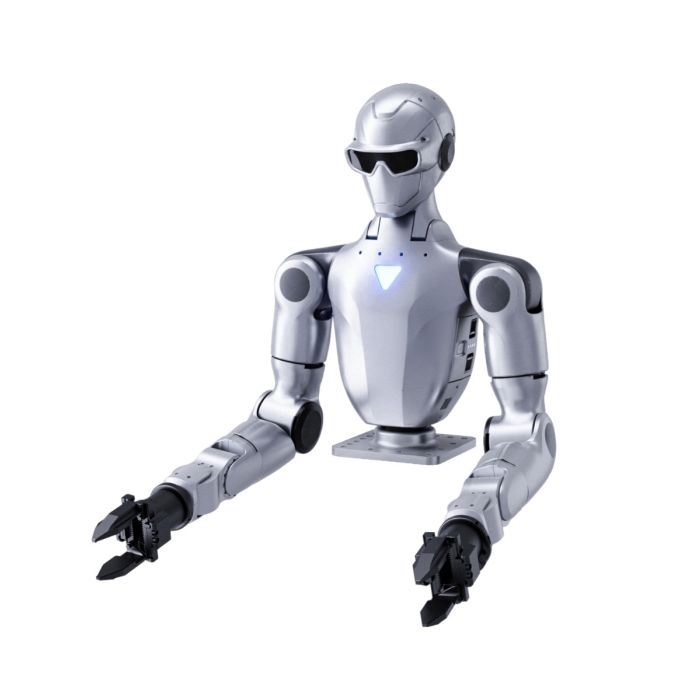
Unitree R1-A7 Fixed Base Dual-Arm Humanoid Robot
In stock
- BRAND:
- UNITREE ROBOTICS
- MODEL:
- R1-A7
- ORIGIN:
- China
- Warranty:
- 12 MONTHS
- AVAILABILITY:
- SUBJECT TO AVAILABILITY
- SKU:
- Unitree-R1-A7
Unitree R1-A7 Fixed Base Dual-Arm Humanoid Robot
Picture a humanoid that never has to take a step. Its whole purpose sits in the space between two shoulders and two hands, where objects are reached, held and passed along. The Unitree R1-A7 Fixed Base Dual-Arm Humanoid Robot is built around that idea: leave out the walking, keep the manipulation, and put the engineering effort where most laboratory and demonstration work actually happens.
The product is available through this page, by quotation.
Background
Unitree Robotics and the R1 line
Unitree Robotics is a manufacturer known for compact legged and humanoid robots that research groups, universities and integrators can work with directly. The R1 line carries the tagline "Ultra-fast deployment, multi-scenario application," and that phrase describes the thinking behind it well. The robot is meant to be set up quickly and then pointed at many different kinds of work, rather than being tied to a single task.
The family includes four versions: R1-A5, R1-A7, R1-A5-D and R1-A7-D. This article gives figures for the R1-A7 only. Anything published for another version stays with that version. If you want to compare configurations within the family, the Unitree R1 category shows the wider range, and the Unitree R1-A7 category groups the R1-A7 listings together.
A fixed base and a dual-arm layout
The fixed-base format changes what the robot is for. Without a mobile platform to balance, the design concentrates on the arms, the joints and the hands. The joint motors are low-inertia, high-speed inner rotor PMSM units, a type of motor chosen for quick response and good heat dissipation. Each joint output uses a crossed roller bearing together with a deep groove ball bearing, a pairing that suits a joint that has to carry load and still turn smoothly.
The software side is just as practical. The robot supports smart OTA updates and secondary development, and it offers open interfaces for the underlying system, the robotic arm, audio, lighting and visual control. In plain terms, a team can build its own behavior on top of the machine rather than accept a closed demonstration product.
Technical Specifications
| Specification | Value |
|---|---|
| Version | R1-A7 |
| Dimensions | 835x357x190mm |
| Weight | Approx. 13kg (with external power supply) |
| Joint motor | Low-Inertia High-Speed Inner Rotor PMSM |
| Joint output bearing | Crossed Roller + Deep Groove Ball |
| Wireless | WiFi 6 and Bluetooth 5.2 |
| End effectors | Optional two-finger gripper / three-finger dexterous hand / five-finger dexterous hand |
| High-computing module | Multiple brands and models available, such as Orin (40-100TOPS) |
| Charger | Included |
| Software and development | Smart OTA update; secondary development supported; open interfaces for the underlying system, robotic arm, audio, lighting and visual control |
Specifications as published by the manufacturer; confirmed against the datasheet at quotation.
The manufacturer has not published the ingress protection rating, the operating temperature range, the battery capacity, the charging time, the operating system, the list of included accessories or the repeatability of the arm; they are confirmed at quotation.
What makes a fixed-base dual-arm robot different from a walking humanoid?
A walking humanoid spends much of its engineering budget on staying upright. Balance control, foot contact, falls and recovery all take time to develop and to protect against. A fixed-base robot like the R1-A7 sets those problems aside. The body stays where it is put, and every part of the design supports reaching, grasping and coordinating two arms.
That has practical effects for a buyer. The setup is simpler, because the robot works from a defined position. The workspace is easier to describe, because it is the area the arms can reach. And the risk to people nearby is easier to manage, because the robot does not move across the room. Users must still maintain a sufficient safety distance between humans and the robot, and that rule applies in every deployment.
The trade-off is plain. A fixed base cannot go and fetch anything. If your task needs travel between stations, a different platform is the right answer. If your task is to be done at one place, a fixed base removes a great deal of complexity.
What can the hand options and compute module change?
The R1-A7 is offered with a choice of end effectors: a two-finger gripper, a three-finger dexterous hand or a five-finger dexterous hand. The choice sets the character of the work. A two-finger gripper suits repeatable pick-and-place tasks. The dexterous hands open the way to more varied objects and to research on in-hand manipulation. Make the decision against your own task.
The high-computing module is also a choice. Multiple brands and models are available, such as Orin (40-100TOPS). A team running perception and learning workloads onboard will weigh this option carefully, while a team that controls the robot from an external machine may need less. WiFi 6 and Bluetooth 5.2 are listed for wireless connection, which helps when the robot is networked with other equipment in a lab or demonstration area.
Who is the Unitree R1-A7 Fixed Base Dual-Arm Humanoid Robot for?
University and research laboratories are the clearest fit. Open interfaces and support for secondary development mean a group can write its own control, vision and audio behavior rather than wait for the vendor. Courses in robotics and embodied intelligence also benefit from a machine that students can set up in a short time and work with at a bench.
System integrators and developers form a second group. They can use the R1-A7 as a manipulation test bed before committing to a larger installation, trying out grasping strategies, interaction scripts and vision pipelines on real hardware. Exhibition and demonstration teams make up a third segment, since a humanoid upper body with two arms draws attention and can be shown at a fixed stand.
If you prefer a configured package, the store lists named versions separately. Examples include Unitree R1-A7 Smart A Humanoid Robot and Unitree R1-A7 Smart E Humanoid Robot. Buyers who are considering the A5 version can look at the Unitree R1-A5 Smart B Humanoid Robot. Compare each page with your own requirements before you decide.
What is the Unitree R1-A7 Fixed Base Dual-Arm Humanoid Robot used for?
- Manipulation research: studying grasping, bimanual coordination and object handling on a real two-arm platform.
- Teaching and training: giving students hands-on access to a humanoid upper body in robotics and AI courses.
- Software development: building custom behavior through the open interfaces for the arm, audio, lighting and visual control.
- Perception and AI trials: running vision and learning workloads with an optional high-computing module.
- Demonstrations and exhibitions: showing interaction and manipulation at a fixed stand, with a safety distance kept from visitors.
- Integration prototyping: testing a manipulation concept before a larger deployment is designed.
Pricing and Availability
No price is printed on this page, because the right configuration depends on the end effector, the compute module and your intended use. Quotation is the next step: tell us what you need and we will respond with the details. Delivery, customs and support are arranged together with the quotation. The Unitree R1-A7 Fixed Base Dual-Arm Humanoid Robot is available on this page.
Frequently Asked Questions
What are the dimensions and weight of the R1-A7?
The dimensions are 835x357x190mm. The weight is approx. 13kg, with the external power supply.
Which hands can be fitted?
You can choose a two-finger gripper, a three-finger dexterous hand or a five-finger dexterous hand. Each is optional.
Can I program my own behavior?
Yes. Secondary development is supported, and open interfaces cover the underlying system, the robotic arm, audio, lighting and visual control. The robot also receives smart OTA updates.
Which wireless connections does it have?
The R1-A7 has WiFi 6 and Bluetooth 5.2.
Is a charger included?
Yes, the charger is included with the robot.
Is it safe to work next to the robot?
Users must maintain a sufficient safety distance between humans and the robot. Plan your workspace with that rule in mind.
Where can I buy the Unitree R1-A7 Fixed Base Dual-Arm Humanoid Robot and what does it cost?
You can buy it through this page, by quotation. The cost depends on the configuration you choose, so request a quotation and we will answer with the details.
Summary
The idea behind the Unitree R1-A7 is simple: a humanoid that does not walk can put everything into the work of its arms. Low-inertia joint motors, a choice of three hand options, an optional high-computing module and open interfaces make it a flexible manipulation platform for laboratories, classrooms and integrators. Dimensions of 835x357x190mm and a weight of approx. 13kg with the external power supply keep it a bench-sized machine. For a quotation tailored to your hand choice and compute needs, this page is the starting point.


