
Unitree R1-A5 Smart B Humanoid Robot
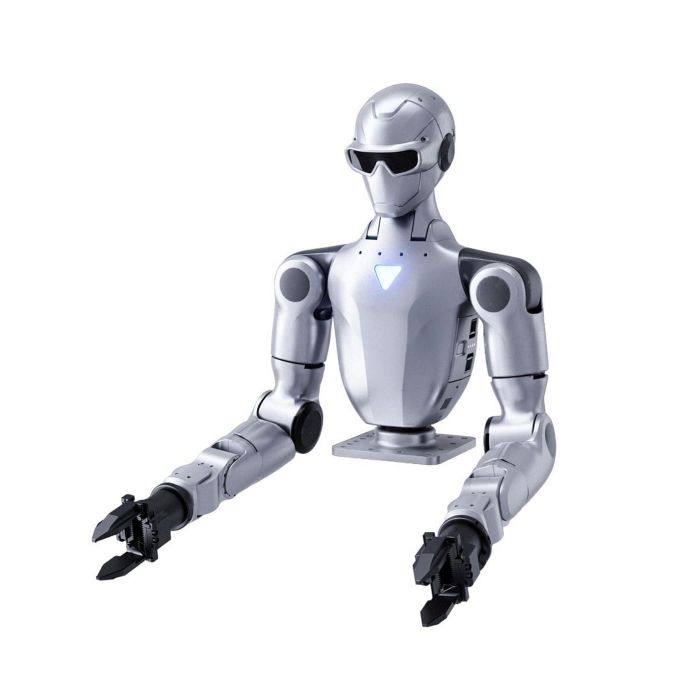
In stock
- BRAND:
- UNITREE ROBOTICS
- MODEL:
- R1-A5-Smart-B
- PART #:
- R1-A5-Smart-B
- ORIGIN:
- China
- Warranty:
- 12 MONTHS
- AVAILABILITY:
- SUBJECT TO AVAILABILITY
- SKU:
- Unitree-R1-A5-Smart-B
Unitree R1-A5 Smart B Humanoid Robot
Most humanoid robots are sold on the spectacle of walking. The Unitree R1-A5 Smart B Humanoid Robot is sold on something quieter and, for a working lab, more useful: it is a platform that sees, thinks and handles objects at a bench. It combines a hand with its own RGB camera and a built-in Orin Nano computing module, so perception and manipulation can be developed on one machine.
The product is available through this page, by quotation.
Background
Unitree Robotics and the R1-A5 lineage
Unitree Robotics is a name robotics teams know from legged and humanoid platforms built for research, education and integration work. The R1-A5 family sits in that tradition. The sources name several versions of it: R1-A5, R1-A7, R1-A5-D, R1-A7-D and three configurations called R1-A5 Smart A, Smart B and Smart C. The letters after the base name identify the configuration, and the configuration decides what is fitted to the arms and what computes on board.
For this reason the model name should always be read in full. The R1-A5 Smart B is not simply an R1-A5 with a different label. It is the configuration that carries the Dex3-1 Hand with RGB Camera and the built-in Orin Nano module rated at 40 Tops. Buyers comparing listings across the family should compare those two items first.
Positioning and key technology
The R1-A5 Smart B is positioned as a development platform. It offers full-stack open secondary development, which means a team can build its own software on the robot rather than being limited to a fixed set of behaviors. Smart OTA updates are also listed, so software can be refreshed over the air.
The joints use a low-inertia, high-speed inner rotor PMSM motor, built for superior responsiveness and heat dissipation. Joint output runs on a crossed roller bearing combined with a deep groove ball bearing. Those choices matter for the kind of work an arm-centered robot does: short, repeated, precise movements where responsiveness counts more than top speed.
The head module adds its own computing power of 10 TOPS, and the audio system pairs a 4-array microphone with dual speakers. Wireless connectivity is WiFi 6 and Bluetooth 5.2. Together, these make the robot a machine that can listen, speak, see and act, with the heavier perception workload handled by the built-in Orin Nano module.
Technical Specifications
| Specification | Value |
|---|---|
| Configuration | R1-A5 Smart B |
| End effector (Smart B) | Dex3-1 Hand (with RGB Camera) |
| Built-in compute (Smart B) | Orin Nano 40 Tops build in |
| Head module computing power | 10 TOPS |
| Dimensions (R1-A5) | 700x357x190mm |
| Weight (R1-A5) | Approx. 11kg (with external power supply) |
| Battery life (battery-powered) | Approx. 1.5h |
| Joint motor | Low-Inertia High-Speed Inner Rotor PMSM (Superior Responsiveness & Heat Dissipation) |
| Joint output bearing | Crossed Roller + Deep Groove Ball |
| Audio | 4-array microphone + dual speakers |
| Wireless | WiFi 6 & Bluetooth 5.2 |
| Secondary development | Full-stack open secondary development |
| OTA updates | Smart OTA Update |
| End effector options across the family | Two-finger gripper / three-finger dexterous hand / five-finger dexterous hand |
Specifications as published by the manufacturer; confirmed against the datasheet at quotation.
The manufacturer has not published the IP rating, the packaged weight, the operating temperature or the list of accessories included with the Smart B; they are confirmed at quotation.
What makes the Smart B different from the other R1-A5 versions?
The difference is in the hand and in the computing. The Smart B is fitted with the Dex3-1 Hand, a three-finger dexterous hand, and that hand carries an RGB camera. A camera at the hand sees the object from the point of view of the grasp, which is a different view from one mounted on the head. For work such as aligning a part, checking a grasp or following a target as it moves, that matters.
The second difference is the Orin Nano module, listed at 40 Tops and built into the robot. It sits alongside the 10 TOPS head module, so the platform has two computing resources instead of one. A team can run image processing, learned models or its own control code on board rather than relying only on an external computer.
Other configurations in the family come with other hands or compute. The Unitree R1-A5 Smart A Humanoid Robot and the Unitree R1-A5 Smart C Humanoid Robot are the two closest neighbors by name, and the Unitree R1-A5 Fixed Base Dual-Arm Humanoid Robot is the base platform. To compare them, ask for the hand and the compute module of each, side by side.
How long does the battery last, and what does that mean for daily use?
The battery life when battery-powered is approximately 1.5 hours. The weight figure in the specification is given with an external power supply, which tells you the robot is designed to be run from a power supply for extended sessions. For a bench or lab, that is usually how it is used: plugged in for long development runs, on battery for shorter demonstrations or when the setup needs to move.
Plan your sessions around that figure. A team that expects hours of untethered operation should raise it when requesting a quotation so the power arrangement can be discussed in advance.
Who is the Unitree R1-A5 Smart B for?
The first group is university and institute laboratories working on manipulation, vision-guided control and human-robot interaction. A hand with its own camera and a dedicated on-board compute module give a research group something to build on immediately, and the open secondary development means the group is not limited to what shipped in the box.
The second group is educators. A robot with a microphone array, speakers, WiFi 6 and Bluetooth 5.2 can be used to teach students about sensing, speech, networking and control on one platform. The open development approach suits project work where students write their own software.
The third group is system integrators and corporate innovation teams evaluating humanoid manipulation for a possible application. For them the Smart B is a way to test whether a vision-equipped dexterous hand can do a task before a larger commitment is made.
Buyers who do not need the camera hand, or who want a different compute arrangement, should look at the Smart A or Smart C versions, or browse the whole Unitree R1-A5 category. The broader Unitree R1 category is the place to start if you are still deciding on the family.
What is the Unitree R1-A5 Smart B used for?
- Vision-guided manipulation research. The camera at the hand lets a team study how images captured during a grasp can steer the next movement.
- Dexterous hand development. The Dex3-1 Hand gives researchers a three-finger platform on which to test grasp strategies and control methods.
- On-board AI experiments. The built-in Orin Nano module lets teams run perception and learning workloads on the robot itself.
- Teaching robotics and AI. Students can work with sensing, audio, wireless links and control on a single humanoid platform.
- Human-robot interaction trials. The 4-array microphone and dual speakers support speech-based interaction studies and demonstrations.
- Application prototyping for integrators. Teams can build a proof of concept with their own software through the open secondary development, then judge whether a task suits a humanoid arm and hand.
Pricing and Availability
No prices are listed on this page. Quotation is how this product is purchased: tell us the configuration, the quantity and the intended use, and we will respond with a written quotation. Delivery, customs and support are arranged together with the quotation, so that nothing is left open after the order. The Unitree R1-A5 Smart B Humanoid Robot is available on this page.
Frequently Asked Questions
What hand does the R1-A5 Smart B have?
It has the Dex3-1 Hand with an RGB camera. Across the R1-A5 family, a two-finger gripper, a three-finger dexterous hand and a five-finger dexterous hand are listed as end effector options.
How much computing power is built in?
The Smart B carries an Orin Nano module rated at 40 Tops, built in. The head module adds a further 10 TOPS of computing power.
Can I write my own software for it?
Yes. Full-stack open secondary development is listed, and the robot also supports Smart OTA updates.
How long does it run on battery?
Battery-powered operation lasts approximately 1.5 hours. The listed weight is given with an external power supply.
What are its size and weight?
For the R1-A5 platform, the dimensions are 700x357x190mm and the weight is approximately 11kg with the external power supply.
What connectivity and audio does it have?
It supports WiFi 6 and Bluetooth 5.2. For audio it has a 4-array microphone and dual speakers.
Where can I buy the Unitree R1-A5 Smart B Humanoid Robot and what does it cost?
You can buy it through this page by requesting a quotation. The cost is stated in the written quotation once configuration, quantity and delivery details are agreed; no price is shown here.
Summary
The Unitree R1-A5 Smart B Humanoid Robot is less a showpiece than a workstation: a platform where a camera-equipped three-finger hand, built-in Orin Nano computing, an open software stack and a head module with microphones and speakers come together on one bench. Its strengths are the ones a laboratory, a classroom or an integration team looks for when developing manipulation with vision. Its battery life, at approximately 1.5 hours, shapes how sessions are planned. If this configuration matches your work, this page is the starting point.


