
Unitree R1-A5 Fixed Base Dual-Arm Humanoid Robot
In stock
- BRAND:
- UNITREE ROBOTICS
- MODEL:
- R1-A5
- ORIGIN:
- China
- Warranty:
- 12 MONTHS
- AVAILABILITY:
- SUBJECT TO AVAILABILITY
- SKU:
- Unitree-R1-A5
Unitree R1-A5 Fixed Base Dual-Arm Humanoid Robot
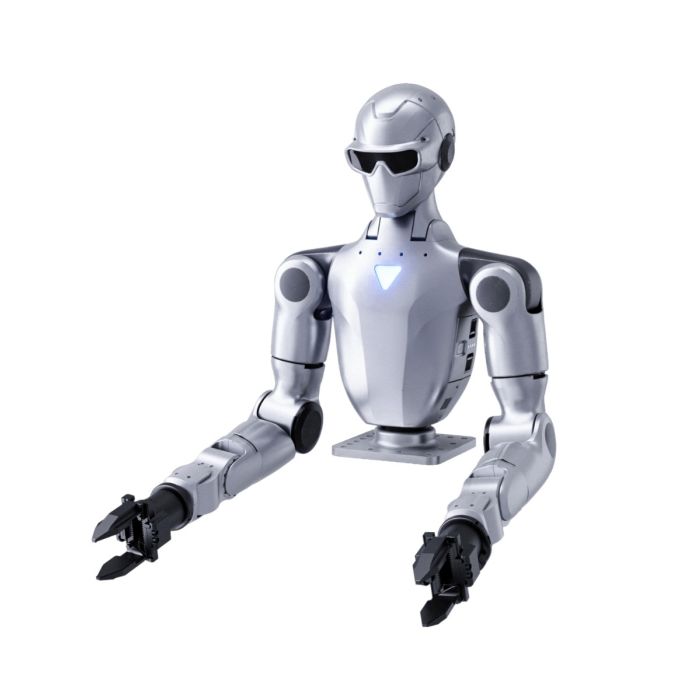
Two arms, a waist and a head, mounted on a base that never walks anywhere: that is the whole idea behind the Unitree R1-A5 Fixed Base Dual-Arm Humanoid Robot. For many labs and workshops, the part of a humanoid that matters is the upper body, the part that looks, turns and reaches. This robot keeps that part and leaves out everything else.
The product is available through this page, by quotation.
Background
Unitree and the R1 family
Unitree Robotics is known for compact, accessible robots that research groups and universities can actually put on a bench. Unitree has extended its R1 dual-arm humanoid family with the new R1-A5 and R1-A7 models. The names carry the main difference: the A5 has five degrees of freedom in each arm, while the R1-A7 has seven per arm. Versions named R1-A5-D and R1-A7-D complete the family.
If you are still comparing options inside the range, the Unitree R1 category shows the wider family, and the Unitree R1-A5 category groups the A5 configurations together.
Positioning and key technology
The R1-A5 is a fixed-base dual-arm humanoid with 13 degrees of freedom: five in each arm, one in the waist and two in the head. A fixed base removes balance control, leg actuators and floor space from the problem. What remains is manipulation, perception and interaction, which is where most application research starts.
The joints use a crossed roller and deep groove ball output bearing, and the cooling is local air cooling. The head carries a binocular camera, with an optional wrist camera for closer views of the work. A 4-array microphone and dual 3W×2 speakers cover voice interaction. WiFi 6 and Bluetooth 5.2 are included, and the robot supports secondary development and smart OTA updates, so teams can write their own software and keep the platform current.
Power comes from an external supply or a Li-ion battery. An NVIDIA Jetson Orin high-computing module in the 40-100 TOPS class is an option for teams that want onboard processing for perception or learning workloads. End effectors are also optional: a two-finger gripper, a three-finger dexterous hand or a five-finger dexterous hand.
Technical Specifications
| Specification | Unitree R1-A5 |
|---|---|
| Type | Fixed-base dual-arm humanoid |
| Total degrees of freedom | 13 |
| Degrees of freedom per arm | 5 |
| Waist degrees of freedom | 1 |
| Head degrees of freedom | 2 |
| Forearm + upper arm length | 420 mm |
| Payload per arm | About 2 kg |
| Weight | Roughly 11 kg |
| Dimensions | 700×357×190 mm |
| Joint motion range | Waist: yaw ±150°; head: yaw ±115°, pitch ±36° |
| Joint output bearing | Crossed roller + deep groove ball |
| Cooling system | Local air cooling |
| High-computing module | Optional NVIDIA Jetson Orin (40-100 TOPS) |
| End effector | Optional two-finger gripper / three-finger dexterous hand / five-finger dexterous hand |
| Power supply | External power or Li-ion battery |
| Camera module | Binocular camera + optional wrist camera |
| Microphone | 4-array |
| Speaker | Dual speakers (3W×2) |
| WiFi 6 and Bluetooth 5.2 | Yes |
| Secondary development | Yes |
| Smart OTA update | Yes |
Specifications as published by the manufacturer; confirmed against the datasheet at quotation.
The manufacturer has not published the battery capacity, the power consumption, the IP rating, the repeatability, the operating temperature, the maximum arm speed or the contents of the box; they are confirmed at quotation.
What makes the R1-A5 different from the R1-A7?
The clearest difference is in the arms. The R1-A5 has five degrees of freedom per arm and a combined forearm and upper arm length of 420 mm. The R1-A7 has seven degrees of freedom per arm and a length of 555 mm. In plain terms, the R1-A7 offers more joints and a longer reach, and the R1-A5 is the more compact of the two.
The A5 also has a smaller footprint, at 700×357×190 mm against 835×357×190 mm for the R1-A7. Both share the same waist and head layout, with one waist degree of freedom and two in the head. Both share the same bearings, cooling, audio, wireless and software features. If your tasks are tabletop pick-and-place, demonstrations or interaction studies, five joints per arm are often enough. If you need to approach objects from awkward angles or work across a wider area, ask us to quote the R1-A7 as well.
Which end effector and compute option should I choose?
The arms are only half of a manipulation setup; the hands decide what the robot can actually do. A two-finger gripper suits repeatable grasping of simple shapes. The three-finger and five-finger dexterous hands are the options for studying finer, more human-like handling. The wrist camera is worth considering whenever the hand needs a close view of the object it is about to touch.
The same logic applies to computing. If your software runs on an external computer, the robot can be driven over its wireless link or by cable. If you want perception and control to run on the robot itself, the optional NVIDIA Jetson Orin module in the 40-100 TOPS class is the route. Tell us which workloads you plan to run, and we will build the quotation around them.
Who is the Unitree R1-A5 for?
University labs and research groups get a manipulation platform with a humanoid upper body, open to secondary development, without the cost and floor space of a walking robot. Educators can use it to teach kinematics, vision and human-robot interaction on a bench. Integrators and product teams can prototype interaction and handling concepts before committing to a larger system.
Buyers who want the robot arranged for them rather than assembled from options can look at the packaged configurations, such as Unitree R1-A5 Smart A and Unitree R1-A5 Smart B. Buyers who need longer reach and seven joints per arm should ask about the R1-A7 instead.
What is the Unitree R1-A5 used for?
- Manipulation research. Two five-joint arms with optional hands make a compact testbed for grasping and bimanual tasks.
- Teaching robotics. A humanoid upper body on a bench lets students work with kinematics, control and perception directly.
- Vision and perception work. The binocular camera and optional wrist camera support experiments in seeing and locating objects.
- Human-robot interaction. The movable head, 4-array microphone and dual speakers allow the robot to turn, listen and respond.
- Software and AI development. Secondary development, OTA updates and the optional Jetson Orin module support custom control and learning code.
- Demonstrations and evaluation. A fixed, tabletop humanoid is easy to set up for exhibitions, pilot projects and operational evaluation.
Pricing and Availability
We do not print prices on this page. The final configuration depends on the hands, the wrist camera, the compute module and the power option you choose, so quotation is the way to buy. Delivery, customs and support are arranged with the quotation. Send us your intended use and the options you need, and the Unitree R1-A5 Fixed Base Dual-Arm Humanoid Robot is available on this page.
Frequently Asked Questions
How many degrees of freedom does the R1-A5 have?
It has 13 in total: five in each arm, one in the waist and two in the head.
Can the robot walk or move around?
No. It is a fixed-base robot, designed to stay mounted where it is used and to work with its arms, waist and head.
Which hands can be fitted?
The options are a two-finger gripper, a three-finger dexterous hand and a five-finger dexterous hand.
Can I run my own software on it?
Yes. Secondary development is supported, and so are smart OTA updates. An NVIDIA Jetson Orin module in the 40-100 TOPS class is available as an option.
How is the robot powered?
Either from an external power supply or from a Li-ion battery.
What is the difference between the R1-A5 and the R1-A7?
The R1-A5 has five degrees of freedom per arm and a 420 mm arm length. The R1-A7 has seven per arm and 555 mm.
Where can I buy the Unitree R1-A5 and what does it cost?
You can buy it through this page by requesting a quotation. The cost depends on the options you select, so we give it in the quotation and not here.
Summary
The Unitree R1-A5 Fixed Base Dual-Arm Humanoid Robot takes the useful part of a humanoid, the head, the waist and two arms, and puts it on a stable base. Thirteen degrees of freedom, a choice of hands, an optional Jetson Orin module and open development make it a practical tool for research, teaching and prototyping. If that matches your work, this page is the starting point.


