
Unitree R1-A5-D Mobile Base Dual-Arm Humanoid Robot
In stock
- BRAND:
- UNITREE ROBOTICS
- MODEL:
- R1-A5-D
- ORIGIN:
- China
- Warranty:
- 12 MONTHS
- AVAILABILITY:
- SUBJECT TO AVAILABILITY
- SKU:
- Unitree-R1-A5-D
Unitree R1-A5-D Mobile Base Dual-Arm Humanoid Robot
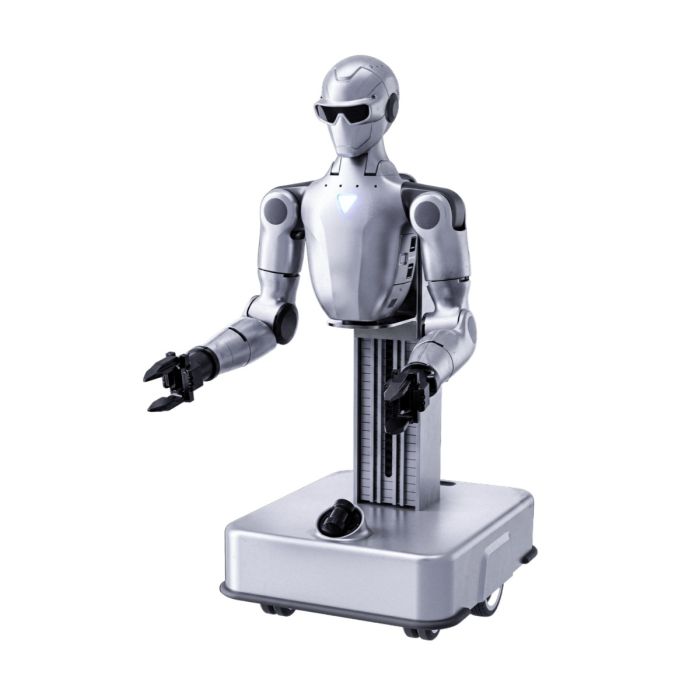
Most people picture a humanoid robot standing in one spot. The Unitree R1-A5-D Mobile Base Dual-Arm Humanoid Robot is built to travel: a head, torso and two arms carried on a wheeled chassis, folded down for transport and raised when there is work to do.
The product is available through this page, by quotation.
Background
Unitree and the R1 lineage
Unitree Robotics is best known for legged machines, and the company has built its name on making advanced robot hardware reachable for laboratories, universities and integrators. The R1 family continues that approach. Rather than copying a walking humanoid, it places an upper body with two arms on a mobile base, which suits indoor manipulation work where a stable platform matters more than a human gait.
The family is sold in several versions: R1-A5, R1-A7, R1-A5-D and R1-A7-D. The R1-A5-D described here is a -D model, and that suffix matters for one figure in particular, the waist range, which is specific to -D models. You can browse the wider family on the Unitree R1 category page, or look at the Unitree R1-A5-D category for the configurations built on this model.
Positioning and key technology
The R1-A5-D sits between a display piece and a full development platform. Its body is run by an 8-core high-performance CPU. Perception comes from a chassis LiDAR and a binocular camera, with a wrist camera available as an option. Voice interaction uses a 4-array microphone with dual speakers, and wireless links are WiFi 6 and Bluetooth 5.2.
What makes it a working tool rather than a showcase is openness. The robot has open interfaces for the underlying system, the robotic arm, audio, lighting and visual control, so a team can write its own behavior on top of the machine. A smart OTA update function keeps the software current. For heavier computing, an add-on module can be fitted, with multiple brands and models available, such as Orin at 40-100TOPS.
Technical Specifications
| Specification | Value |
|---|---|
| Model | R1-A5-D |
| Shrunk size | 683x520x440mm |
| Raised size | 1600x520x440mm |
| Weight | Approx. 30kg |
| Body processor | 8-core high-performance CPU |
| Sensors | Chassis LiDAR + Binocular Camera + Optional Wrist Camera |
| Binocular field of view | Horizontal 146°, Vertical 124° |
| Binocular eye spacing | 60mm |
| Waist (lumbar) joint range, -D models | ±35° |
| Neck (cervical) joint range | Yaw ± 115°, Pitch ± 36° |
| Voice | 4-array microphone + dual speakers |
| Speakers | Dual Speakers (3W×2) |
| Battery life (battery-powered) | Approx. 1.5h |
| Wireless | WiFi 6 & Bluetooth 5.2 |
| End effectors | Optional two-finger gripper / three-finger dexterous hand / five-finger dexterous hand |
| Add-on compute module | Multiple brands and models available such as Orin (40-100TOPS), etc. |
| Secondary development | Open interfaces for the underlying system, robotic arm, audio, lighting, visual control, etc. |
| Smart OTA update | Yes |
Specifications as published by the manufacturer; confirmed against the datasheet at quotation.
The manufacturer has not published the battery capacity, the chassis maximum speed, the IP rating, the LiDAR model or the operating temperature; they are confirmed at quotation.
What makes the R1-A5-D different from a fixed-base robot arm?
A fixed arm does one job at one location. The R1-A5-D carries its arms with it, and the height range of its body, from a shrunk size of 683x520x440mm to a raised size of 1600x520x440mm, lets it work at different levels and then fold down to move through tighter spaces. The waist joint, with a range of ±35° on -D models, adds reach by leaning and turning the upper body rather than repositioning the whole base.
The head adds another layer. The neck turns through ±115° in yaw and ±36° in pitch, and the binocular camera covers a 146° horizontal and 124° vertical field of view with 60mm eye spacing. That gives the robot a human-like way of looking at a workspace, which is useful when a researcher wants perception and manipulation to be developed together on one platform.
How does the choice of hand change the robot?
The end effector decides what the robot can actually do with an object. The options are a two-finger gripper, a three-finger dexterous hand and a five-finger dexterous hand. A two-finger gripper suits simple pick-and-place routines. The dexterous hands open the door to more detailed grasping studies and richer demonstrations. Because the hand is an option, it is worth stating your task at the quotation stage so the configuration is matched to the work. If you want to compare packaged variants, the Unitree R1-A5-D Smart A and Unitree R1-A5-D Smart B pages are a good place to start.
Who is the Unitree R1-A5-D for?
Universities and research labs are the clearest fit. Open interfaces for the arm, audio, lighting and visual control let students and researchers write their own software, and the optional add-on compute module gives room to run heavier perception or learning workloads.
Robotics integrators can use it as a mobile manipulation testbed before committing to a purpose-built cell. Training centers and technical schools can use it to teach kinematics, vision and human-robot interaction on a machine that students can see and approach. Exhibition and demonstration teams will value the voice system and the ability to fold down for transport.
Buyers who want a more complete bundle may prefer one of the packaged versions, such as Smart C, Smart D or the Unitree R1-A5-D Smart Ultimate D. Ask us at quotation which one matches your intended work.
What is the Unitree R1-A5-D used for?
- Mobile manipulation research: test grasping and arm control from a moving base with two arms.
- Vision and perception studies: use the chassis LiDAR and binocular camera, with an optional wrist camera, to build and test perception pipelines.
- Teaching robotics: give students a real humanoid upper body to program through open interfaces.
- Human-robot interaction: work with the 4-array microphone and dual speakers to develop voice-driven behavior.
- System integration trials: evaluate how a humanoid platform fits into a workflow before a wider rollout.
- Demonstrations and exhibitions: fold the robot down to move it, then raise it to show its reach and head movement.
Pricing and Availability
We do not print prices on this page. Quotation is the way to buy: tell us the hand option, the compute module and the version you want, and we will prepare an offer. Delivery, customs and support are arranged together with the quotation. The Unitree R1-A5-D Mobile Base Dual-Arm Humanoid Robot is available on this page.
Frequently Asked Questions
What is the weight of the R1-A5-D?
The weight is approximately 30kg.
How long does the battery last?
Battery life when battery-powered is approximately 1.5h.
Can I write my own software for it?
Yes. The robot offers open interfaces for the underlying system, the robotic arm, audio, lighting and visual control, and it supports smart OTA updates.
Which hands can be fitted?
The options are a two-finger gripper, a three-finger dexterous hand and a five-finger dexterous hand.
Can I add more computing power?
Yes. An add-on compute module is available in multiple brands and models, such as Orin at 40-100TOPS.
How does it connect wirelessly?
It uses WiFi 6 and Bluetooth 5.2.
Where can I buy the Unitree R1-A5-D and what does it cost?
You can buy it through this page by requesting a quotation. The cost depends on the configuration you choose, and we give it in the quotation rather than on the page.
Summary
The Unitree R1-A5-D is a humanoid that earns its place by moving: a compact body that folds to 683x520x440mm and rises to 1600x520x440mm, two arms, a head with binocular vision, and a software layer open to your own code. It is not the answer for every task, but for research, teaching and integration work it offers a practical starting platform. If it fits your project, this page is the starting point.