
Unitree R1-A5-D Smart Ultimate D Humanoid Robot
In stock
- BRAND:
- UNITREE ROBOTICS
- MODEL:
- R1-A5-D-Smart-Ultimate-D
- PART #:
- R1-A5-D-Smart-Ultimate-D
- ORIGIN:
- China
- Warranty:
- 12 MONTHS
- AVAILABILITY:
- SUBJECT TO AVAILABILITY
- SKU:
- Unitree-R1-A5-D-Smart-Ultimate-D
Unitree R1-A5-D Smart Ultimate D Humanoid Robot
Count the joints before you count the headlines. The Unitree R1-A5-D Smart Ultimate D Humanoid Robot offers 16 degrees of freedom, a head that carries 10 TOPS of computing power and a chassis that carries its own LiDAR. For a team deciding whether a humanoid platform will earn its place in a lab or a workshop, those are the numbers that matter more than any demonstration video.
The robot is available through this page, by quotation.
Background
Unitree and the R1 lineage
Unitree Robotics is known for building its own actuators and for bringing robotics hardware to research groups, universities and integrators. The R1 family continues that approach. Its members share a common architecture, and the model code tells you which configuration you are looking at: R1-A5, R1-A7, R1-A5-D and R1-A7-D are named among the versions, and Smart D and Ultimate D are named as configurations of the R1-A5-D.
Reading the code correctly matters when you compare listings. The R1-A5-D is the base platform, and this page covers the Smart Ultimate D configuration built on it. If you want to see the plain platform first, the Unitree R1-A5-D Mobile Base Dual-Arm Humanoid Robot is the place to start, and the wider Unitree R1 category shows the rest of the family.
Positioning and key technology
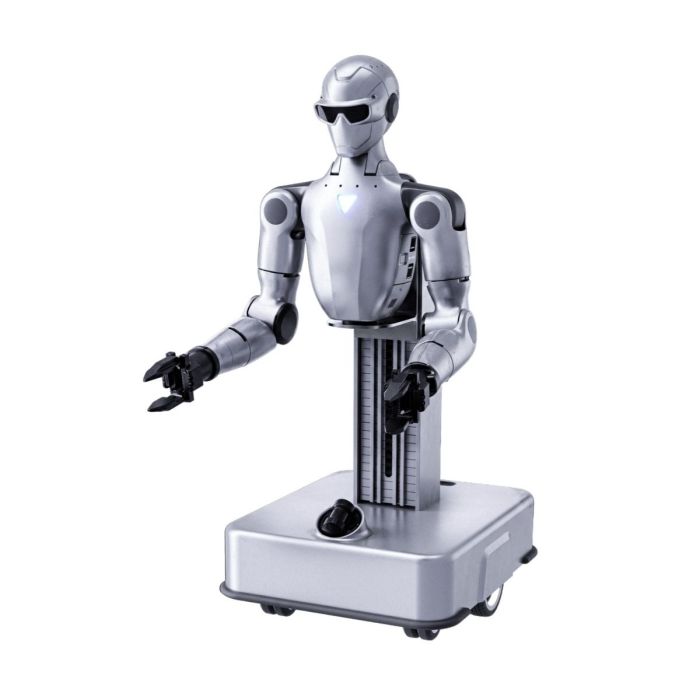
The R1-A5-D is a humanoid in the sense that matters for manipulation: two arms, a waist, a head with cameras and a central pillar, all mounted on a base with a chassis LiDAR. The joint motor is a low-inertia, high-speed inner rotor PMSM with superior responsiveness and heat dissipation. In practice that is the kind of motor choice that suits repeated, controlled arm movements.
The head module is the thinking part of the machine. It offers 10 TOPS of computing power and an 8-core high-performance CPU. A binocular camera gives a field of view of 146° horizontal and 124° vertical. WiFi 6 and Bluetooth 5.2 handle wireless connections. Secondary development is supported, and so are smart OTA updates, so the robot can be programmed for your own tasks and kept current without a workshop visit.
Technical Specifications
| Specification | Value |
|---|---|
| Weight (R1-A5-D) | Approx. 30kg |
| Total degrees of freedom (R1-A5-D) | 16 (5 single arms × 2 + 1 waist + 2 heads + 1 pillar + 2 bases) |
| Head module computing power | 10 TOPS |
| Head processor | 8-core high-performance CPU |
| Binocular field of view | Horizontal 146°, Vertical 124° |
| Camera module (R1-A5-D) | Chassis LiDAR + Binocular Camera + Optional Wrist Camera |
| Battery life (battery-powered) | Approx. 1.5h |
| Joint motor | Low-Inertia High-Speed Inner Rotor PMSM |
| Wireless | WiFi 6 and Bluetooth 5.2 |
| Secondary development | Yes |
| Smart OTA update | Yes |
| End effector options | Two-finger gripper, three-finger dexterous hand or five-finger dexterous hand (optional) |
Specifications as published by the manufacturer; confirmed against the datasheet at quotation.
The manufacturer has not published the battery capacity, the payload at full extension, the IP rating, the maximum travel speed of the chassis, the LiDAR model, the operating temperature or the power consumption; they are confirmed at quotation.
What does the head module give this robot?
Most of what separates a useful research robot from an expensive ornament happens in perception and computing. The head module of this robot carries 10 TOPS of computing power and an 8-core high-performance CPU. That is enough headroom to run vision models close to the sensors instead of sending every frame elsewhere, which keeps reaction time and network dependence in your own hands.
The binocular camera covers 146° horizontally and 124° vertically, a wide view for a robot that has to find objects on a table and also see what is around it. The chassis LiDAR supplies a second view, this one from the base, and a wrist camera can be added as an option when a task needs a close look at what the hand is about to grasp.
How do the hand options change what the robot can do?
The end effector decides the kind of work the robot can attempt. Three options are listed: a two-finger gripper, a three-finger dexterous hand and a five-finger dexterous hand. A two-finger gripper is the simple choice for picking and placing regular objects. The dexterous hands open the way to more varied grasps and to research on manipulation itself.
Because the arms and hands are separate choices, you can match the configuration to the project instead of paying for capability you will not use. If your task involves heavier objects, send the object and the reach with your request and the quotation will address them.
Who is the Unitree R1-A5-D Smart Ultimate D Humanoid Robot for?
University laboratories and research institutes are the clearest fit. A 16-degree-of-freedom platform with secondary development support gives students and researchers a real machine on which to test control, vision and manipulation ideas. Integrators and system builders will value the open development route and the OTA updates, which let them deliver a working solution and maintain it afterward.
Education and training centers can use the robot to teach robotics with hardware that looks and behaves like the platforms they will meet in industry. Companies evaluating humanoid automation will find that it makes a sensible pilot: weighing approx. 30kg for the R1-A5-D platform, it is a platform you can move, set up and test without building a program around it.
If you are still deciding between configurations, compare it with the Unitree R1-A5-D Smart D Humanoid Robot, or browse the full Unitree R1-A5-D category. Siblings such as the Unitree R1-A5-D Smart A Humanoid Robot are listed there as well, and our team can explain the differences when you ask for a quotation.
What is the Unitree R1-A5-D Smart Ultimate D Humanoid Robot used for?
- Manipulation research. Test grasping and arm control with the choice of two-finger, three-finger or five-finger end effectors.
- Computer vision work. Train and run perception models on the 10 TOPS head module with the binocular camera.
- Navigation experiments. Use the chassis LiDAR to study mapping and movement around a room or a workshop.
- Teaching robotics. Give students a complete humanoid platform on which to learn kinematics, control and programming.
- Custom application development. Build your own software through secondary development and update it over the air.
- Pilot projects. Evaluate humanoid automation for service, inspection or assistance tasks before a larger commitment.
Pricing and Availability
We do not print prices on this page, because the final configuration, hand choice and accessories decide what you receive. Send us your requirements and we will prepare a quotation that matches them. Delivery, customs and support are arranged with the quotation, so you know the full picture before you commit. The Unitree R1-A5-D Smart Ultimate D Humanoid Robot is available on this page.
Frequently Asked Questions
How many degrees of freedom does the R1-A5-D have?
The R1-A5-D has 16 degrees of freedom in total: 5 single arms × 2, 1 waist, 2 heads, 1 pillar and 2 bases.
How much computing power does the head module have?
The head module provides 10 TOPS of computing power and an 8-core high-performance CPU.
How long does the battery last?
Battery life when battery-powered is approx. 1.5h.
Can I program the robot for my own applications?
Yes. Secondary development is supported, and the robot also receives smart OTA updates. It connects over WiFi 6 and Bluetooth 5.2.
Which hands can be fitted?
A two-finger gripper, a three-finger dexterous hand or a five-finger dexterous hand can be chosen as an option. A wrist camera is also optional.
What about the IP rating and the payload?
Tell us the environment and the objects you have in mind when you request your quotation, and we will answer both for your configuration.
Where can I buy the Unitree R1-A5-D Smart Ultimate D Humanoid Robot and what does it cost?
You can buy it through this page by requesting a quotation. The cost depends on the configuration and accessories, so it is given in the quotation and not printed here.
Summary
The Unitree R1-A5-D Smart Ultimate D Humanoid Robot is best judged by what it counts: 16 degrees of freedom, 10 TOPS in the head, a binocular view of 146° by 124°, and a choice of three hands. Add secondary development and OTA updates, and it becomes a platform that grows with a research or integration project instead of ending at a demonstration. For a quotation tailored to your requirements, this page is the starting point.


