
Unitree R1-A5 Smart A Humanoid Robot
In stock
- BRAND:
- UNITREE ROBOTICS
- MODEL:
- R1-A5-Smart-A
- PART #:
- R1-A5-Smart-A
- ORIGIN:
- China
- Warranty:
- 12 MONTHS
- AVAILABILITY:
- SUBJECT TO AVAILABILITY
- SKU:
- Unitree-R1-A5-Smart-A
Unitree R1-A5 Smart A Humanoid Robot
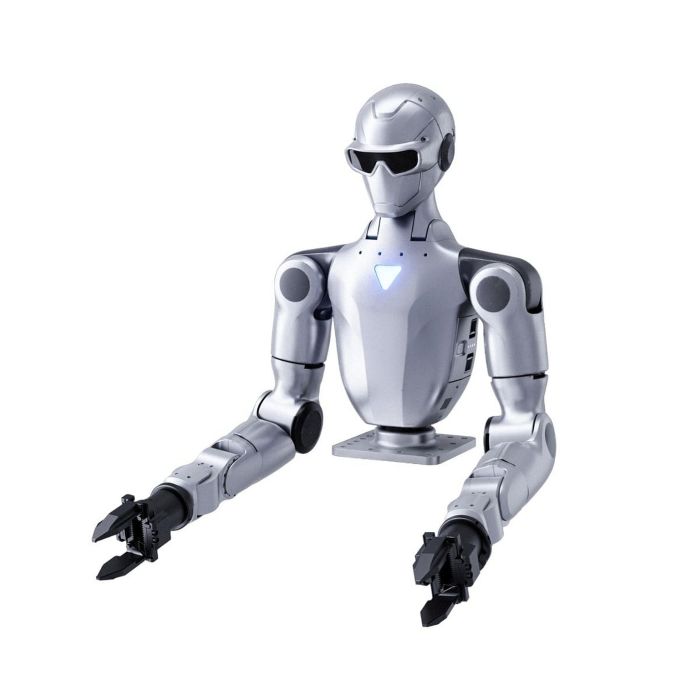
Take a humanoid and stop it at the waist. What remains is a head that looks, two arms that reach, and a torso that turns, all bolted to a surface where the work happens. That is the idea behind the Unitree R1-A5 Smart A Humanoid Robot, a fixed-base, dual-arm platform for people who care more about what a robot can do with its hands than about whether it can cross a room.
The product is available through this page, by quotation.
Background
Unitree Robotics and the R1 family
Unitree Robotics is known for building its own actuators and motion hardware instead of buying them in. The R1 line grows out of that habit. The sources describe R1-A5 and R1-A7 as dual-arm models without legs, fitted with grippers or dexterous hands, and offered on a fixed or a wheeled base. Because they carry no legs, they will not dance or walk. The upper body, a head and two arms, is the whole point.
Five versions are named across the sources: R1-A5, R1-A7, R1-A5-D, R1-A7-D and the R1-A5 Smart A described on this page. The A5 and A7 names separate the arm designs. The A5 arm has 5 degrees of freedom and a 420 mm forearm plus upper arm length. The A7 arm has 7 degrees of freedom and a 555 mm length.
Where the Smart A sits in the range
The Smart A is a configuration of the R1-A5 platform. It shares the A5 arm geometry: 13 degrees of freedom in total, made up of 5 per arm, 1 in the waist and 2 in the head. The sources describe the platform as roughly 11 kg, with about 2 kg of payload per arm. They carry no weight or gripper specification for the Smart A configuration itself.
Secondary development is listed as available. That matters for a robot of this kind, because most of its value comes from the software a team puts on top of it: perception routines, motion planning, teleoperation or learning pipelines. You can browse the wider family under Unitree R1 and the A5 group under Unitree R1-A5.
Technical Specifications
The figures below are the R1-A5 platform figures as the sources print them.
| Specification | Value |
|---|---|
| Type | Fixed-base dual-arm humanoid |
| Degrees of freedom | 13 (5 per arm, 1 waist, 2 head) |
| Degrees of freedom per arm | 5 |
| Weight | Roughly 11 kg |
| Dimensions | 700×357×190mm |
| Forearm + upper arm length | 420mm |
| Payload | About 2 kg per arm |
| Joint motion range | Waist: Yaw ±150°; Head: Yaw ±115°, Pitch ±36° |
| Joint motor | Low-Inertia High-Speed Inner Rotor PMSM |
| Camera module | Binocular Camera + Optional Wrist Camera |
| Head camera output | RGB and depth maps with 1280×720 @ 30 Hz and 544 x 488 @ 10 Hz resolution and frame rates, respectively |
| Speaker | Dual Speakers (3W×2) |
| Microphone | 4-Array |
| Wireless | WiFi 6 & Bluetooth 5.2 |
| Power supply | External Power or Li-ion Battery |
| End effector | Optional two-finger gripper / three-finger dexterous hand / five-finger dexterous hand |
| Secondary development | Yes |
Specifications as published by the manufacturer; confirmed against the datasheet at quotation.
The manufacturer has not published the exact weight of the Smart A configuration, the gripper specifications, the IP rating, the power consumption, the list of included accessories or the operating temperature; they are confirmed at quotation.
What makes the Smart A different from a walking humanoid?
A walking humanoid spends much of its engineering budget on balance, foot contact and fall recovery. A fixed-base robot spends none of it there. Its base does not move, so every joint in the body serves the task at hand: looking, leaning, reaching and gripping. For a lab that wants to study manipulation, that is a sensible trade.
The waist is a good example. It offers yaw motion of ±150°, which lets the torso swing toward whichever side of the bench needs attention without anyone repositioning the robot. The head adds yaw of ±115° and pitch of ±36°, so the binocular camera can sweep the workspace and tilt down toward the table. Together with the five joints in each arm, the robot has enough freedom to approach an object from more than one direction.
Perception comes built in. The head carries a binocular camera that outputs RGB and depth maps, with 1280×720 @ 30 Hz and 544 x 488 @ 10 Hz given as the resolutions and frame rates. A wrist camera is listed as an option, which is the usual way to get a closer view while a hand is about to grasp something. For voice and sound work, the platform lists a 4-array microphone and dual 3W×2 speakers, and WiFi 6 and Bluetooth 5.2 handle the wireless side.
How does the A5 arm compare with the A7 arm?
The sources print both. The A5 arm has 5 degrees of freedom per arm and a 420 mm forearm plus upper arm length, with dimensions of 700×357×190mm. The A7 arm has 7 degrees of freedom per arm and a 555 mm length, with dimensions of 835×357×190mm. Every Smart A figure on this page belongs to the A5 side of that comparison.
An arm with more joints can usually reach around obstacles more freely, while a shorter, lighter arm suits a compact bench. The A5 keeps the footprint small. If your task calls for the longer reach or the extra joints, the A7 is the version to ask about, and we can discuss it when you request a quotation.
Who is the Unitree R1-A5 Smart A Humanoid Robot for?
University and institute labs are the natural first group. A fixed-base dual-arm robot with a head, a waist, secondary development and a choice of end effectors gives students and researchers a body on which to test manipulation, vision and interaction software without a mobile base to manage.
Integrators and product teams form the second group. If you are prototyping a demonstration cell, a reception or guide concept, or a teleoperation setup, a compact upper-body platform lets you work on the software before committing to a larger design.
Educators and technical trainers are the third. A robot that sits on a table is easier to share across a class than one that needs floor space and safety margins.
If you would rather start from the plain base configuration, see the Unitree R1-A5 Fixed Base Dual-Arm Humanoid Robot. Neighboring configurations are also listed, such as the Unitree R1-A5 Smart B Humanoid Robot. Tell us what your project needs, and we will help you choose between them.
What is the Unitree R1-A5 Smart A Humanoid Robot used for?
- Manipulation research. Two five-joint arms and a turning waist give researchers a platform for grasping and handling studies at a bench.
- Vision and perception work. The binocular head camera supplies RGB and depth data for object detection and scene understanding.
- Teleoperation and data collection. A body with arms, a waist and a head suits setups where a person guides the robot and the motions are recorded.
- Human-robot interaction. The microphone array and dual speakers support voice-based experiments and guided demonstrations.
- Teaching and training. A tabletop humanoid brings robotics into the classroom without the demands of a walking machine.
- Custom application development. Secondary development lets integrators build their own software and pair the robot with the end effector their task needs.
Pricing and Availability
Pricing depends on the configuration, the end effector and the options you select, so we handle it by quotation and publish no amounts on this page. Send us your requirements and we will prepare a quotation for the Smart A. Delivery, customs and support are arranged together with the quotation. The Unitree R1-A5 Smart A Humanoid Robot is available on this page.
Frequently Asked Questions
Does the Smart A walk?
No. The R1-A5 and R1-A7 models come without legs. This is a fixed-base upper-body robot made up of a head, a waist and two arms.
How many degrees of freedom does it have?
The R1-A5 platform has 13: 5 in each arm, 1 in the waist and 2 in the head.
What can its arms carry?
The sources give about 2 kg of payload per arm and a 420 mm arm reach for the R1-A5 platform.
Which end effectors can it use?
The sources list an optional two-finger gripper, three-finger dexterous hand or five-finger dexterous hand.
Can I write my own software for it?
Yes. Secondary development is listed as available for the platform.
How is it powered?
It runs from external power or a Li-ion battery.
Where can I buy the Unitree R1-A5 Smart A Humanoid Robot and what does it cost?
You can request it through this page, by quotation. We publish no prices; the cost depends on the configuration and options you choose.
Summary
The Unitree R1-A5 Smart A Humanoid Robot takes a humanoid and keeps only the parts that do the work: a head that sees, a waist that turns and two arms that reach. It has 13 degrees of freedom, a 420 mm arm reach, about 2 kg of payload per arm, a binocular depth camera, a microphone array and open secondary development. For labs, classrooms and integrators who need a manipulation platform and not a walker, it is a focused choice. If you are ready to take the next step, this page is the starting point.


