
Unitree R1-A7 Smart A Humanoid Robot
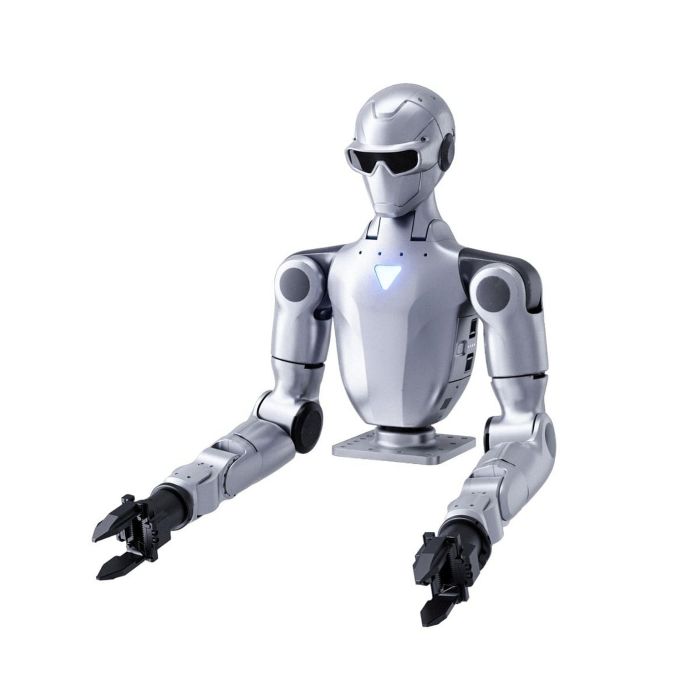
In stock
- BRAND:
- UNITREE ROBOTICS
- MODEL:
- R1-A7-Smart-A
- PART #:
- R1-A7-Smart-A
- ORIGIN:
- China
- Warranty:
- 12 MONTHS
- AVAILABILITY:
- SUBJECT TO AVAILABILITY
- SKU:
- Unitree-R1-A7-Smart-A
Unitree R1-A7 Smart A Humanoid Robot
Most of the difficulty in a manipulation robot sits between the eyes and the hands: what the machine sees, how quickly it can make sense of it, and what it can do next. The Unitree R1-A7 Smart A Humanoid Robot is built around that gap. It pairs a binocular head with a dual-arm body and adds a dedicated compute module for the Smart configurations, so the thinking sits close to the sensing.
The Unitree R1-A7 Smart A Humanoid Robot is available through this page, by quotation.
Background
Unitree and the dual-arm humanoid line
Unitree Robotics is a manufacturer known for legged and humanoid platforms that research groups, universities and integrators can program for themselves. The R1 family belongs to its dual-arm humanoid line, which the manufacturer describes with the words ultra-fast deployment and multi-scenario application. The emphasis is on getting a working upper body onto a bench quickly, not on locomotion.
The family is organized by version. The sources name R1-A5, R1-A7, R1-A5-D and R1-A7-D, and the arm configuration is given as 5x2 or 7x2 degrees of freedom across the family. Within the R1-A7 range the store lists several Smart configurations, lettered A to E, next to a fixed-base model. Because the letters matter, the exact configuration should always be named when requesting a quotation. You can browse the wider range in the Unitree R1 category or the narrower Unitree R1-A7 category.
Where the Smart A sits in the range
The Smart configurations add a 40 TOPS Orin Nano to the robot. That is a second compute resource beyond the head module, which itself provides 10 TOPS and an 8-core high-performance CPU. For a team that wants to run perception models, planning code and its own application software on the robot instead of on a separate workstation, that extra module is the reason to look at a Smart version.
Beyond compute, the platform is defined by its openness. The manufacturer describes full-stack open secondary development, which means the software is meant to be extended by the buyer, not used only as shipped. The R1-A7 Smart A Humanoid Robot is therefore best understood as a development platform with a body attached, one that rewards teams that arrive with a clear project.
Technical Specifications
| Specification | Value |
|---|---|
| Product line | Unitree Dual-Arm Humanoid Robot |
| Weight (R1-A7) | Approx. 13kg (with external power supply) |
| Dimensions (R1-A7) | 835x357x190mm |
| Arm degrees of freedom (across the family) | 5x2 / 7x2 |
| Binocular field of view | Horizontal 146°, Vertical 124° |
| Eye spacing | 60mm |
| Head module computing power | 10 TOPS |
| Head processor | 8-core high-performance CPU |
| Head joint range | Yaw ± 115°, Pitch ± 36° |
| Audio | 4-array microphone + dual speakers |
| End effector options | Optional two-finger gripper / three-finger dexterous hand / five-finger dexterous hand |
| Software development | Full-stack open secondary development |
| Compute module in Smart configurations | 40 TOPS Orin Nano |
Specifications as published by the manufacturer; confirmed against the datasheet at quotation.
The manufacturer has not published the battery capacity, the IP rating, the operating temperature, the power consumption, the end effector included with the Smart A or the contents of the box; they are confirmed at quotation.
What makes the Smart A different from a fixed-base R1-A7?
The clearest difference is compute. The Smart configurations carry a 40 TOPS Orin Nano on top of the head module with its 10 TOPS and 8-core CPU. A buyer who plans to run vision models, grasp planning or a language-driven interface on the robot itself will find that extra module relevant. The fixed-base model, listed as the Unitree R1-A7 Fixed Base Dual-Arm Humanoid Robot, is the page to read when the application does not call for it.
The second difference is how the configurations are labeled. The Smart versions are lettered, and hands are offered as options, from a two-finger gripper to a three-finger or five-finger dexterous hand, so name the hand you want when you request the quotation. Comparing against the Unitree R1-A7 Smart B Humanoid Robot or the Unitree R1-A7 Smart C Humanoid Robot on the same questions keeps the choice clear.
How does the head help the robot work with its hands?
Manipulation depends on seeing the workspace well. The head carries a binocular camera pair with 60mm eye spacing and a field of view of 146° horizontally and 124° vertically. That is a wide view, useful when the robot must keep a table, a tool and its own arms in frame together.
The head can also move to look. Its joints cover yaw of ± 115° and pitch of ± 36°, so the robot can turn toward a person or tilt down to a work surface without repositioning the body. A 4-array microphone and dual speakers add a voice channel, which suits demonstrations, guided interaction and research on speech-driven control. Taken together, these features let a developer build behavior that looks, listens and acts from one platform.
Who is the Unitree R1-A7 Smart A Humanoid Robot for?
University laboratories and research institutes are the natural first audience. They need a humanoid upper body with open software, enough onboard compute to try new models, and a form factor that fits a bench. Education programs that teach manipulation, perception or human-robot interaction can use it in the same way.
System integrators and product teams form the second group. They can prototype a dual-arm application, test it with a chosen hand and judge whether it justifies a larger program. Companies exploring service or demonstration roles can use the audio and head movement for interactive displays. Buyers who do not need the added compute module may prefer the fixed-base version, while those who want to compare other lettered configurations can look at the Smart D or Smart E pages in the same range.
What is the Unitree R1-A7 Smart A Humanoid Robot used for?
- Dual-arm manipulation research. Teams develop and test grasping and bimanual tasks on a compact upper-body platform.
- Vision and perception work. The binocular head and onboard compute support experiments in recognition and scene understanding.
- Teaching and training. Classrooms and labs use it to show students how sensing, planning and motion fit together.
- Human-robot interaction. The microphone array, speakers and moving head support speech and gesture studies.
- Application prototyping. Integrators build and evaluate dual-arm workflows before committing to a larger deployment.
- Custom software development. Open secondary development lets engineers write their own control and behavior layers.
Pricing and Availability
Pricing is provided by quotation and is tied to the configuration you choose, including the end effector. Delivery, customs and support are arranged together with the quotation, so that the whole path from order to commissioning is agreed in one place. Send your requirements and the quotation for the Unitree R1-A7 Smart A Humanoid Robot is prepared from them; the product is available on this page.
Frequently Asked Questions
How heavy is the R1-A7 and how big is it?
The R1-A7 weighs approx. 13kg with the external power supply and measures 835x357x190mm. These figures are stated for the R1-A7 version.
What does the Smart configuration add?
The Smart configurations add a 40 TOPS Orin Nano. The head module also provides 10 TOPS and an 8-core high-performance CPU.
Which hands can be fitted?
The manufacturer lists an optional two-finger gripper, a three-finger dexterous hand and a five-finger dexterous hand. Tell us which one you need and it is included in your quotation.
Can I write my own software for it?
Yes. The manufacturer describes full-stack open secondary development, so the platform is intended to be extended with your own code.
What can the head see and hear?
The binocular view covers 146° horizontally and 124° vertically with 60mm eye spacing. Audio is handled by a 4-array microphone and dual speakers.
Are the battery life and IP rating given?
No. This page carries no figure for them; the specification section lists what is missing.
Where can I buy the Unitree R1-A7 Smart A Humanoid Robot and what does it cost?
You can request it through this page, by quotation. The cost depends on the configuration and is given in the quotation, not listed here.
Summary
The question at the start was how much brain to put behind the eyes. The Unitree R1-A7 Smart A Humanoid Robot answers it with a wide-view binocular head, a head module of 10 TOPS, an added 40 TOPS Orin Nano, two arms and a software stack that is open to the buyer. It suits teams that want to develop manipulation behavior of their own and that agree the hand and the open details in advance. For a quotation on this configuration, this page is the starting point.


