
Unitree R1-A7 Smart C Humanoid Robot
In stock
- BRAND:
- UNITREE ROBOTICS
- MODEL:
- R1-A7-Smart-C
- PART #:
- R1-A7-Smart-C
- ORIGIN:
- China
- Warranty:
- 12 MONTHS
- AVAILABILITY:
- SUBJECT TO AVAILABILITY
- SKU:
- Unitree-R1-A7-Smart-C
Unitree R1-A7 Smart C Humanoid Robot
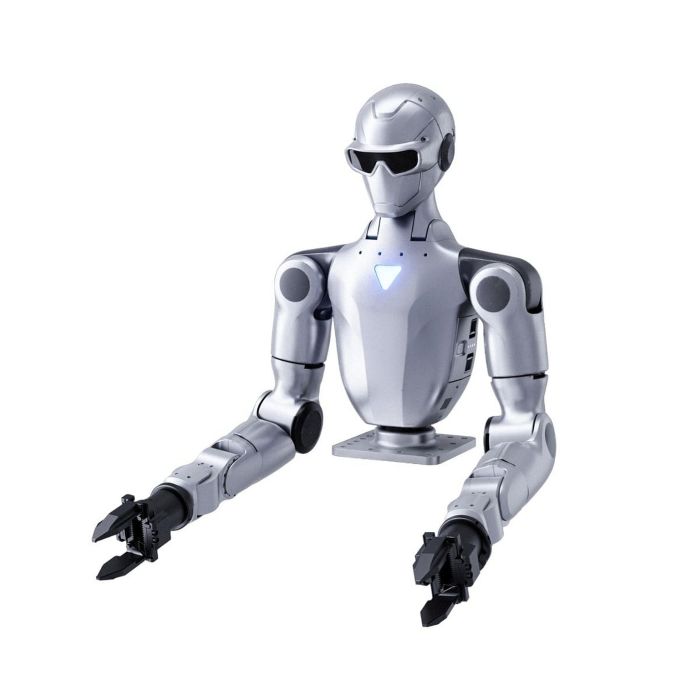
A hand that can register 10 g is a different tool from a hand that only closes. The Unitree R1-A7 Smart C Humanoid Robot is built around that difference: a bench-mounted upper body with two seven-joint arms, a turning waist, a sensing head and hands that report how hard they are holding.
The Unitree R1-A7 Smart C Humanoid Robot is available through this page, by quotation.
Background
Unitree and the R1-A7 lineage
Unitree Robotics is known for compact, accessible robots that research groups and teams can put to work without a large budget or a long integration project. The R1-A7 continues that approach. It is the 7-DoF-per-arm version of Unitree's dual-arm manipulation platform, with two arms of 555 mm (21.9 in) reach, a rotating waist and a 2-DoF sensor head.
The platform comes in several named versions. They are separated mainly by the hand they carry: R1-A7 Smart A with the Dex1-1 gripper, Smart B with the Dex3-1, Smart C with the Dex3-1 and haptics, Smart D with the Revo 2 basic hand, Smart E with the Revo 2 and haptics, Smart F and Smart G with the Linker Hand O6 (without and with haptics), and Smart H with a tendon-driven hand. A separate R1-A7-D mobile base version also exists. Reading the suffix correctly is the first step in choosing well.
Where the Smart C sits in the range
The Smart C pairs a force-controlled 3-finger hand with 33 haptic sensors per hand, covering 10 g to 2500 g. The whole system has 31 DoF. For a team studying contact-rich manipulation, that touch data is the main reason to choose this version over a plain gripper.
The Smart series also includes an integrated expansion dock with 40 TOPS of computing power and an Open SDK for secondary development. The head already carries an 8-core CPU with 10 TOPS, and the body has an 8-core CPU, both as standard. This is a torso, not a humanoid that moves around: it does not walk, and that is what lets the engineering concentrate on arms, hands and perception.
Technical Specifications
| Specification | Value |
|---|---|
| Platform | 7-DoF-per-arm dual-arm manipulation platform, rotating waist, 2-DoF sensor head |
| Total degrees of freedom (Smart C) | 31 DoF |
| Hand (Smart C) | Force-controlled 3-finger hand |
| Haptic sensors (Smart C) | 33 per hand, 10 g to 2500 g |
| Arm reach | 555 mm (21.9 in), forearm plus upper arm |
| Arm payload | 2 to 4 kg (4.4 to 8.8 lb) per arm, varies with arm extension |
| Maximum shoulder torque (desk-mount) | 60 Nm (44 lb-ft) |
| End-clamp repeatability (desk-mount) | ±0.1 mm (±0.004 in) |
| Dimensions (desk-mount) | 835 x 357 x 190 mm (32.9 x 14.1 x 7.5 in) |
| Weight (desk-mount) | About 13 kg (29 lb) |
| Waist yaw | ±150° on the desk-mount; ±35° on the mobile base |
| Head range | Yaw ±115°, pitch ±36° |
| Head camera | Binocular; RGB 1280 x 720 at 30 Hz; depth 544 x 448 at 10 Hz |
| Binocular field of view | 146° horizontal by 124° vertical, eye spacing 60 mm (2.4 in) |
| Standard compute | 8-core CPU in the body; 8-core CPU with 10 TOPS in the head |
| AI expansion (Smart series) | Integrated expansion dock, 40 TOPS |
| Audio | 4-array microphone, dual 3 W speakers |
| Wireless | Wi-Fi 6, Bluetooth 5.2 |
| Battery runtime (desk-mount) | About 1.5 hours; also runs on external power |
| Joint design | Crossed-roller and deep-groove ball bearings, hollow internal wiring, dual encoders on the arm joints, local air cooling |
| Locomotion | None; the robot does not walk |
Specifications as published by the manufacturer; confirmed against the datasheet at quotation.
The manufacturer has not published the IP rating, the operating temperature range, the top speed, the charging time or the battery capacity; they are confirmed at quotation.
What makes the Smart C different from the other R1-A7 versions?
The difference is in the hand. The Smart B carries the Dex3-1 hand, and the Smart C carries the same Dex3-1 with haptics added. Those 33 sensors per hand, sensitive from 10 g up to 2500 g, give a control program real contact information instead of leaving it to infer grip from motor current alone. Anyone teaching a robot to pick up soft, fragile or awkward objects will notice the gain quickly.
Other versions take different routes. The R1-A7 Smart A uses the Dex1-1 gripper, a simpler end effector. The R1-A7 Smart D uses the Revo 2 basic hand, and the R1-A7 Smart E adds haptics to the Revo 2. The arms, waist, head and compute framework are shared across the Smart series, so the choice comes down to which hand suits your tasks and how much touch feedback you need.
Does the Smart C walk or move around?
No. This is a torso, not a humanoid that walks. On the desk-mount it is a bench instrument, and the waist turns ±150° so the arms can reach around a work area. The R1-A7-D mobile base version limits waist yaw to ±35°. If you need a platform that moves between stations, ask us about that version when you request a quotation. If your work happens at one table, the fixed arrangement is simpler and keeps attention on manipulation. The Unitree R1-A7 Fixed Base Dual-Arm Humanoid Robot is also listed for comparison.
Who is the Unitree R1-A7 Smart C for?
University and corporate research labs are the first audience, especially groups working on imitation learning, grasping and tactile perception. Haptic data from both hands, together with a binocular head camera, gives them a rich stream to train on. The open interfaces for the underlying system, the arms, audio, lighting and vision, together with full secondary development support, mean the robot can be programmed at the level a project needs.
Educators can use it to teach robot control and human-robot interaction, since the 4-array microphone and dual 3 W speakers support voice work. System integrators can evaluate it as a manipulation cell before committing to a larger design. Teams that do not need touch sensing may find the R1-A7 Smart B sufficient, since it carries the Dex3-1 hand without haptics. Teams that need a different hand may prefer another lettered version from the Unitree R1-A7 category.
What is the Unitree R1-A7 Smart C used for?
- Tactile grasping research: haptic sensors on each hand let researchers study how contact force changes over a grasp.
- Imitation learning: two coordinated 7-DoF arms and a binocular camera provide the data for demonstration-based training.
- Benchtop assembly trials: repeatability of ±0.1 mm at the end clamp on the desk-mount suits careful placement experiments.
- Vision and AI development: the 40 TOPS expansion dock and Open SDK give room for custom perception models.
- Voice and interaction studies: the microphone array and speakers support spoken commands and responses.
- Teaching robotics: a single platform lets students work on kinematics, sensing, control and software together.
Pricing and Availability
We do not list a price on this page. Each configuration is quoted on request, so the quotation reflects the version, accessories and support you actually need. Delivery, customs and support are arranged with the quotation. The Unitree R1-A7 Smart C Humanoid Robot is available on this page.
Frequently Asked Questions
How many degrees of freedom does the Smart C have?
The Smart C is a 31 DoF system. Each arm has seven joints, and the platform adds a rotating waist, a 2-DoF head and the force-controlled 3-finger hands.
What do the haptic sensors measure?
Each hand carries 33 haptic sensors covering 10 g to 2500 g. They report contact so a program can respond to how firmly an object is held.
What payload can the arms carry?
The payload is 2 to 4 kg (4.4 to 8.8 lb) per arm. Unitree is explicit that the figure changes a long way with arm extension, so plan around your actual reach.
How long does the battery last?
The desk-mount runs for about 1.5 hours on battery. It also runs on external power, which is how most benchtop work is done. The battery capacity and charging time have not been published.
Can I develop my own software for it?
Yes. Open interfaces cover the underlying system, the arms, audio, lighting and vision, with full secondary development support. The Smart series also has an Open SDK and a 40 TOPS expansion dock.
Does it connect wirelessly?
It supports Wi-Fi 6 and Bluetooth 5.2. Optional wrist cameras are available.
Where can I buy the Unitree R1-A7 Smart C Humanoid Robot and what does it cost?
You can request it through this page. The cost is given in a quotation prepared for your configuration, and no price is printed here.
Summary
The Smart C is for work where touch matters more than travel. It stays at the bench and invests in two 7-DoF arms, a waist and head with generous range, a binocular camera, 31 DoF in total and hands with 33 haptic sensors each. Anything it lacks, such as walking, is a deliberate trade for focus. If your project depends on understanding contact, this page is the starting point.


