
Unitree R1-A7 Smart D Humanoid Robot
In stock
- BRAND:
- UNITREE ROBOTICS
- MODEL:
- R1-A7-Smart-D
- PART #:
- R1-A7-Smart-D
- ORIGIN:
- China
- Warranty:
- 12 MONTHS
- AVAILABILITY:
- SUBJECT TO AVAILABILITY
- SKU:
- Unitree-R1-A7-Smart-D
Unitree R1-A7 Smart D Humanoid Robot
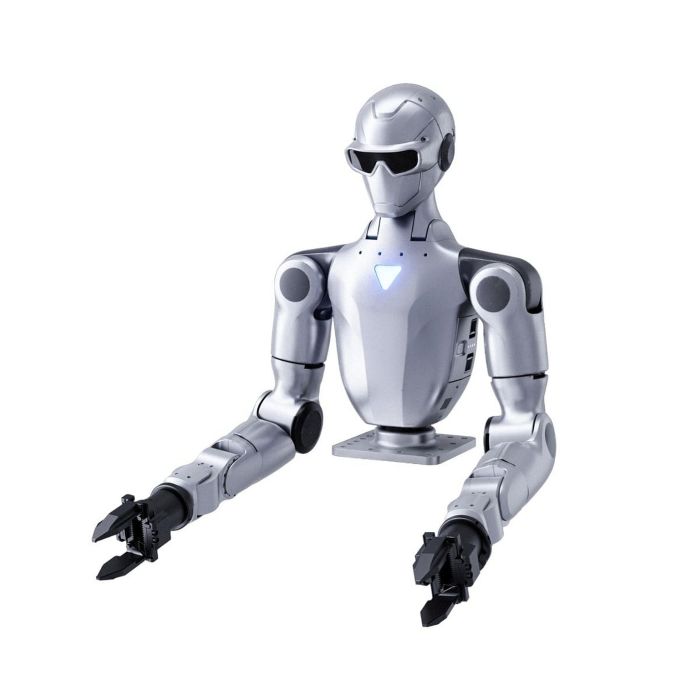
A robot that cannot walk may still be the most useful one in the room. The Unitree R1-A7 Smart D Humanoid Robot leaves the legs out on purpose and puts its engineering where tabletop work happens: two seven-joint arms, a movable head with a binocular camera, and a pair of BrainCo Revo 2 Basic Hands. Unitree is plain about it: this is a torso, not a humanoid, and it does not walk.
The product is available through this page, by quotation.
Background
Unitree and the R1-A7 lineage
UNITREE ROBOTICS is the maker behind the R1 family, and the family is organized around a few clear choices. The R1-A7 is the desk-mount torso. The R1-A7-D adds a wheeled chassis and a mobile base. Lettered Smart configurations, from A to H, change the hands and compute that come with the torso, and an R1-A5 sits alongside as a related model. Each lettered package carries its own end effector, so the letter at the end of a name matters as much as the number in the middle.
The Smart D is the configuration fitted with BrainCo Revo 2 Basic Hands. If you are still choosing among hands, the sibling pages for Unitree R1-A7 Smart A and Unitree R1-A7 Smart E show the neighboring packages, and the whole family is gathered in the Unitree R1 category.
What the platform is built to do
The R1-A7 is positioned as an upper-body research and development platform. Its joints use low-inertia inner-rotor motors, crossed-roller and deep-groove ball bearings, hollow internal wiring, dual encoders on the arm joints and local air cooling. In practice that means cables stay inside the structure, the arms can be sensed precisely, and heat is handled at the joint instead of being left to build up.
The software side is just as deliberate. Unitree provides open interfaces for the underlying system, the arms, audio, lighting and vision, with full secondary development support. The robot is meant to be programmed, extended and taught new behavior by the people who buy it, not simply run as delivered.
Technical Specifications
| Specification | Value |
|---|---|
| Configuration | R1-A7 Smart D – BrainCo Revo 2 Basic Hands |
| Product type | Torso; does not walk |
| Dimensions (desk-mount) | 835 x 357 x 190 mm (32.9 x 14.1 x 7.5 in) |
| Weight (desk-mount) | About 13 kg (29 lb) |
| Total degrees of freedom (desk-mount) | 19 |
| Arms | Two, 7 degrees of freedom per arm |
| Arm reach | Forearm plus upper arm 555 mm (21.9 in) |
| Arm payload | 2 to 4 kg (4.4 to 8.8 lb) per arm, varying with arm extension |
| Maximum shoulder torque | 60 Nm (44 lb-ft) |
| End-clamp repeatability | ±0.1 mm (±0.004 in) |
| Waist yaw (desk-mount) | ±150° |
| Head range | Yaw ±115°, pitch ±36° |
| Head camera, RGB | 1280 x 720 at 30 Hz |
| Head camera, depth | 544 x 448 at 10 Hz |
| Binocular field of view | 146° horizontal by 124° vertical; eye spacing 60 mm (2.4 in) |
| Standard compute | 8-core CPU in the body; 8-core CPU with 10 TOPS in the head |
| Optional compute | NVIDIA Orin module, 40 to 100 TOPS (Smart configurations: 40 TOPS Orin Nano) |
| Audio | 4-array microphone, dual 3 W speakers |
| Wireless | Wi-Fi 6, Bluetooth 5.2 |
| Power | External supply standard; optional upper-body battery giving about 1.5 h |
| Development | Open interfaces for the underlying system, arms, audio, lighting and vision |
Specifications as published by the manufacturer; confirmed against the datasheet at quotation.
The manufacturer has not published the IP rating, the operating temperature range, the top speed or the contents of the box; these are confirmed at quotation.
What makes the Smart D different from a walking humanoid?
A walking humanoid spends much of its budget, weight and software effort on staying upright. The Smart D spends none of it there. It is fixed to a desk, so its 19 degrees of freedom all go to the upper body: two arms, a waist and a head. The result is a platform whose attention is on manipulation, and whose behavior is easier to reason about because the base never moves.
The arms are the center of that argument. Each has 7 degrees of freedom, a reach of 555 mm (21.9 in) and a payload of 2 to 4 kg (4.4 to 8.8 lb) that changes with how far the arm is extended. Unitree itself stresses that the payload moves a long way with extension, so plan your tasks around the arm pose and not around the largest number. A maximum shoulder torque of 60 Nm (44 lb-ft) and end-clamp repeatability of ±0.1 mm (±0.004 in) describe an arm intended for careful, repeatable work.
The waist and head add to that. Waist yaw of ±150° on the desk-mount lets the robot turn toward different parts of a workspace without being moved, and the head turns ±115° in yaw and ±36° in pitch. With a binocular camera in the head, the robot can look where its hands are going.
What do the BrainCo Revo 2 Basic Hands add?
Hands decide what a torso can actually do. The Smart D carries BrainCo Revo 2 Basic Hands, part of the group of bionic, humanlike options that Unitree offers for this platform. The Smart configurations span several hand choices: Revo 2 hands for the D and E packages, LinkerBot O6 hands for F and G, and tendon-driven hands in H for maximum dexterity.
For a buyer, that means the Smart D is the right place to start if you want a humanlike hand form factor on a desk-mounted arm pair. Tasks that involve picking, handing over and arranging objects, or demonstrating motion for a learning policy, suit it. If your plan is to work with very fine finger motion, compare the hand options before you decide.
Perception and compute round out the package. The head camera delivers RGB at 1280 x 720 at 30 Hz and depth at 544 x 448 at 10 Hz, across a 146° by 124° field of view. The standard 8-core CPU with 10 TOPS in the head handles on-board basics, and the Smart configurations list a 40 TOPS Orin Nano for running your own perception and policy models on board.
Who is the Unitree R1-A7 Smart D Humanoid Robot for?
University labs and research groups are the clearest fit. A fixed torso with open interfaces, dual encoders and secondary development support gives teams a controlled platform for manipulation, imitation learning and human-robot interaction studies, without the added variables of locomotion.
Training programs benefit as well. A desk-mounted robot with a camera, microphone array and speakers can be used in classrooms and demonstration spaces to teach perception, control and voice interaction on real hardware. Integrators and product teams can use it to prototype tabletop tasks before committing to a larger system.
If you need a plain dual-arm base without the Smart package, look at the Unitree R1-A7 Fixed Base Dual-Arm Humanoid Robot. If you need the robot to move between workstations, note that the R1-A7-D version adds a wheeled chassis and 22 degrees of freedom; ask us about it when you request a quotation. The wider range is listed under Unitree R1-A7.
What is the Unitree R1-A7 Smart D Humanoid Robot used for?
- Manipulation research. Two 7-degree-of-freedom arms and Revo 2 hands give a stable base for grasping and bimanual experiments.
- Imitation and policy learning. Dual encoders, a depth-capable head camera and optional Orin compute support collecting demonstrations and running policies.
- Teaching and demonstration. A desk-mounted torso with voice interaction makes robotics tangible in classrooms and open days.
- Human-robot interaction studies. The 4-array microphone, dual 3 W speakers and head movement support conversational and gesture work.
- Tabletop task prototyping. Integrators can test picking, handing over and sorting before designing a full cell.
- Custom software development. Open interfaces for the system, arms, audio, lighting and vision let teams build their own control stacks.
Pricing and Availability
We do not list prices on this page; the Unitree R1-A7 Smart D Humanoid Robot is supplied by quotation, so that the configuration, options such as the Orin module or upper-body battery, and your location are all taken into account. Delivery, customs and support are arranged with the quotation. Send us your requirements and the product is available on this page.
Frequently Asked Questions
Does the Smart D walk?
No. Unitree describes the R1-A7 as a torso, not a humanoid, and it does not walk. The desk-mount version is fixed in place.
What hands does the Smart D have?
It is configured with BrainCo Revo 2 Basic Hands. Other Smart packages use different hand options.
How much can the arms carry?
The payload is 2 to 4 kg (4.4 to 8.8 lb) per arm, and it varies with arm extension.
Can I run my own models on the robot?
Yes. An optional NVIDIA Orin module is available, and Smart configurations list a 40 TOPS Orin Nano. The open interfaces support your own software.
How is it powered?
An external supply is standard. An optional upper-body battery gives about 1.5 h.
Does the robot have an IP rating or a stated operating temperature range?
Neither is given in the material we hold. Ask for both with your quotation request, together with the box contents.
Where can I buy the Unitree R1-A7 Smart D Humanoid Robot and what does it cost?
You can buy it through this page by requesting a quotation. The cost depends on the configuration and options you choose, so we provide it in the quotation and not as a listed figure.
Summary
The Unitree R1-A7 Smart D Humanoid Robot shows what happens when a humanoid stops trying to walk and concentrates on work at a table. Two 7-degree-of-freedom arms, a 555 mm (21.9 in) reach, ±0.1 mm (±0.004 in) repeatability, a binocular head camera, BrainCo Revo 2 Basic Hands and open development interfaces make it a focused upper-body platform for research, teaching and prototyping. If that is the work you have in mind, this page is the starting point.


