
Unitree R1-A7-D Ultimate G Humanoid Robot
In stock
- BRAND:
- UNITREE ROBOTICS
- MODEL:
- R1-A7-D-Ultimate-G
- PART #:
- R1-A7-D-Ultimate-G
- ORIGIN:
- China
- Warranty:
- 12 MONTHS
- AVAILABILITY:
- SUBJECT TO AVAILABILITY
- SKU:
- Unitree-R1-A7-D-Ultimate-G
Unitree R1-A7-D Ultimate G Humanoid Robot
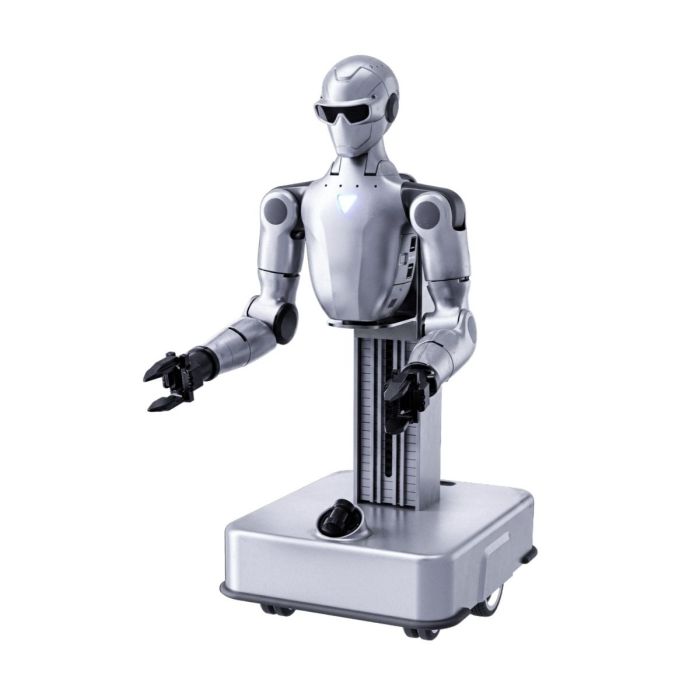
A robot that works at a bench is one thing; a robot that rolls up to the bench is another. The Unitree R1-A7-D Ultimate G Humanoid Robot is built around that difference: a pair of seven-joint arms and a sensor head, set on a wheeled base that can lift the torso from a folded crouch up to 1,600 mm (63 in). This is the configuration for teams that want manipulation research to leave the tabletop.
The Unitree R1-A7-D Ultimate G Humanoid Robot is available through this page, by quotation.
Background
Unitree's dual-arm manipulation platform
Unitree Robotics is best known for legged and humanoid machines that put advanced motion hardware within reach of laboratories and universities. The R1 family applies that thinking to two-armed manipulation. Its core is a torso with two arms, a rotating waist and a two-degree-of-freedom sensor head, offered in several versions that share the same upper body.
The family is split along two lines. The R1-A5 and R1-A7 names separate the arm designs, and the R1-A7 is the version with seven degrees of freedom per arm. The R1-A7 is the desk-mount version, while the R1-A7-D mounts the same torso on a wheeled mobile base. Within the R1-A7-D range, the Smart, Ultimate and No Hands variants, and the lettered packages, change the hands and the compute.
Where the Ultimate G sits
The Ultimate G is the R1-A7-D with LinkerBot O6 Tactile hands and 100 TOPS of compute. The Ultimate tier is the one with Orin NX compute for onboard VLA and policy inference, so this is the configuration for teams that want to run learned policies on the robot rather than on a remote workstation. Every configuration in the family is open for secondary development, which suits groups writing their own control and learning software.
The wheeled base turns the arms into a mobile manipulator. A powered lifting column changes the working height, and a chassis LiDAR gives the robot a way to sense its surroundings as it moves.
Technical Specifications
| Specification | Value |
|---|---|
| Configuration | R1-A7-D Ultimate G: LinkerBot O6 Tactile hands, 100 TOPS |
| Arms | Two arms, 7 DoF per arm |
| Total degrees of freedom (R1-A7-D, wheeled chassis) | 22 |
| Arm reach (forearm plus upper arm) | 555 mm (21.9 in) |
| Arm payload | 2 to 4 kg (4.4 to 8.8 lb) per arm, varying a long way with arm extension |
| Maximum shoulder torque | 60 Nm (44 lb-ft) |
| End-clamp repeatability | ±0.1 mm (±0.004 in) |
| Size, collapsed (R1-A7-D) | 683 x 520 x 440 mm (26.9 x 20.5 x 17.3 in) |
| Height, raised (R1-A7-D) | 1,600 mm (63 in) |
| Weight (R1-A7-D) | About 32 kg (71 lb) |
| Waist yaw (mobile base) | ±35° |
| Head yaw / pitch | ±115° / ±36° |
| Head camera | Binocular; RGB 1280 x 720 at 30 Hz, depth 544 x 448 at 10 Hz |
| Camera field of view | 146° horizontal by 124° vertical, eye spacing 60 mm (2.4 in) |
| Standard compute | 8-core CPU in the body; 8-core CPU with 10 TOPS in the head |
| Audio | 4-array microphone, dual 3 W speakers |
| Wireless | Wi-Fi 6, Bluetooth 5.2 |
| Battery runtime | About 1.5 hours |
| Mobile base sensing | Chassis LiDAR, powered lifting column |
| Joint design | Crossed-roller and deep-groove ball bearings, hollow internal wiring, dual encoders on the arm joints, local air cooling |
Specifications as published by the manufacturer; confirmed against the datasheet at quotation.
The manufacturer has not published the IP rating, the operating temperature range, the top speed or the charging time; they are confirmed at quotation.
What makes the R1-A7-D different from the desk-mount R1-A7?
The upper body is the same. The difference is where it stands. The desk-mount R1-A7 is fixed in place and has 19 total degrees of freedom, with a waist that turns ±150°. The R1-A7-D has 22, because the wheeled chassis adds motion, and its waist yaw on the mobile base is ±35°.
That narrower waist range is a real trade-off. In return the robot can drive to a workstation, raise or lower its torso with the lifting column and use the chassis LiDAR to sense the space around it. For a task that moves between shelves, benches or rooms, those gains matter more than the extra waist rotation. For a task that stays at one table, the desk-mount version may be the simpler choice.
The mobile version is also compact for what it does. Collapsed, it measures 683 x 520 x 440 mm (26.9 x 20.5 x 17.3 in), and at about 32 kg (71 lb) it is a machine one team can handle without heavy lifting gear.
What does the Ultimate G configuration add?
The standard build carries an 8-core CPU in the body and an 8-core CPU with 10 TOPS in the head. The Ultimate tier steps up to Orin NX compute for onboard VLA and policy inference, and the Ultimate G is listed at 100 TOPS. The practical effect is that vision-language-action models and learned manipulation policies can run on the robot itself.
The other half of the configuration is the hand. The Ultimate G carries LinkerBot O6 Tactile hands. Tactile sensing matters when a task depends on feeling contact, such as a slipping object, a soft item or an insertion, and not only on seeing it through the binocular head camera. The other Ultimate packages use the same base with their own hand options, so compare them before you order, starting with Ultimate A and Ultimate B. The full range is grouped in the R1-A7-D Ultimate category.
Who is the Unitree R1-A7-D Ultimate G for?
Research laboratories are the first audience. A group studying imitation learning, VLA models or tactile manipulation gets two arms with 60 Nm of maximum shoulder torque, ±0.1 mm end-clamp repeatability and a compute tier made for onboard inference. Open secondary development means the control stack is theirs to change.
Universities and technical schools are the second. The robot is small enough to bring into a teaching lab, and its voice hardware, a 4-array microphone and dual 3 W speakers, supports interaction projects.
Integrators and pilot-project teams form the third group. They can test whether a mobile two-armed platform suits a real workflow before committing to a larger deployment. Note the payload of 2 to 4 kg (4.4 to 8.8 lb) per arm, which moves a long way with arm extension, and the battery runtime of about 1.5 hours; both shape which tasks are realistic.
If your work does not need the tactile hands or the 100 TOPS tier, the R1-A7-D Smart C is a lighter option in the same family. The wider Unitree R1-A7-D category shows every version.
What is the Unitree R1-A7-D Ultimate G used for?
- Tactile manipulation research. The LinkerBot O6 Tactile hands let teams study grasping that responds to contact.
- Onboard policy inference. The 100 TOPS compute runs VLA and learned policies on the robot itself.
- Mobile manipulation studies. The wheeled base, lifting column and chassis LiDAR let the arms work at different locations and heights.
- Teleoperation and data collection. Two arms, a binocular head camera and a sensor head make it a natural source of demonstration data.
- Teaching robotics. Students can work with perception, arm control and mobile base motion on one machine.
- Voice and human-robot interaction. The microphone array, speakers, Wi-Fi 6 and Bluetooth 5.2 support interactive demonstrations.
Pricing and Availability
This page carries no prices. Quotation is the next step: tell us the configuration, the quantity and where the robot will work, and we prepare an offer. Delivery, customs and support are arranged with the quotation. The Unitree R1-A7-D Ultimate G Humanoid Robot is available on this page.
Frequently Asked Questions
How many degrees of freedom does the R1-A7-D have?
The R1-A7-D has 22 total degrees of freedom with its wheeled chassis. Each arm has 7 of them, and the desk-mount R1-A7 has 19 in total.
What can the arms lift?
The payload is 2 to 4 kg (4.4 to 8.8 lb) per arm, and the figure moves a long way with arm extension, so test your own task at its real reach.
How long does the battery last?
Runtime is about 1.5 hours on battery.
What does the head camera see?
The binocular camera gives RGB at 1280 x 720 at 30 Hz and depth at 544 x 448 at 10 Hz. Its field of view is 146° horizontal by 124° vertical.
Can I write my own software for it?
Yes. Every configuration is open for secondary development, and the Ultimate tier has onboard compute for VLA and policy inference.
Does the robot move on wheels?
Yes. The R1-A7-D mounts the torso on a wheeled mobile base with a powered lifting column and a chassis LiDAR.
Where can I buy the Unitree R1-A7-D Ultimate G Humanoid Robot and what does it cost?
You can buy it through this page by requesting a quotation. The cost depends on the configuration and the delivery terms, and it is given in the quotation, not on the page.
Summary
The Unitree R1-A7-D Ultimate G Humanoid Robot takes a two-armed manipulation platform off the bench and puts it on wheels. It reaches 555 mm (21.9 in) with each arm, rises to 1,600 mm (63 in), feels contact through LinkerBot O6 Tactile hands and carries 100 TOPS of compute for onboard policies. Its limits are plain too: a payload that depends on extension, about 1.5 hours of battery and a waist range narrower than on the desk-mount version. For teams that need mobile, learning-ready manipulation, this page is the starting point.


