
Unitree R1-A7-D Ultimate B Humanoid Robot
In stock
- BRAND:
- UNITREE ROBOTICS
- MODEL:
- R1-A7-D-Ultimate-B
- PART #:
- R1-A7-D-Ultimate-B
- ORIGIN:
- China
- Warranty:
- 12 MONTHS
- AVAILABILITY:
- SUBJECT TO AVAILABILITY
- SKU:
- Unitree-R1-A7-D-Ultimate-B
Unitree R1-A7-D Ultimate B Humanoid Robot
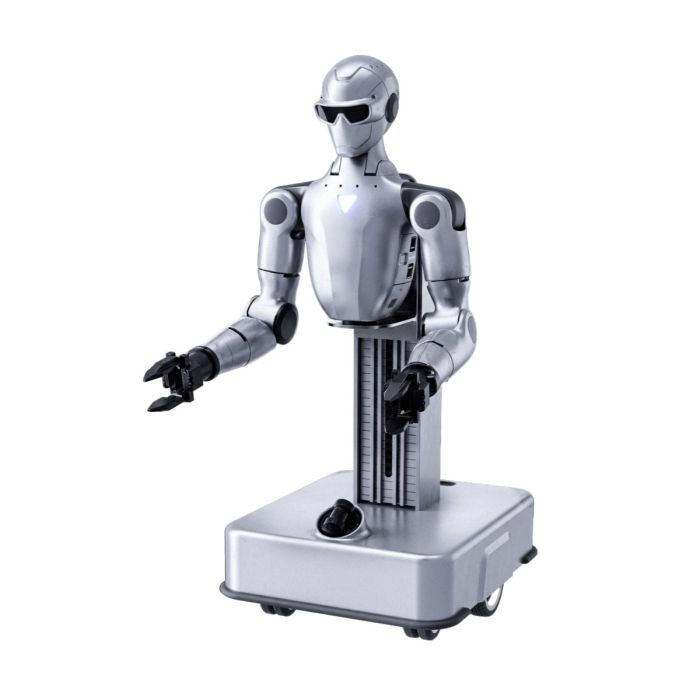
Most people picture a humanoid robot crossing a floor, but the work that pays off in a lab or workshop happens at arm's length from a bench, a shelf or a bin. The Unitree R1-A7-D Ultimate B Humanoid Robot is built for that reach. It rolls instead of walking, lifts its torso on a column, and carries force-controlled three-finger hands together with a 100 TOPS onboard computer for running learned policies.
The Unitree R1-A7-D Ultimate B Humanoid Robot is available through this page, by quotation.
Background
Unitree and the R1 lineage
Unitree Robotics is known for compact, actuator-focused machines that research groups and integrators can program themselves. The R1-A7 belongs to its dual-arm manipulation line. It is the 7-DoF-per-arm version of the platform, with two 7-DoF arms that have 555 mm (21.9 in) of reach, a rotating waist and a 2-DoF sensor head. The lineage also includes the R1-A5 and R1-A5-D, so buyers will see several related names while comparing options.
The R1-A7 comes in two mounting styles. The R1-A7 is the desk-mount version. The R1-A7-D mounts the torso on a wheeled mobile base with a powered lifting column and a chassis LiDAR, which is what makes mobile manipulation possible. The R1-A7-D then divides into Smart versions with 40 TOPS and Ultimate versions with 100 TOPS, labeled A through H.
Where the Ultimate B sits
The Ultimate B is an R1-A7-D configuration with Dex3-1 hands and 100 TOPS of compute. Its Ultimate-class computing is Orin NX hardware for onboard VLA and policy inference. The Dex3-1 is a three-finger, force-controlled hand, and the same hand is fitted to the B and C configurations. In short, the B takes the mobile base and the arms, adds a hand designed to feel what it grips, and adds enough compute to run models on the robot itself.
Joint design supports that purpose. The arms use crossed-roller and deep-groove ball bearings, hollow internal wiring, dual encoders on the arm joints and local air cooling. Open interfaces cover the underlying system, the arms, audio, lighting and vision, with full secondary development support. Teams that want to write their own control code are the intended audience.
Technical Specifications
| Specification | Value |
|---|---|
| Configuration | R1-A7-D Ultimate B – Dex3-1, 100 TOPS |
| Arms | Two 7-DoF arms, 555 mm (21.9 in) of reach |
| Degrees of freedom (R1-A7-D) | 20, which adds a 3-DoF wheeled chassis; 22 counting the grippers |
| Dimensions (R1-A7-D, collapsed) | 683 x 520 x 440 mm (26.9 x 20.5 x 17.3 in) |
| Height (R1-A7-D, raised) | 1,600 mm (63 in) |
| Weight (R1-A7-D) | About 32 kg (71 lb) |
| Arm payload | 2 to 4 kg (4.4 to 8.8 lb) per arm, varying a great deal with arm extension |
| Maximum shoulder torque | 60 Nm (44 lb-ft) |
| End-clamp repeatability | ±0.1 mm (±0.004 in) |
| Waist yaw (mobile base) | ±35° |
| Head range | Yaw ±115°, pitch ±36° |
| Head camera | Binocular; RGB 1280 x 720 at 30 Hz, depth 544 x 448 at 10 Hz |
| Binocular field of view | 146° horizontal by 124° vertical, eye spacing 60 mm (2.4 in) |
| Standard compute | 8-core CPU in the body; 8-core CPU with 10 TOPS in the head |
| Ultimate AI compute | Orin NX, 100 TOPS, for onboard VLA and policy inference |
| Hands | Dex3-1 three-finger force-controlled hands |
| Audio | 4-array microphone and dual 3 W speakers |
| Wireless | Wi-Fi 6 and Bluetooth 5.2 |
| Sensors | Chassis LiDAR; optional wrist cameras |
| Battery runtime | About 1.5 hours |
| Locomotion | Wheeled base; it does not walk |
Specifications as published by the manufacturer; confirmed against the datasheet at quotation.
The manufacturer has not published the IP rating, the operating temperature range, the top speed, the battery capacity, the charging time or the contents of the box; they are confirmed at quotation.
What makes the Ultimate B different from the other R1-A7-D versions?
The difference comes from two choices, the compute and the hands. Smart versions of the R1-A7-D carry 40 TOPS, while the Ultimate versions carry 100 TOPS from an Orin NX module. That extra headroom matters when a vision-language-action model or a learned policy has to run on the robot instead of on a tethered workstation. Every R1-A7-D also has the standard body CPU and the head CPU with 10 TOPS, so the Ultimate compute is added to a working base system and does not replace it.
The hands are the second choice. The Ultimate B uses Dex3-1 three-finger force-controlled hands. Force control means the hand can regulate how hard it holds, which suits objects that are soft, fragile or awkwardly shaped. The same hand is fitted to the Unitree R1-A7-D Ultimate C Humanoid Robot. If your project calls for a different hand option, the R1-A7-D Ultimate category shows the other lettered configurations, including the Unitree R1-A7-D Ultimate A Humanoid Robot.
Does the Ultimate B walk, and how does it move?
It does not walk. The R1-A7-D sits on a wheeled base with a 3-DoF chassis, which is why its degrees of freedom rise to 20, or 22 counting the grippers. A powered lifting column carries the torso from a collapsed 683 x 520 x 440 mm (26.9 x 20.5 x 17.3 in) up to 1,600 mm (63 in), so the arms can work at table height or higher. The chassis LiDAR supports navigation around a workspace.
That choice trades the spectacle of walking for stability and working height. Because the base stays planted while the arms move, the robot suits tasks that need repeatable positioning, and the end-clamp repeatability of ±0.1 mm (±0.004 in) points to precision work. On the mobile base the waist yaw is ±35°. The head turns ±115° in yaw and ±36° in pitch, which lets the binocular camera look across the workspace while the arms stay busy.
Payload needs a careful reading. Each arm handles 2 to 4 kg (4.4 to 8.8 lb), and the figure moves a long way with arm extension. Plan around the load at the distance you actually need, not the best case. Maximum shoulder torque is 60 Nm (44 lb-ft). Battery runtime is about 1.5 hours, so allow for it in the shift plan.
Who is the Unitree R1-A7-D Ultimate B for?
University and corporate research labs are the clearest fit. Teams working on imitation learning, VLA models or manipulation policies get onboard inference, open interfaces and secondary development support in one platform. Education programs can use it to show students how perception, planning and grasping fit together on a real machine.
System integrators and product teams form the second group. They can build and test a mobile manipulation prototype before committing to a custom design. The 4-array microphone and dual 3 W speakers make voice interaction possible, which helps for demonstrations and reception-style applications. Wi-Fi 6 and Bluetooth 5.2 cover connectivity, and optional wrist cameras can be added where a close view of the grasp matters.
Buyers who only need the arms on a fixed bench should look at the desk-mount R1-A7, which has a wider waist yaw. Buyers who want the mobile base but a different hand or compute level can compare the Unitree R1-A7-D range. If the Dex3-1 hand and 100 TOPS match your plan, the Ultimate B is the one to quote.
What is the Unitree R1-A7-D Ultimate B used for?
- Manipulation research: Two 7-DoF arms and a rotating waist give researchers a full dual-arm test bed for new control methods.
- Policy and VLA inference: The Orin NX compute runs learned policies on the robot without a separate machine.
- Dexterous grasping studies: Dex3-1 force-controlled hands support work on contact-rich handling.
- Mobile pick and place: The wheeled base, lifting column and chassis LiDAR let the robot move between stations and reach different heights.
- Teaching and demonstration: Students and visitors can see sensing, motion and voice interaction working together on a single platform.
- Custom application development: Open interfaces for the system, arms, audio, lighting and vision allow integrators to build their own software.
Pricing and Availability
We do not list a price for the Unitree R1-A7-D Ultimate B Humanoid Robot. Pricing depends on the configuration, options such as wrist cameras, and your destination, so quotation is the way to buy. Delivery, customs and support are arranged with the quotation, and the Unitree R1-A7-D Ultimate B Humanoid Robot is available on this page.
Frequently Asked Questions
Does the Ultimate B have a walking base?
No. It does not walk; it rolls on a wheeled mobile base with a powered lifting column and a chassis LiDAR.
What hands does the Ultimate B use?
It uses Dex3-1 three-finger force-controlled hands. The same hand is used on the B and C configurations.
How much compute does it carry?
The Ultimate class delivers 100 TOPS from Orin NX compute for onboard VLA and policy inference. The standard 8-core body CPU and the 8-core head CPU with 10 TOPS are also fitted.
How much can each arm carry?
Each arm carries 2 to 4 kg (4.4 to 8.8 lb). The figure varies a great deal with arm extension, so check it against the reach your task needs.
How long does the battery last?
Runtime is about 1.5 hours on battery.
Can I write my own software for it?
Yes. Open interfaces cover the underlying system, the arms, audio, lighting and vision, with full secondary development support.
Where can I buy the Unitree R1-A7-D Ultimate B Humanoid Robot and what does it cost?
You can buy it through this page by requesting a quotation. We do not publish a price; the cost is given in the quotation for your configuration and destination.
Summary
The Unitree R1-A7-D Ultimate B Humanoid Robot gives up walking to focus on work at arm's length. Two 7-DoF arms, a lifting column, a wheeled base, Dex3-1 hands and 100 TOPS of onboard compute let a team test manipulation ideas on real hardware, with open interfaces for its own software. The figures cover reach, payload, torque, repeatability, vision and runtime. If that profile matches your project, this page is the starting point.


