
Unitree R1-A7-D Ultimate A Humanoid Robot
In stock
- BRAND:
- UNITREE ROBOTICS
- MODEL:
- R1-A7-D-Ultimate-A
- PART #:
- R1-A7-D-Ultimate-A
- ORIGIN:
- China
- Warranty:
- 12 MONTHS
- AVAILABILITY:
- SUBJECT TO AVAILABILITY
- SKU:
- Unitree-R1-A7-D-Ultimate-A
Unitree R1-A7-D Ultimate A Humanoid Robot
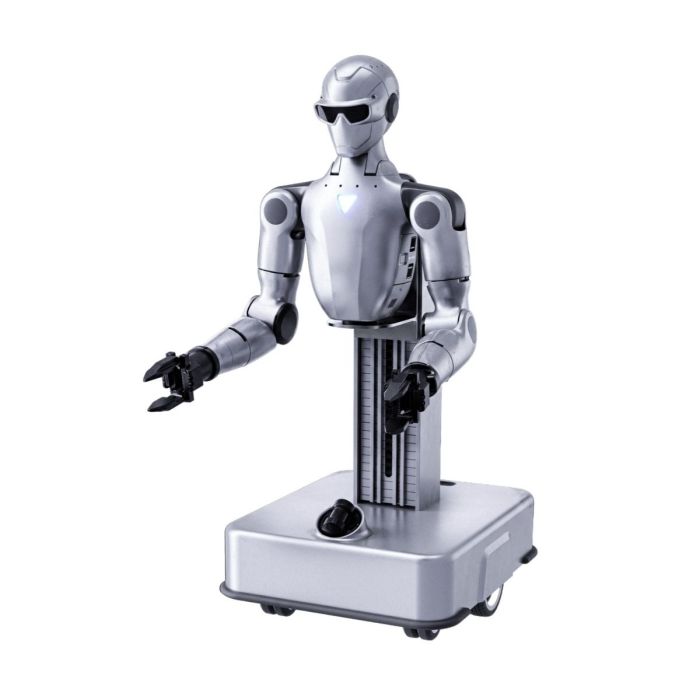
Some robots earn attention by walking. The Unitree R1-A7-D Ultimate A Humanoid Robot earns it by staying put on wheels and doing careful work with its hands. It is a torso with two seven-joint arms, a head with a binocular camera, and a powered lifting column that raises it from a compact folded stance to roughly the height of a standing person. The Ultimate A adds 100 TOPS of onboard compute, so a learned policy can run on the robot itself.
This product is available through this page, by quotation.
Background
Unitree and the R1 lineage
Unitree Robotics is known for compact, actuator-driven machines that research labs and universities can afford to experiment with. The R1 family follows that approach: build a capable body, open its interfaces, and let the buyer decide what it is for. Six versions are named: R1-A7 (desk-mount), R1-A7-D (mobile base), R1-A7-D Smart A-H, R1-A7-D Ultimate A-H, R1-A5 and R1-A5-D.
The desk-mount R1-A7 has 19 degrees of freedom in total. The R1-A7-D mounts the same kind of torso on a wheeled mobile base with a powered lifting column and a chassis LiDAR, which brings the total to 22. The Ultimate A sits on the R1-A7-D platform and is paired with the Dex1-1 V2 end effector and 100 TOPS of compute.
Positioning and key technology
Unitree is plain about what this machine is: a torso, not a humanoid. It does not walk. That choice puts the engineering effort into manipulation, perception and compute instead of balance. Each arm has 7 degrees of freedom on low-inertia inner-rotor joint motors, with crossed-roller and deep-groove ball bearings, hollow internal wiring, dual encoders on the arm joints and local air cooling.
On the Ultimate tier, Orin NX compute is provided for onboard VLA and policy inference. The platform also offers open interfaces for the underlying system, the arms, audio, lighting and vision, with full secondary development support. For a team that writes its own control and learning code, that openness matters as much as the hardware.
Technical Specifications
| Specification | Value |
|---|---|
| Version | R1-A7-D Ultimate A |
| Form factor | Torso on a wheeled mobile base with a powered lifting column and a chassis LiDAR |
| Dimensions, collapsed | 683 x 520 x 440 mm (26.9 x 20.5 x 17.3 in) |
| Height, extended | 1,600 mm (63 in) |
| Weight | About 32 kg (71 lb) |
| Total degrees of freedom | 22 |
| Arms | Two arms, 7 degrees of freedom per arm |
| Arm reach | Forearm plus upper arm 555 mm (21.9 in) |
| Arm payload | 2 to 4 kg (4.4 to 8.8 lb) per arm, varying a long way with arm extension |
| Maximum shoulder torque | 60 Nm (44 lb-ft) |
| End-clamp repeatability | ±0.1 mm (±0.004 in) |
| Waist yaw | ±35° on the mobile base |
| Head range | Yaw ±115°, pitch ±36° |
| Head camera | Binocular; RGB 1280 x 720 at 30 Hz, depth 544 x 448 at 10 Hz |
| Standard compute | 8-core CPU in the body; 8-core CPU with 10 TOPS in the head |
| Ultimate compute | 100 TOPS, Orin NX, for onboard VLA and policy inference |
| End effector | Dex1-1 V2 |
| Wireless | Wi-Fi 6 and Bluetooth 5.2 |
| Voice interaction | 4-array microphone and dual 3 W speakers |
| Optional sensing | Wrist cameras |
| Battery runtime | About 1.5 hours; also runs on external power |
| Locomotion | Wheeled base; the robot does not walk |
Specifications as published by the manufacturer; confirmed against the datasheet at quotation.
The manufacturer has not published the IP rating, the operating temperature range, the top speed, the charging time, the battery capacity or what is in the box; they are confirmed at quotation.
What makes the Ultimate A different from the desk-mount R1-A7?
The difference starts with the base. The desk-mount R1-A7 stays where it is bolted down and has 19 degrees of freedom. The R1-A7-D puts the torso on wheels with a powered lifting column and a chassis LiDAR, giving 22 degrees of freedom. A robot that can travel and change its working height can serve several benches, shelves and tables, and it can be tested on tasks that involve moving between them.
There is a trade-off. Waist yaw is ±35° on the mobile base, against ±150° on the desk-mount. A buyer who needs a wide sweep of the upper body from a fixed position should weigh that figure against the freedom to travel.
The Ultimate tier adds the compute. Beyond the standard 8-core CPUs, it carries 100 TOPS of Orin NX compute for onboard VLA and policy inference. Running a learned policy on the robot, rather than on a tethered workstation, changes how a project is built and how it is demonstrated.
How does the Ultimate A compare with other Ultimate versions?
The R1-A7-D Ultimate line runs from A to H, and the lettered versions differ in their packages. The Ultimate A pairs the Dex1-1 V2 end effector with 100 TOPS. We do not carry figures for the other letters on this page, so we do not compare them figure by figure. If you are weighing hand options, look at the Unitree R1-A7-D Ultimate B Humanoid Robot and the Unitree R1-A7-D Ultimate C Humanoid Robot, or browse the R1-A7-D Ultimate category.
Do not treat a lettered suffix as interchangeable with another. Ask for the exact hand, compute and accessory list when you request a quotation, and keep each figure with its own version.
Who is the Unitree R1-A7-D Ultimate A for?
Research groups working on manipulation and learned control are the clearest fit. With 100 TOPS onboard and open interfaces, they can test a policy on real hardware without a separate compute rig. University labs and teaching programs will value the two-arm layout and the secondary development support, which give students a full robot to program rather than a simulation.
Integrators and innovation teams evaluating mobile manipulation for a site will find the lifting column and chassis LiDAR useful for early proofs of concept. Be realistic about scale: payload is 2 to 4 kg per arm and falls with extension, so this is a platform for light tasks and evaluation.
If you only need a stationary bench robot, the desk-mount R1-A7 may be the better match. If you want to see the other versions on the mobile base, the Unitree R1-A7-D category lists them.
What is the Unitree R1-A7-D Ultimate A used for?
- Learned-policy research: run VLA and policy inference on the robot's own 100 TOPS of compute.
- Bimanual manipulation studies: two 7-degree-of-freedom arms with 555 mm of reach and ±0.1 mm end-clamp repeatability.
- Mobile manipulation trials: move between workstations on the wheeled base and adjust height with the lifting column.
- Perception development: use the binocular head camera, with RGB and depth streams, as the basis for vision work.
- Voice interaction demonstrations: use the 4-array microphone and dual 3 W speakers for spoken interfaces.
- Teaching and secondary development: build on open interfaces for the arms, audio, lighting and vision.
Pricing and Availability
We publish no prices on this page; quotation is the way to buy. Tell us the version, the end effector and the accessories you need, and we will prepare a quotation for you. Delivery, customs and support are arranged with the quotation. The Unitree R1-A7-D Ultimate A Humanoid Robot is available on this page.
Frequently Asked Questions
Does the robot walk?
No. Unitree describes it as a torso, not a humanoid. It moves on a wheeled base.
How much can each arm carry?
Each arm carries 2 to 4 kg (4.4 to 8.8 lb), and the figure varies a long way with arm extension. Tell us your task when you request a quotation.
How long does the battery last?
About 1.5 hours on battery. The robot also runs on external power, which is how most benchtop work is done.
What compute does the Ultimate A carry?
It has an 8-core CPU in the body and an 8-core CPU with 10 TOPS in the head as standard. The Ultimate tier adds 100 TOPS of Orin NX compute for onboard VLA and policy inference.
Can I write my own software for it?
Yes. The platform provides open interfaces for the underlying system, the arms, audio, lighting and vision, with full secondary development support.
What is the IP rating?
It is one of the items listed in the sentence under the specification table. Ask for it when you request a quotation.
Where can I buy the Unitree R1-A7-D Ultimate A Humanoid Robot and what does it cost?
You can buy it through this page by requesting a quotation. We show no price here; the cost depends on the configuration you choose, and it is given in the quotation.
Summary
The Unitree R1-A7-D Ultimate A Humanoid Robot is built on a simple trade: it gives up legs and puts the effort into hands, eyes and compute. Two seven-joint arms, a binocular head camera, a lifting column on a wheeled base and 100 TOPS of onboard compute make it a focused platform for manipulation research and teaching. It does not walk, and its payload is modest, but within that scope it offers open interfaces and real hardware. If that matches your project, this page is the starting point.


