
Unitree R1-A7-D Ultimate D Humanoid Robot
In stock
- BRAND:
- UNITREE ROBOTICS
- MODEL:
- R1-A7-D-Ultimate-D
- PART #:
- R1-A7-D-Ultimate-D
- ORIGIN:
- China
- Warranty:
- 12 MONTHS
- AVAILABILITY:
- SUBJECT TO AVAILABILITY
- SKU:
- Unitree-R1-A7-D-Ultimate-D
Unitree R1-A7-D Ultimate D Humanoid Robot
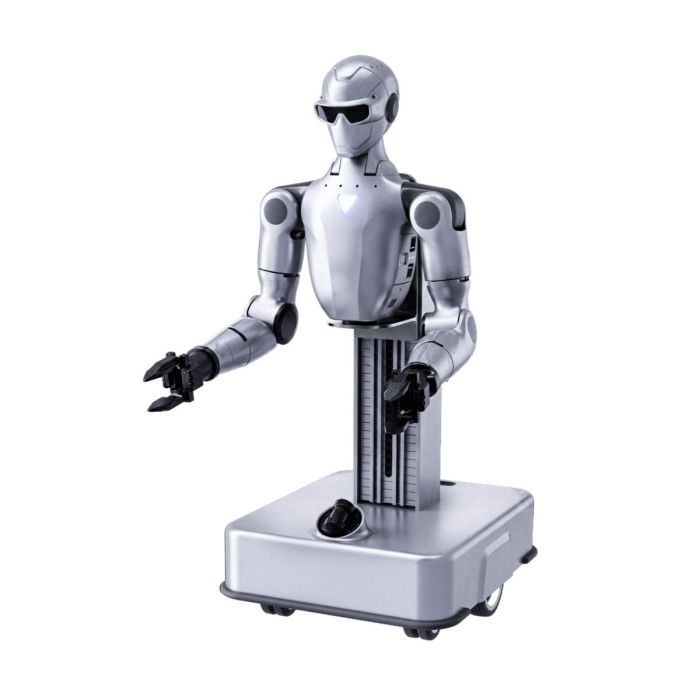
Most dual-arm robots are judged by their arms. The Unitree R1-A7-D Ultimate D Humanoid Robot asks you to look at two other things first: the hands at the end of those arms and the computer that decides what they do. This configuration pairs a BrainCo Revo 2 Basic hand with a 100 TOPS Orin NX, on a wheeled base that carries the whole machine to the work.
This product is available through this page, by quotation.
Background
Unitree and the R1 lineage
Unitree Robotics is known for compact, developer-friendly robots, and the R1 family extends that approach to manipulation. The sources name six versions: R1-A5, R1-A7, R1-A5-D, R1-A7-D, and the R1-A7-D Smart and Ultimate groups, each with lettered configurations from A to H. The R1-A7 is the 7-DoF-per-arm version of Unitree's dual-arm manipulation platform. It has two 7-DoF arms with 555 mm (21.9 in) of reach, a rotating waist and a 2-DoF sensor head.
The D in R1-A7-D marks the version with a wheeled chassis. That chassis adds a 3-DoF base, so the robot has 20 degrees of freedom, or 22 when the grippers are counted. The Smart configurations carry 40 TOPS of compute. The Ultimate configurations, available on the A7-D only, add a 100 TOPS Orin NX. The Ultimate D described here is one of the lettered Ultimate packages and is defined by its BrainCo Revo 2 Basic hand.
Positioning and key technology
The R1-A7-D Ultimate D is built for teams that want to develop on the robot rather than simply watch it. The sources list open interfaces for the underlying system, robotic arm, audio, lighting and visual control, so researchers and integrators can write their own behavior on top of the platform.
The mechanical design follows the same practical logic. The joints use crossed-roller and deep-groove ball bearings, the wiring runs hollow through the interior, the arm joints have dual encoders, and local air cooling keeps the actuators in their working range. For perception, the head carries a binocular camera with a 60 mm eye spacing and a field of view of 146° horizontal by 124° vertical. The mobile-base model adds a chassis LiDAR. For interaction there is a 4-array microphone and dual 3 W speakers, plus Wi-Fi 6 and Bluetooth 5.2.
Technical Specifications
| Specification | Value |
|---|---|
| Configuration | R1-A7-D Ultimate D, BrainCo Revo 2 Basic, 100 TOPS |
| Compute (Ultimate configurations) | 100 TOPS Orin NX |
| Size on mobile base, collapsed | 683 x 520 x 440 mm (26.9 x 20.5 x 17.3 in) |
| Raised size | 1600 x 520 x 440 mm; rises to 1,600 mm (63 in) |
| Weight on mobile base | About 32 kg (71 lb) |
| Degrees of freedom | 20, or 22 counting the grippers (includes 3-DoF wheeled chassis) |
| Arm reach (forearm and upper arm) | 555 mm (21.9 in) |
| Binocular field of view | Horizontal 146°, vertical 124° |
| Binocular eye spacing | 60 mm |
| Chassis sensing | LiDAR |
| Audio | 4-array microphone, dual 3 W speakers |
| Wireless | Wi-Fi 6, Bluetooth 5.2 |
| Battery | Removable chassis battery, about 1.5 h; external power supply also supported |
| End effector options | Two-finger gripper, three-finger dexterous hand, five-finger dexterous hand |
| Secondary development | Open interfaces for system, arm, audio, lighting and visual control |
Specifications as published by the manufacturer; confirmed against the datasheet at quotation.
The manufacturer has not published the IP rating, the operating temperature range, the top speed, the charging time or the chassis payload capacity; they are confirmed at quotation. The manufacturer also notes that the maximum load of the arm varies greatly with the arm's extension posture, so no single payload figure applies.
What makes the Ultimate D different from the Smart configurations?
The difference is compute. Smart configurations carry 40 TOPS, while the Ultimate group adds a 100 TOPS Orin NX, and that option exists only on the A7-D. For a team running perception models, learned manipulation policies or several vision pipelines at once, that extra headroom decides whether processing happens on the robot or has to be offloaded.
The letter in the name points to the hand. The Ultimate D is specified with the BrainCo Revo 2 Basic, so the end effector is part of the configuration rather than an afterthought. The sources also list a two-finger gripper, a three-finger dexterous hand and a five-finger dexterous hand as options for the platform. Ask which of them applies to your quotation and confirm it against your task.
How does the mobile base change what the robot can do?
A fixed dual-arm platform works wherever you bolt it down. The R1-A7-D adds a wheeled chassis with 3 degrees of freedom, a chassis LiDAR and a removable battery of about 1.5 h, so the same arms can serve more than one station. Collapsed, the robot measures 683 x 520 x 440 mm and weighs about 32 kg, which makes it easier to move between rooms or vehicles than a full-size humanoid. Raised, it stands at 1,600 mm, a working height that suits benches, shelves and counters.
Because it also runs on an external supply, it can stay at one station for long sessions without depending on the battery. The manufacturer's guidance is firm on one point: the dual-arm robot has a complex structure and strong output, so users must keep a safe distance between people and the robot and use it with great caution.
Who is the Unitree R1-A7-D Ultimate D for?
University and corporate research labs are the clearest fit. Open interfaces, dual encoders on the arm joints and 100 TOPS of onboard compute suit work on imitation learning, vision-guided grasping and human-robot interaction. Teams that want more than one workstation from a single robot will value the mobile base.
System integrators can use it as a development and demonstration platform before committing to a larger deployment. Education programs can use it to teach manipulation and perception on hardware that students can program through the open interfaces. Innovation centers and showrooms can use the voice interaction, lighting control and a full-height working stance.
If your work calls for a different hand or compute choice, compare the other lettered configurations, such as the Unitree R1-A7-D Ultimate A Humanoid Robot or the Unitree R1-A7-D Ultimate B Humanoid Robot, or browse the full R1-A7-D Ultimate category.
What is the Unitree R1-A7-D Ultimate D used for?
- Manipulation research. Two 7-DoF arms with 555 mm of reach and a rotating waist give researchers a bimanual testbed.
- Perception development. The binocular head camera and chassis LiDAR support vision and mapping work on the onboard 100 TOPS compute.
- Dexterous-hand studies. The BrainCo Revo 2 Basic hand lets teams test grasping strategies with a multi-finger end effector.
- Voice and interaction projects. The 4-array microphone and dual 3 W speakers support spoken interfaces and guided demonstrations.
- Integration prototyping. Open interfaces for the arm, audio, lighting and visual control let integrators connect the robot to their own software.
- Teaching and demonstration. The collapsible mobile base moves between classrooms, labs and exhibition spaces and works at full height when raised.
Pricing and Availability
No prices are listed on this page, because the configuration, end effector and accessories are confirmed individually. Request a quotation and we will respond with the details for your project. Delivery, customs and support are arranged together with the quotation. The Unitree R1-A7-D Ultimate D Humanoid Robot is available on this page.
Frequently Asked Questions
What compute does the Ultimate D carry?
It carries the 100 TOPS Orin NX that the Ultimate configurations add to the A7-D. The Smart configurations carry 40 TOPS.
Which hand comes with this configuration?
The Ultimate D is specified with the BrainCo Revo 2 Basic. The platform also lists two-finger, three-finger and five-finger end effector options.
How big is the robot?
On the mobile base it measures 683 x 520 x 440 mm collapsed and rises to 1,600 mm. It weighs about 32 kg.
How long does the battery last?
The removable chassis battery runs about 1.5 h, and the robot can also run on an external power supply.
Can I develop my own software for it?
Yes. The manufacturer provides open interfaces for the underlying system, robotic arm, audio, lighting and visual control.
What is the arm payload?
The maximum arm load varies greatly with the extension posture, and no single figure is published. The payload for your use case is confirmed at quotation. See the Unitree R1-A7-D category for related configurations.
Where can I buy the Unitree R1-A7-D Ultimate D Humanoid Robot and what does it cost?
You can buy it through this page by requesting a quotation. The cost depends on the configuration and delivery, and it is given in the quotation rather than listed here.
Summary
The Unitree R1-A7-D Ultimate D Humanoid Robot puts its weight on hands and compute rather than on the arms alone. A BrainCo Revo 2 Basic hand and a 100 TOPS Orin NX sit on a wheeled, collapsible base with open interfaces, a binocular head camera, a chassis LiDAR and voice interaction. For research, integration and teaching teams that want to develop manipulation on one mobile platform, this page is the starting point.


