
Unitree R1-A7-D Smart C Humanoid Robot
In stock
- BRAND:
- UNITREE ROBOTICS
- MODEL:
- R1-A7-D-Smart-C
- PART #:
- R1-A7-D-Smart-C
- ORIGIN:
- China
- Warranty:
- 12 MONTHS
- AVAILABILITY:
- SUBJECT TO AVAILABILITY
- SKU:
- Unitree-R1-A7-D-Smart-C
Unitree R1-A7-D Smart C Humanoid Robot
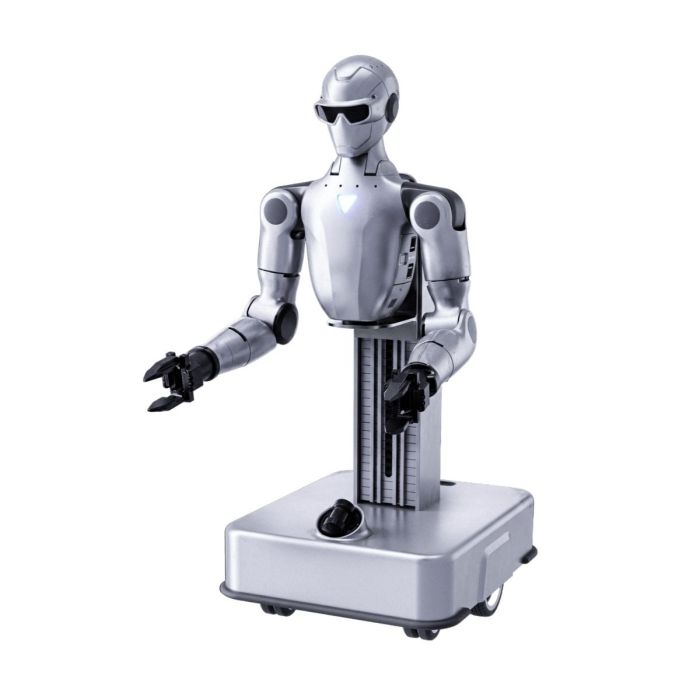
Most humanoid robots are judged by how they walk. The Unitree R1-A7-D Smart C Humanoid Robot is judged by how it reaches, how it grips and what it can feel. It is an upper-body humanoid on a wheeled base, built for work at a bench, a shelf or a workstation rather than for a stroll across a field.
The Unitree R1-A7-D Smart C Humanoid Robot is available through this page, by quotation.
Background
Unitree Robotics and the R1 lineage
Unitree Robotics is known for compact, capable legged and humanoid platforms aimed at research, education and applied development. The R1 family follows that approach. The sources name six versions: R1-A5, R1-A7, R1-A5-D, R1-A7-D, R1-A7-D Smart C and R1-A7-D Ultimate C.
The split is simple. You can choose the desk-mount R1-A7, or the R1-A7-D, which mounts the torso on a wheeled mobile base with a powered lifting column and a chassis LiDAR for mobile manipulation. The Smart C configuration described here belongs to the R1-A7-D branch and is supplied with Dex3-1 tactile hands.
Positioning and key technology
The R1-A7-D Smart C sits where manipulation research meets mobility. Its two 7-DoF arms, rotating waist and 2-DoF sensor head give it a humanoid upper body. The wheeled chassis and lifting column let it move between work areas and change its working height.
Smart configurations add a 40 TOPS Orin Nano to the onboard compute. The hands are Dex3-1 force-controlled three-finger hands, and on the C version the fingertips are tactile. Every configuration is open for secondary development, so teams can write their own control, perception and learning software.
Technical Specifications
| Specification | Value |
|---|---|
| Configuration | R1-A7-D Smart C – Dex3-1 Tactile Hands |
| Base | Torso on a wheeled mobile base with a powered lifting column and chassis LiDAR |
| Arms | Two 7-DoF arms with 555 mm (21.9 in) of reach |
| Dimensions | 683 x 520 x 440 mm (26.9 x 20.5 x 17.3 in) collapsed; rises to 1,600 mm (63 in) |
| Weight | About 32 kg (71 lb) |
| Degrees of freedom | 20 (adds a 3-DoF wheeled chassis), or 22 counting the grippers |
| Arm payload | 2 to 4 kg (4.4 to 8.8 lb) per arm |
| Shoulder torque | 60 Nm (44 lb-ft) maximum |
| End-clamp accuracy | ±0.1 mm (±0.004 in) |
| Waist and head range | Waist yaw ±35°, head yaw ±115° and pitch ±36° |
| Head camera | RGB at 1280 x 720 at 30 Hz; depth at 544 x 448 at 10 Hz |
| Chassis sensing | Chassis LiDAR in addition to the head camera |
| Compute | 8-core CPU (body) plus 8-core CPU with 10 TOPS (head); 40 TOPS Orin Nano in Smart configurations |
| Power | Removable chassis battery standard (about 1.5 h) plus external supply |
| Joint design | Crossed-roller and deep-groove ball bearings, hollow internal wiring, dual encoders on the arm joints, local air cooling |
| Hands | Dex3-1 three-finger force-controlled hands with tactile fingertips |
| Audio | 4-array microphone and dual 3 W speakers |
| Wireless | Wi-Fi 6 and Bluetooth 5.2 |
| Development | Open for secondary development |
Specifications as published by the manufacturer; confirmed against the datasheet at quotation.
The manufacturer has not published the top speed, the IP rating, the operating temperature range, the charging time, the battery capacity or the package contents; they are confirmed at quotation.
What makes the Smart C different from the other R1-A7-D configurations?
The first difference is touch. The Dex3-1 hands are force-controlled, and the C version adds tactile fingertips. A robot that only follows a trajectory has to be told whether a grasp succeeded. A robot with tactile fingertips can sense contact while it happens. That matters for delicate objects, for uncertain positions and for teams studying learning from demonstration.
The second difference is compute. Smart configurations add a 40 TOPS Orin Nano to the 8-core CPU in the body and the 8-core, 10 TOPS CPU in the head. That gives perception and learning workloads a place to run on the robot itself.
The third difference is the base. Compared with the desk-mount R1-A7, the R1-A7-D carries its torso on a wheeled chassis with a powered lifting column. It stands 683 mm long, 520 mm wide and 440 mm high when collapsed, and rises to 1,600 mm. It can move between stations, reach a low shelf and then lift to a higher working height. The chassis LiDAR sits alongside the head camera to support work in a mobile setting.
You can compare the other lettered configurations on their own pages, including the Unitree R1-A7-D Smart B Humanoid Robot, or browse the R1-A7-D Smart category.
How precise and how strong is the arm system?
Each arm has seven degrees of freedom and 555 mm (21.9 in) of reach, which gives the wrist room to approach an object from different angles. Maximum shoulder torque is 60 Nm (44 lb-ft). Payload is 2 to 4 kg (4.4 to 8.8 lb) per arm, and end-clamp accuracy is ±0.1 mm (±0.004 in).
The joints use crossed-roller and deep-groove ball bearings, with hollow internal wiring and dual encoders on the arm joints. Local air cooling keeps the joints within their working conditions. The waist yaws ±35°, and the head yaws ±115° and pitches ±36°, so the camera can follow the hands without moving the base.
Who is the Unitree R1-A7-D Smart C for?
University and corporate research labs will value the combination of tactile hands, onboard compute and open development. It suits work on manipulation, imitation learning and sensor fusion.
Robotics educators can use a platform with real arms, real sensors and an open software interface to teach kinematics, perception and control.
System integrators can evaluate it as a mobile manipulation module for pilot projects, such as handling parts, tending a workstation or demonstrating a concept to a customer.
Teams that do not need mobility may prefer the desk-mount R1-A7, which has no wheeled base. Teams that do not need tactile fingertips may compare the other Smart configurations in the Unitree R1-A7-D category.
What is the Unitree R1-A7-D Smart C used for?
- Dexterous manipulation research: tactile fingertips and force-controlled hands let researchers study grasping and in-hand contact.
- Mobile manipulation trials: the wheeled chassis, lifting column and LiDAR let the robot move to a task and adjust its working height.
- Imitation and learning experiments: the 40 TOPS Orin Nano and open development support onboard policies and data collection.
- Teaching and demonstration: an upper-body humanoid with cameras, microphones and speakers makes robotics concepts easy to show in a classroom.
- Human-robot interaction studies: the 4-array microphone, dual 3 W speakers and a head that turns and tilts support voice and gesture work.
- Integration prototyping: teams can test whether a humanoid mobile manipulator fits a process before committing to a design.
Pricing and Availability
We do not print prices on this page. Please request a quotation for the Unitree R1-A7-D Smart C Humanoid Robot, and tell us your application, your configuration needs and your delivery location. Delivery, customs and support are arranged together with the quotation. The Unitree R1-A7-D Smart C Humanoid Robot is available on this page.
Frequently Asked Questions
Does the Smart C have tactile hands?
Yes. It is supplied with Dex3-1 three-finger force-controlled hands, and the C version has tactile fingertips.
How tall is the robot?
It measures 683 x 520 x 440 mm (26.9 x 20.5 x 17.3 in) collapsed and rises to 1,600 mm (63 in) with the powered lifting column.
How much can each arm carry?
The payload is 2 to 4 kg (4.4 to 8.8 lb) per arm. The maximum shoulder torque is 60 Nm (44 lb-ft).
Can I write my own software for it?
Yes. Every configuration is open for secondary development, and the Smart configurations add a 40 TOPS Orin Nano for onboard workloads.
How long does the battery last?
The removable chassis battery is rated at about 1.5 h, and an external supply is also available. The battery capacity and the charging time have not been published.
What sensors does it carry?
The head camera gives RGB at 1280 x 720 at 30 Hz and depth at 544 x 448 at 10 Hz. A chassis LiDAR is added, along with a 4-array microphone.
Where can I buy the Unitree R1-A7-D Smart C Humanoid Robot and what does it cost?
It is available through this page, by quotation. Send us your requirements and we will prepare a quotation that includes delivery, customs and support arrangements.
Summary
The Unitree R1-A7-D Smart C Humanoid Robot is built around reaching and touching rather than walking. Two 7-DoF arms, Dex3-1 tactile hands, a lifting column, a wheeled base, a 40 TOPS Orin Nano and open development give research and integration teams a capable mobile manipulation platform. For a quotation, or to confirm details against the datasheet, this page is the starting point.


