
Unitree G1-D Standard A U1 Fixed base Dual-Arm Humanoid Robot
In stock
- BRAND:
- UNITREE ROBOTICS
- MODEL:
- U1
- PART #:
- G1-D-U1
- ORIGIN:
- China
- Warranty:
- 12 MONTHS
- AVAILABILITY:
- SUBJECT TO AVAILABILITY
- SKU:
- Unitree-G1-D
Unitree G1-D Standard A U1 Fixed base Dual-Arm Humanoid Robot
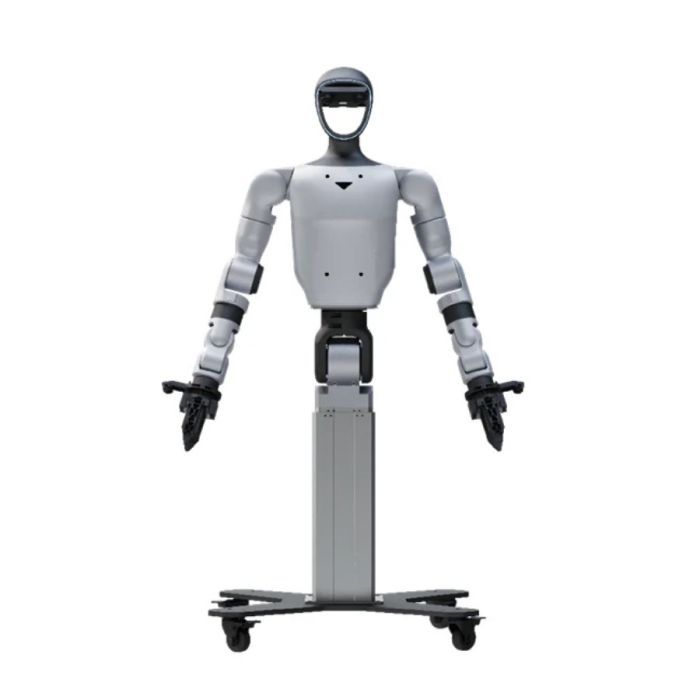
Most humanoid robots spend their effort on staying upright. The Unitree G1-D Standard A U1 Fixed base Dual-Arm Humanoid Robot makes a different bargain: it gives up walking and puts everything into reach, working height and two capable arms. A column carries the torso up and down, so the robot meets the workpiece instead of chasing it across a floor.
The product is available through this page, by quotation.
Background
Unitree Robotics and the G1-D line
Unitree Robotics is a robotics company known for legged and humanoid platforms that research labs, universities and integrators use as development tools. The G1-D family carries that experience into manipulation. The range is organized by base type and by package. The Standard versions use a fixed base, while the Ultimate versions use a wheel base. Within the Standard group, the lettered U-numbers mark different packages, and this page covers Standard A, known as U1.
If you are still deciding which package to compare, the Unitree G1-D category shows the whole family in one place.
Where the Standard A U1 sits
The G1-D Standard A U1 is a humanoid upper body on a height-adjustable column. It has two seven-degree-of-freedom arms, a waist that moves on two axes, a head camera pair and a camera on each wrist. Its builders chose a stationary base, so the workspace is defined by the arms, the waist and the column rather than by navigation. That makes it a natural fit for bench-style tasks such as teleoperated data collection, manipulation research and training, where the same setup has to be repeated again and again.
The platform is open to secondary development and ships with a visualization computer. It also has an optional high computing power module, so teams can bring their own algorithms and run them on board.
Technical Specifications
| Specification | Value (G1-D Standard) |
|---|---|
| Total degrees of freedom (excl. end effector) | 17 |
| Single arm degrees of freedom (excl. end effector) | 7 |
| Maximum single arm payload | Approx. 3kg |
| Overall dimensions, minimum column height | 1260x620x620mm |
| Overall dimensions, maximum column height | 1680x620x620mm |
| Vertical workspace | 0-2m |
| Column lifting speed | Approx. 60mm/s |
| Total weight (incl. battery) | Approx. 90kg |
| Waist joint range of motion | Z-axis: ±155°, Y-axis: -2.5° to +135° |
| Basic computing power | 8-core High-performance CPU |
| High computing power module | Multiple brands and models available, such as Orin NX 16GB (100TOPS) |
| Perception sensors | Head HD Binocular Camera *1 + Wrist HD Camera *2 |
| Wi-Fi 6, Bluetooth 5.2 | Yes |
| Battery | Upper Body Battery (Quick-release): 9Ah |
| Battery life | Approx. 2 hours |
| End effector options | Optional 2-Finger Gripper / 3-Finger Dexterous Hand (No Tactile) / 3-Finger Dexterous Hand (With Tactile) / 5-Finger Dexterous Hand |
| Secondary development | Yes |
| Visualization computer | Yes |
Specifications as published by the manufacturer; confirmed against the datasheet at quotation.
The manufacturer has not published the IP rating, the operating temperature, the power consumption, the camera model details or the operating system; they are confirmed at quotation.
What makes the G1-D Standard A U1 different from a walking humanoid?
A walking humanoid has to solve balance, footing and energy use before it can do any useful work with its hands. The G1-D Standard A U1 sets those problems aside. Its base is fixed, so the arms work from a stable platform, and the working height is changed by the column rather than by bending or crouching. The column covers a vertical workspace of 0-2m and moves at approximately 60mm/s, which lets an operator bring the torso level with a shelf, a table or a fixture.
The body is also easier to reason about. With 17 degrees of freedom excluding the end effector, 7 of them in each arm, the robot concentrates its motion where manipulation happens. The waist adds a Z-axis range of ±155° and a Y-axis range of -2.5° to +135°, so the upper body can turn and lean toward the task. A platform that stays in one place also makes camera placement and repeatability simpler, which matters when you record demonstrations or compare runs.
The trade-off is plain. This version does not travel. If your work needs the robot to move between stations, look at the wheel-base versions such as the Unitree G1-D Ultimate A U6 Wheel Base Dual-Arm Humanoid Robot instead.
What can you fit to the arms of the Standard A U1?
The end effector is a choice rather than a fixed part. The manufacturer lists a 2-finger gripper, two 3-finger dexterous hands (one without tactile sensing and one with it) and a 5-finger dexterous hand. That range lets you start with simple pick-and-place work and move toward finer, hand-like manipulation when your research asks for it. Each arm is rated for a maximum payload of approximately 3kg, which is a useful figure to keep in mind when you choose a hand and plan the objects it will lift.
Sensing is built in. A binocular HD camera in the head gives the operator or the algorithm a view of the workspace, and an HD camera on each wrist shows the grasp up close. Wi-Fi 6 and Bluetooth 5.2 are included, and secondary development is supported, so teams can connect their own software. For heavier on-board processing, the optional high computing power module is offered in multiple brands and models, such as Orin NX 16GB (100TOPS).
Who is the Unitree G1-D Standard A U1 for?
University labs and research groups are the clearest match. They can use the fixed base for repeatable manipulation studies, teleoperation and imitation learning, and they can build on the open development support. Teaching programs can use the same setup to show students how a humanoid upper body, a column and a set of cameras work together.
System integrators and corporate R&D teams will find it useful as a proving ground for bench-level tasks before they commit to a production design. If your project needs a different package within the Standard group, compare the Unitree G1-D Standard B U2 Fixed base Dual-Arm Humanoid Robot and the Unitree G1-D Standard C U3 Fixed base Dual-Arm Humanoid Robot. Teams that need mobility should ask about the wheel-base Ultimate versions. Buyers in the Caribbean who plan a first humanoid purchase are welcome to ask us to walk through the options at the quotation stage.
What is the Unitree G1-D Standard A U1 used for?
- Manipulation research: two seven-degree-of-freedom arms give a stable base for grasping and handling studies.
- Teleoperation and data collection: head and wrist cameras capture the view needed to record demonstrations.
- Teaching and training: students can work with a humanoid upper body, a lifting column and a development interface.
- Dexterous hand evaluation: the gripper and hand options let teams compare end effectors on the same platform.
- Workstation prototyping: the column's vertical workspace helps test tasks at table and shelf heights.
- Algorithm development: secondary development support and an optional high computing power module host custom perception and control software.
Pricing and Availability
We do not publish prices on this page. A quotation is the way to start: tell us which end effector, computing module and package you need, and we will prepare it for you. Delivery, customs and support are arranged together with the quotation, so you know the full picture before you decide. Everything you need to begin is available on this page.
Frequently Asked Questions
Can the G1-D Standard A U1 walk?
No. This version has a fixed base and works from a column that adjusts its height. Wheel-base versions exist in the same family for projects that need movement.
How many degrees of freedom does it have?
The G1-D Standard has 17 degrees of freedom excluding the end effector, and each arm contributes 7 of them.
How much can each arm carry?
The maximum single arm payload is approximately 3kg.
Which hands can be fitted?
The options are a 2-finger gripper, a 3-finger dexterous hand without tactile sensing, a 3-finger dexterous hand with tactile sensing and a 5-finger dexterous hand.
What is the battery life?
The manufacturer lists approximately 2 hours for the Standard version, using a quick-release upper body battery of 9Ah.
Can I develop my own software for it?
Yes. Secondary development is supported, and a visualization computer is included. An optional high computing power module is also available.
Where can I buy the Unitree G1-D Standard A U1 and what does it cost?
You can request it through this page, and we answer with a quotation. The cost depends on the package and options you choose, so we do not print a price here.
Summary
The Unitree G1-D Standard A U1 trades travel for reach. A fixed base, a column with a vertical workspace of 0-2m, two seven-degree-of-freedom arms, a two-axis waist and a choice of hands add up to a steady manipulation platform for research, teaching and prototyping. The details that remain unpublished are confirmed at quotation, and from there the choice of package is yours. To bring a humanoid to your bench, this page is the starting point.
Specifications
General
Physical
Mobility
Performance
Connectivity
Battery + Power
Shipping
Feature
| Height, width and thickness (standing): 1270x450x200mm |
| Height, width and thickness (folded): 690x450x300mm |
| Total freedom (joint motor): 23 |
| Freedom of one leg: 6 |
| Waist Freedom: 1 |
| Freedom of one arm: 5 |
| Single-handed freedom: Dexterous hand and double-freedom wrist optional |
| Maximum knee torque: 90N.m |
| Maximum arm load: 2kg |
| Calf + thigh length: 0.6m |
| Arm span: approx. 0.45m |
| Extra large joint movement space Lumbar Z-axis joint: ±155° |
| Knee joint: 0~165° |
| Hip joint: P±154°, R-30~+170°, Y±158°” |
| Full joint hollow internal alignment: Yes |
| Joint encoder: dual encoder |
| Heat dissipation system: localized air-cooled heat dissipation |
| Power supply: 13 series battery |
| Base Computing Power: 8-core high performance CPU |
| Sensor: Depth camera + 3D LIDAR |
| WiFi 6, Bluetooth 5.2: Yes |
| Stereo speakers and microphone array as standard |
| Smart battery (quick release) 1pc |
| Charger 1pc |
| Handheld remote control 1 set |
| Endurance: about 2h |
| Intelligent OTA upgrade: support |
| Secondary development: no |
| Warranty: 8 months |
What's included
Related Products
Out of stock


