
Unitree G1-D Standard B U2 Fixed base Dual-Arm Humanoid Robot
In stock
- BRAND:
- UNITREE ROBOTICS
- MODEL:
- U2
- PART #:
- G1-D-U2
- ORIGIN:
- China
- Warranty:
- 12 MONTHS
- AVAILABILITY:
- SUBJECT TO AVAILABILITY
- SKU:
- Unitree-G1-D-1
Unitree G1-D Standard B U2 Fixed base Dual-Arm Humanoid Robot
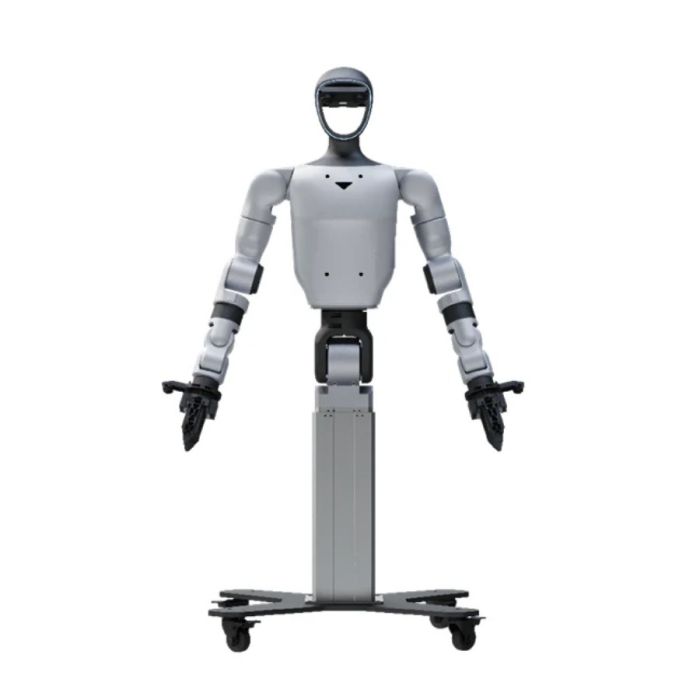
Most humanoid demonstrations ask the robot to walk, and then quietly hope the work gets done at the end of the walk. The Unitree G1-D Standard B U2 Fixed base Dual-Arm Humanoid Robot turns that around: it stays put and puts its effort into the arms and hands, where the real work happens. For a team that cares about reaching, gripping and handling, that is a plain and welcome trade.
The Unitree G1-D Standard B U2 is available through this page, by quotation.
Background
Unitree Robotics and the G1-D line
Unitree Robotics is a robotics maker best known for legged robots and humanoids, and its machines are common in university labs, training programs and development teams around the world. The G1-D family carries that experience into a form built around manipulation. The line includes the Standard A U1, the Standard B U2 and the Standard D U4, and each keeps its own figures. Nothing on this page borrows a number from a sibling.
The Standard B U2 is one step in that lineup. If you want to see how the other configurations are set up, the Unitree G1-D category lists them side by side, and the Standard A U1 and Standard D U4 pages are a good place to compare.
Positioning: a fixed base with two working arms
As its name says, the Standard B U2 has a fixed base and two arms. That is a different idea from a robot that walks or rolls through a building. A fixed platform gives you a known position, a repeatable workspace and one less thing to tune before an experiment begins. The arms then do the talking. Each of the two articulated arms has seven degrees of freedom, and the hands at their ends are part of the configuration.
This positioning suits benches, cells and teaching stations, where the task comes to the robot instead of the robot going to the task. It also keeps the conversation with a buyer honest: the questions that matter are about reach, payload and hands.
Technical Specifications
| Specification | Value |
|---|---|
| Base | Fixed base |
| Arm structure | Two articulated arms with seven degrees of freedom per arm |
| Payload per arm | 3 kg |
| Arm reach | 450 mm |
| Hand dimensions | 175 × 88 × 77 mm |
| Hand weight | Approximately 650 g |
| Hand operating voltage | 12–58V, with low standby current |
Specifications as published by the manufacturer; confirmed against the datasheet at quotation.
The manufacturer has not published the IP rating, the operating temperature, the power consumption, the charger specification, the operating system or the wrist camera resolution; they are confirmed at quotation.
What does seven degrees of freedom per arm mean for the work?
Seven degrees of freedom matters to anyone who has fought an awkward pose. An arm with that many joints can approach an object from more than one direction and still arrive with the hand where it is wanted. That helps when a part sits behind another part, when a shelf edge is in the way, or when a motion has to be rehearsed several ways before it is trusted.
With two such arms, the Standard B U2 can be used for tasks that need both hands: holding one object while the other works on it, passing an item from one hand to the other, or moving a larger object with a balanced grip. Those are the situations in which single-arm setups start to feel limited.
The payload is 3 kg per arm, and the reach is 450 mm. Together they describe a working envelope: a tabletop-scale zone in which each arm can lift and place moderate loads. They do not describe a heavy-duty machine, and a buyer should plan the task around those two numbers instead of around a general impression of what a humanoid can do.
What should a buyer know about the hands?
The hands are where this version earns its keep. Each hand measures 175 × 88 × 77 mm and weighs approximately 650 g. That weight sits at the end of the arm, so it matters when you think about the payload the arm can carry and how smoothly it moves.
The hands operate at 12–58V, with low standby current. The practical meaning is easy to see: a hand that draws little while idle is easier to live with during long sessions of teaching, waiting and repeating. Power planning for the whole robot is a separate matter, and we go through it with you when we prepare the quotation.
Who is the Unitree G1-D Standard B U2 for?
Research labs are the first group. A fixed-base platform with two seven-degree-of-freedom arms is a natural fit for studies of manipulation, motion planning and two-handed coordination, where a stable base removes one variable from the experiment.
Universities and technical schools are the second. A robot that stays in one place is easier to place in a classroom or workshop, easier to supervise and easier to share between student groups, while still showing the real challenges of humanoid arms and hands.
Integrators and development teams are the third. They can use it to prove an idea at bench scale before committing to a larger system, checking whether a 3 kg payload per arm and a 450 mm reach cover the part or the process they have in mind.
Buyers who want a different configuration can look at the Standard A U1 or the Standard D U4 and ask for a side-by-side comparison with the quotation. We would rather you compare the real figures than guess.
What is the Unitree G1-D Standard B U2 used for?
- Manipulation research. Study grasping, placing and two-handed coordination on a stable, fixed platform.
- Teaching robotics. Give students a real dual-arm humanoid to program, observe and discuss in a lab or classroom.
- Motion planning trials. Use seven degrees of freedom per arm to test reach strategies and approach angles within a 450 mm reach.
- Bench-scale prototyping. Check a handling idea with loads up to 3 kg per arm before building a larger cell.
- Hand and gripper evaluation. Work with hands of a known size and weight to see how they suit your parts and your tasks.
- Demonstrations. Show visitors, partners and sponsors what a humanoid with two working arms can do at a table.
Pricing and Availability
We do not list prices on this page. Quotation is how a purchase begins: tell us the version, the quantity and the place of delivery, and we will answer with a quotation. Delivery, customs and support are arranged with the quotation, so the details are settled in one conversation. The Unitree G1-D Standard B U2 is available on this page.
Frequently Asked Questions
Does the Unitree G1-D Standard B U2 walk?
No. This version has a fixed base and is built around its two arms and hands. It is meant for work at a station, not for moving through a building.
How many degrees of freedom does each arm have?
Each of the two articulated arms has seven degrees of freedom.
What payload can the arms carry?
The payload is 3 kg per arm. The reach of each arm is 450 mm.
What are the hand dimensions and weight?
Each hand measures 175 × 88 × 77 mm and weighs approximately 650 g. The hands operate at 12–58V, with low standby current.
What about the IP rating or operating temperature?
We have no figures for either to give you today, and the same goes for the power consumption and the operating system. Ask us and we will bring them with the quotation.
Are other versions of the G1-D available?
Yes. The G1-D category lists the other configurations, and each one has its own figures. Ask us to compare any of them with the Standard B U2.
Where can I buy the Unitree G1-D Standard B U2 and what does it cost?
You can buy it through this page by requesting a quotation. We do not print prices here; the cost is given in the quotation, together with delivery, customs and support arrangements.
Summary
The Unitree G1-D Standard B U2 begins from a simple idea: if the work happens at the hands, put the robot's strength there and keep the rest still. Two articulated arms with seven degrees of freedom each, a 3 kg payload per arm, a 450 mm reach and hands of 175 × 88 × 77 mm give a clear picture of what it can do at a bench. For research, teaching and bench-scale development in the Caribbean and beyond, this page is the starting point.
Specifications
General
Physical
Mobility
Performance
Connectivity
Battery + Power
Shipping
Feature
| Height, width and thickness (standing): 1270x450x200mm |
| Height, width and thickness (folded): 690x450x300mm |
| Total freedom (joint motor): 23 |
| Freedom of one leg: 6 |
| Waist Freedom: 1 |
| Freedom of one arm: 5 |
| Single-handed freedom: Dexterous hand and double-freedom wrist optional |
| Maximum knee torque: 90N.m |
| Maximum arm load: 2kg |
| Calf + thigh length: 0.6m |
| Arm span: approx. 0.45m |
| Extra large joint movement space Lumbar Z-axis joint: ±155° |
| Knee joint: 0~165° |
| Hip joint: P±154°, R-30~+170°, Y±158°” |
| Full joint hollow internal alignment: Yes |
| Joint encoder: dual encoder |
| Heat dissipation system: localized air-cooled heat dissipation |
| Power supply: 13 series battery |
| Base Computing Power: 8-core high performance CPU |
| Sensor: Depth camera + 3D LIDAR |
| WiFi 6, Bluetooth 5.2: Yes |
| Stereo speakers and microphone array as standard |
| Smart battery (quick release) 1pc |
| Charger 1pc |
| Handheld remote control 1 set |
| Endurance: about 2h |
| Intelligent OTA upgrade: support |
| Secondary development: no |
| Warranty: 8 months |
What's included
Related Products
Out of stock


