
Paxini TORA ONE Multi-Dimensional Tactile Wheeled Humanoid Robot
In stock
- BRAND:
- PAXINI
- PART #:
- TORA-ONE
- ORIGIN:
- China
- AVAILABILITY:
- SUBJECT TO AVAILABILITY
- SKU:
- Paxini-TORA-ONE
Paxini TORA ONE Multi-Dimensional Tactile Wheeled Humanoid Robot
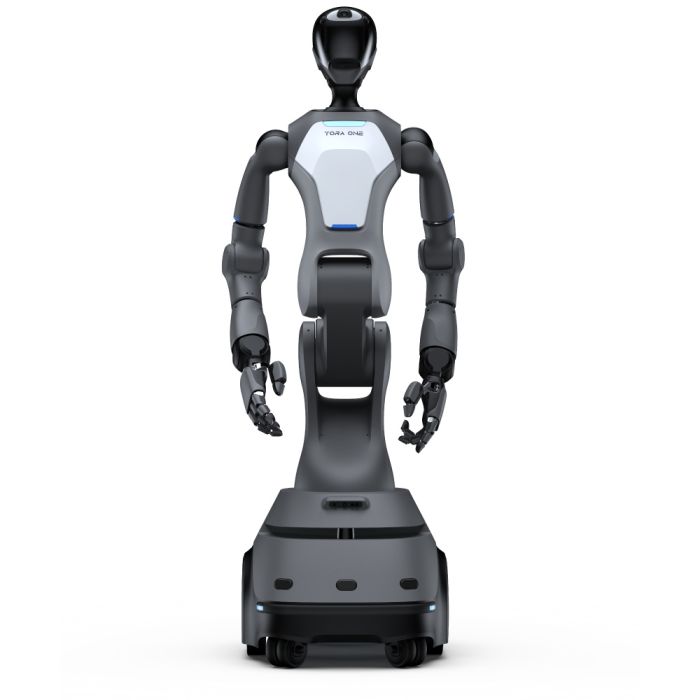
Most robots that handle objects are good at looking and poor at feeling. The Paxini TORA ONE Multi-Dimensional Tactile Wheeled Humanoid Robot takes the harder route: it puts touch at the center of the design, so that a grip is judged by what the fingertips sense and not only by what the cameras predict.
The product is available through this page, by quotation.
Background
Paxini and the move toward tactile robotics
Paxini is a brand working in embodied AI, the field that gives machine intelligence a physical body and lets it learn from contact with the real world. For many years, robot manipulation leaned on vision alone. Cameras told the controller where an object was, and the gripper closed with a force that was set in advance. That works for rigid, predictable parts. It works far less well for soft, slippery or irregular items, where the right grip can only be found by feeling the object.
Paxini builds its products around that gap. The TORA ONE is described by its source as the first multidimensional tactile humanoid robot in the embodied AI industry. The same thinking shows in the company's separate dexterous hands, which are sold on their own pages, such as the Paxini DexH13 Dexterous Robot Hand, the Paxini Dexh5 and the Paxini GMH18 Robot Hand.
Positioning and key technology of the TORA ONE
The TORA ONE is a wheeled humanoid. Instead of walking on legs, it moves on a chassis and uses a deformable body: the waist can be folded or extended, which changes the working height of the robot. Above the waist sit two arms ending in dexterous hands, and a head carrying cameras. Wheels keep the base steady and the navigation simple, while the upper body does the work that people expect from a humanoid.
Its dexterous hand is presented as the industry's first integrated multidimensional tactile and AI vision dual-modal hand. Each hand has four fingers and carries tactile sensing units together with a camera. Behind the hardware sits the VTLA model, which stands for Visual-Tactile-Language-Action. The name describes the loop: the robot sees, feels, understands an instruction in language and then acts.
Organizations that are comparing platforms can browse the wider Wheeled Humanoids category.
Technical Specifications
| Specification | Value |
|---|---|
| Product type | Multidimensional tactile humanoid robot, wheeled |
| Height | Deformable structure: waist folded 1.46 m, extended 1.86 m |
| Body degrees of freedom (excluding dexterous hands) | 21 |
| Bimanual degrees of freedom | 32 |
| Fingers on each hand | 4 |
| Dexterous hand degrees of freedom (single hand) | 16 DOF (13 active + 3 passive) |
| Dexterous hand drive mode | Coreless motor |
| Tactile perception | 2280 ITPU multi-dimensional tactile sensing units |
| Number of tactile signals | 6840 channels |
| Fingertip force control | 0.01N high-precision force control |
| Visual capacity | 5 RGB cameras (3 in head + 1 in each hand) + 2 RGBD cameras (1 in head + 1 in chassis) |
| Single arm straight-arm load capacity (including dexterous hand) | Rated 5 kg |
| Maximum moving speed | 0.6 m/s |
| Maximum turning speed | 0.4 rad/s |
| Repeatability accuracy | 1.5 cm |
| Absolute accuracy | 3 cm |
| Heading angle error | 3 degrees |
| Obstacle crossing height | 2 cm |
| Ditch width | 2 cm |
| Climbing angle | 7 degrees |
| Navigation method | Laser SLAM autonomous navigation |
| Charging time | 6 h |
| Endurance | 8 h |
| AI model | VTLA-Model: Visual-Tactile-Language-Action |
Specifications as published by the manufacturer; confirmed against the datasheet at quotation.
The manufacturer has not published the weight, the footprint dimensions, the power consumption, the onboard compute, the IP rating, the connectivity, the operating temperature or the contents of the box; they are confirmed at quotation.
What makes the TORA ONE different from a vision-only humanoid?
The difference starts in the fingertips. The TORA ONE carries 2280 ITPU multi-dimensional tactile sensing units, which produce 6840 channels of tactile signals. A camera can tell a controller that a cup is in the hand. A tactile layer can tell it whether the cup is slipping, whether the grip is too hard and where on the finger the contact sits. Fingertip force control is stated at 0.01N, which is the kind of resolution that matters when the object is fragile or the task needs a gentle touch.
The second difference is that vision and touch are treated as partners. Seven cameras are fitted in total: five RGB cameras, with three in the head and one in each hand, and two RGBD cameras, one in the head and one in the chassis. The cameras in the hands look at the object from the point of view of the grip itself, while the tactile units confirm what the cameras suggest. The VTLA model ties both signals to language instructions and to actions.
The third difference is the body. Twenty-one degrees of freedom in the body, excluding the hands, and 32 bimanual degrees of freedom give the robot room to reach and to use both arms together. The deformable waist lets the same robot work at 1.46 m with the waist folded or at 1.86 m when extended, so a low bench and a high shelf are both within reach.
How does the TORA ONE move and find its way?
The robot navigates with laser SLAM, using a LIDAR system alongside its cameras for 360-degree depth detection of the surroundings. This lets it build a map of a space and place itself within it without fixed guide lines on the floor.
The chassis figures are modest and honest for an indoor machine: a maximum moving speed of 0.6 m/s, a maximum turning speed of 0.4 rad/s, repeatability accuracy of 1.5 cm and absolute accuracy of 3 cm, with a heading angle error of 3 degrees. It can cross an obstacle 2 cm high, span a ditch 2 cm wide and climb a slope of 7 degrees. In practice, that points to floors that are level and well kept, such as laboratories, showrooms, workshops and service areas. Endurance is 8 h, and charging takes 6 h, which suits a working day followed by an overnight charge.
Who is the TORA ONE for?
Research laboratories and universities are the clearest fit. Teams working on embodied AI, tactile learning or bimanual manipulation need a platform in which touch data is a first-class signal, and the 6840 tactile channels give them that data from the outset.
Industrial innovation groups in manufacturing, logistics and assembly can use it to test tasks that need a careful grip, where a purely visual robot has trouble. Service and demonstration settings, such as showrooms, technology centers and training facilities, can use a humanoid that moves between stations and handles objects in front of an audience.
Integrators and system developers who want a mobile, two-armed base to build applications on will also find a complete body, hands, sensing and navigation in one product. Buyers who want a different configuration within the same family should look at the PaXini TORA DOUBLE ONE Lightweight Humanoid Robot, and can ask for a comparison at the time of quotation. Buyers who only need a hand for an existing arm are better served by one of the separate Paxini hands listed above.
What is the TORA ONE used for?
- Tactile manipulation research. Collect and study touch, vision and action data on a single humanoid platform.
- Fine object handling. Pick and place items where grip force has to be adjusted to the object, using the fingertip force control.
- Bimanual tasks. Use both arms together for work that a single gripper cannot do, such as holding with one hand and operating with the other.
- Mobile service tasks. Move between work areas by laser SLAM navigation and carry out tasks at each stop.
- Embodied AI development. Train and test models, including the VTLA approach, on real hardware instead of simulation alone.
- Demonstration and training. Show visitors, students and clients what tactile humanoid robotics can do in a live setting.
Pricing and Availability
The TORA ONE is quoted to order, according to the configuration and the destination. Please send us your application and your location, and we will prepare a quotation. Delivery, customs and support are arranged with the quotation, so that nothing is left for you to sort out alone. The Paxini TORA ONE Multi-Dimensional Tactile Wheeled Humanoid Robot is available on this page.
Frequently Asked Questions
What does ITPU stand for in the TORA ONE's tactile system?
The source names the sensors as ITPU multi-dimensional tactile sensing units and does not spell out the abbreviation. The robot carries 2280 of them, giving 6840 channels of tactile signals.
How tall is the TORA ONE?
Its structure is deformable. The height is 1.46 m with the waist folded and 1.86 m with the waist extended.
How many degrees of freedom does it have?
The body has 21 degrees of freedom, excluding the hands, and the bimanual figure is 32. Each dexterous hand has 16 DOF, made up of 13 active and 3 passive.
How much can each arm carry?
The rated load for a single arm with the arm straight, including the dexterous hand, is 5 kg.
How long does it run, and how long does it take to charge?
Endurance is 8 h, and the charging time is 6 h.
Does the TORA ONE navigate on its own?
Yes. It uses laser SLAM autonomous navigation, supported by a LIDAR system and cameras that give 360-degree depth detection of the environment.
Where can I buy the Paxini TORA ONE and what does it cost?
It is available through this page, by quotation. The cost depends on the configuration and the destination, so please request a quotation and we will answer with the details.
Summary
The TORA ONE answers a simple question: what if a humanoid could feel what it holds? With 2280 tactile sensing units, seven cameras, two arms with 32 degrees of freedom between them, a waist that changes the working height and laser SLAM navigation, it brings touch, sight and movement together in one wheeled body. It suits research, industrial testing, service work and demonstration. For a quotation tailored to your project in the Caribbean, this page is the starting point.


