
Paxini Dexh5 (DexH5)
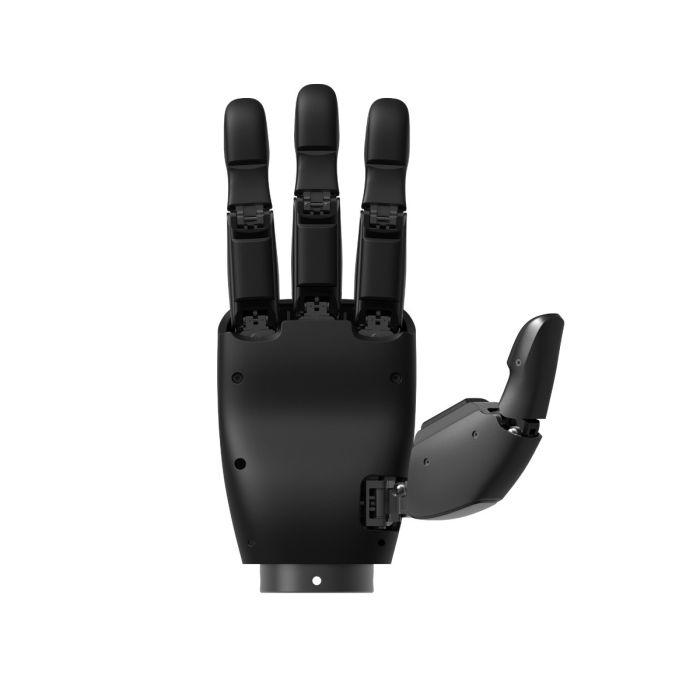
In stock
- BRAND:
- PAXINI
- PART #:
- DexH5
- ORIGIN:
- China
- AVAILABILITY:
- SUBJECT TO AVAILABILITY
- SKU:
- Paxini-DexH5
Paxini Dexh5 (DexH5)
A hand that only opens and closes is a gripper in disguise, and any robot team that has tried to pick up a soft, odd-shaped or slippery object knows the difference. The Paxini Dexh5 (DexH5) starts from a different idea: give the robot fingers that feel what they hold, and let the controller react to contact instead of guessing at it. For teams moving from simple pick-and-place toward real manipulation, that shift matters more than any single motor or joint.
The product is available through this page, by quotation.
Background
PaXini and the tactile-first approach
The DexH5 comes from PaXini Tech, a robotics company whose work centers on tactile perception for robot hands and for the humanoid platforms built around them. The PaXini range on this site includes dexterous hands as well as wheeled humanoid robots, and the common thread is touch: sensing that lets a machine register contact the way a person's fingertips do. You can browse the wider range in the PaXini category.
Tactile sensing has moved from a laboratory curiosity to a practical requirement. Cameras report where an object is, but they cannot report whether it is beginning to slip, how firmly it is pressed, or whether a fingertip has made contact at all. Hands that carry their own sensing close that gap at the point where the work is actually done.
Where the DexH5 sits
The DexH5 is a four-finger dexterous hand with 5 active degrees of freedom and 9 degrees of freedom in total. It is driven by coreless motors and carries 528 ITPU multidimensional tactile sensing units. It is offered as a left hand and a right hand, so a two-handed cell or a mirrored research setup can be specified properly from the start.
In practice, the DexH5 is positioned between a plain two-finger gripper and a full human-like hand. It gives enough fingers and enough joints for grip, pinch, press and other basic hand movements, while the dense tactile array supplies the feedback a controller needs to use those movements well. It speaks EtherCAT and Modbus, two protocols already common in industrial and research robot cells.
Technical Specifications
| Specification | Value |
|---|---|
| Number of fingers | 4 |
| Active degrees of freedom | 5 |
| Total degrees of freedom | 9 |
| Tactile perception | 528 ITPU multidimensional tactile sensing units |
| Payload | 4 kg |
| Maximum grip diameter | 10 cm |
| Minimum opening and closing time | 1 s |
| Driving method | Coreless motor |
| Achievable movements | Grip, pinch, press and other basic hand movements |
| Communication protocol | EtherCAT / Modbus |
Specifications as published by the manufacturer; confirmed against the datasheet at quotation.
The manufacturer has not published the weight, the dimensions, the operating voltage, the power consumption, the fingertip force, the software and SDK support, the contents of the box, the IP rating or the mounting interface details; they are confirmed at quotation.
What makes the DexH5 different from a conventional gripper?
A conventional gripper has one job: close until something stops it. That works well for rigid, predictable parts in a fixture, and it is hard to beat for cost and simplicity. It works poorly when the object is irregular, when its position is uncertain, or when the grip has to be adjusted while the object is being moved.
The DexH5 changes the problem in two ways. First, it has four fingers and 9 total degrees of freedom, so it can form different grasps rather than a single pinch. Second, its 528 ITPU multidimensional tactile sensing units give the controller a continuous picture of contact across the hand. Together, these let a program tell the difference between a fingertip that has just touched an object and a hand that is holding it firmly, and respond to each.
The figures also show a hand built for practical work rather than for display. It has a payload of 4 kg, can grip objects up to 10 cm in diameter, and can open and close in as little as 1 s. Those numbers describe a hand that is meant to handle everyday objects at a useful pace, not a slow demonstrator.
How does the DexH5 connect to a robot cell?
Integration is often where a promising end effector stalls, so the communication options deserve attention. The DexH5 uses EtherCAT and Modbus as its communication protocols. EtherCAT is widely used for real-time control in industrial automation and robotics, while Modbus is a long-established, simple protocol that most controllers and test benches can already talk to. Having both gives a team a choice between a tightly timed production setup and a quick bench connection for development.
The drive is built on coreless motors, which are generally chosen for compact size and quick response. For a hand that must open and close quickly while reading contact, that is a sensible choice.
Who is the DexH5 for?
The DexH5 suits several kinds of buyer, and it is worth being clear about which.
Research labs and universities working on manipulation, embodied AI or learning from touch will find a hand whose tactile array is the main feature, not an add-on. Left and right versions also make bimanual experiments possible.
Robot integrators and automation teams handling irregular or delicate objects, or tasks where position is uncertain, can use contact feedback to make grasping steadier than vision alone allows.
Developers of humanoid and mobile manipulators need a hand that can be attached to an arm and driven over a standard fieldbus. For these teams, the EtherCAT and Modbus support is a practical advantage.
Buyers who want to compare options within the same maker's range can look at the Paxini DexH13 Dexterous Robot Hand (DexH13) or the Paxini GMH18 Robot Hand. Ask us about task, object size and integration, and we will help you decide which hand fits.
What is the DexH5 used for?
- Grasping irregular objects. Four fingers and tactile feedback help a hand adapt to shapes that a plain gripper would handle badly.
- Pinching small items. Pinch is one of the hand's movements, useful for picking up thin or small parts with the fingertips.
- Pressing and actuating. The hand can press, which covers buttons, switches and light contact tasks.
- Manipulation research. The 528 tactile units provide rich contact data for studying touch-driven control and learning.
- Bimanual setups. With left and right versions, two hands can be specified for paired work in a lab or demonstration cell.
- Fieldbus-driven automation. EtherCAT and Modbus let the hand sit in a controller network alongside other robot components.
Pricing and Availability
We do not publish prices for the DexH5; every order starts with a quotation based on your version (left or right), quantity and application. Delivery, customs and support are arranged together with the quotation, so you receive one clear package instead of separate surprises. To begin, send us your requirements and the hand you need, and the DexH5 is available on this page.
Frequently Asked Questions
How many fingers and degrees of freedom does the DexH5 have?
The DexH5 has 4 fingers, 5 active degrees of freedom and 9 degrees of freedom in total.
What kind of tactile sensing does it use?
It carries 528 ITPU multidimensional tactile sensing units, which give the controller contact information across the hand.
What movements can it perform?
It performs grip, pinch, press and other basic hand movements.
Which communication protocols are supported?
The DexH5 communicates over EtherCAT and Modbus, so it fits both industrial controllers and simple bench setups.
What payload and grip size does it offer?
The payload is 4 kg and the maximum grip diameter is 10 cm. The minimum opening and closing time is 1 s.
Is it available as a left and a right hand?
Yes, the DexH5 is offered as a left version and a right version. Tell us which one you need when you request a quotation.
Where can I buy the DexH5 and what does it cost?
You can buy the Paxini Dexh5 (DexH5) through this page, by quotation. We do not list a price here; send your requirements and we will prepare an offer that covers delivery, customs and support.
Summary
The Paxini Dexh5 (DexH5) answers a simple question: what if a robot hand could feel as well as grip? With four fingers, 9 total degrees of freedom, 528 tactile sensing units, coreless motors and EtherCAT and Modbus communication, it is built for teams whose projects have outgrown the open-and-close gripper. If touch-aware manipulation is what your work needs, this page is the starting point.


