
PaXini TORA DOUBLE ONE Lightweight Humanoid Robot
In stock
- BRAND:
- PAXINI
- MODEL:
- TORA DOUBLE ONE
- ORIGIN:
- China
- AVAILABILITY:
- SUBJECT TO AVAILABILITY
- SKU:
- Paxini-TORA-DOUBLE-ONE
PaXini TORA DOUBLE ONE Lightweight Humanoid Robot
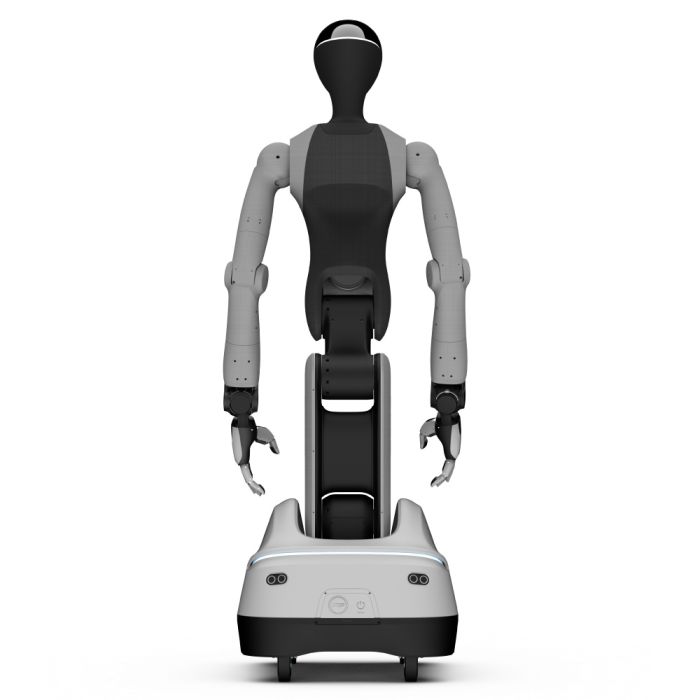
A humanoid robot is only as useful as the floor under it and the touch in its hands. The PaXini TORA DOUBLE ONE Lightweight Humanoid Robot is built around that pairing: a tactile, dexterous upper body that can sit on either of two very different chassis, one made for steady industrial floors and one made for rough ground and tight spaces.
The product is available through this page, by quotation.
Background
PaXini and its tactile lineage
PaXini is a robotics company known for tactile sensing and dexterous robot hands. Its approach rests on the idea that a robot which only sees will always handle objects clumsily, and that touch is what turns a camera-guided arm into a hand that can work. That thinking runs through the company's range, from individual hands to complete wheeled humanoids such as the Paxini TORA ONE Multi-Dimensional Tactile Wheeled Humanoid Robot.
The TORA DOUBLE ONE belongs to this family and is described as a lightweight model. The word lightweight here describes the design aim: a compact humanoid that can be folded down, moved and redeployed, rather than a fixed installation. It sits among the Wheeled Humanoids in the wider field of Humanoids.
Key technology: OmniVTLA, PX-Core and AGX Orin
Three pieces of technology define the robot's behavior. The first is the in-house OmniVTLA embodied intelligence model, which is PaXini's own AI model for turning perception into action. The second is PX-Core, the control layer that combines vision and touch in a dual-modal approach. The third is the AGX Orin computing platform, which supplies the compute for running all of this on the robot itself.
The upper body offers up to 52 degrees of freedom. That figure is the maximum, and it is what gives a humanoid enough joints to reach, turn and handle objects in ways a simple arm on a base cannot. The robot can also carry PaXini's full line of multi-dimensional tactile dexterous hands, so the hand can be matched to the task. For perception, the robot comes with 3D LiDAR, a fisheye camera, a depth camera and circular microphone arrays.
Technical Specifications
| Specification | Value |
|---|---|
| Maximum degrees of freedom | 52 joint degrees of freedom |
| Minimum folded height (both chassis models) | Less than 60cm |
| AI model | In-house OmniVTLA embodied intelligence model |
| Compute platform | AGX Orin |
| Control | PX-Core visual-tactile dual-modal control |
| Chassis options | Omnidirectional chassis (dual-steer, Model P); obstacle-crossing chassis (4WD folding, Model X) |
| Hands | Compatible with PaXini's full line of multi-dimensional tactile dexterous hands |
| Sensors | 3D LiDAR, fisheye camera, depth camera, circular microphone arrays |
| Slope climbing | Up to 8.5 degrees |
| Obstacle height | 21.5cm |
Specifications as published by the manufacturer; confirmed against the datasheet at quotation.
The manufacturer has not published the weight, the payload, the battery capacity, the ingress protection rating, the dimensions, the contents of the box, the connectivity or the operating system; they are confirmed at quotation.
What is the difference between the Model P and Model X chassis?
The robot is offered with a choice of two chassis, and the choice matters more than it might seem, because it decides where the robot is comfortable working.
The omnidirectional chassis, Model P, uses a dual-steer design. It is a dual-steer AGV chassis, and the design allows the robot to turn flexibly and to translate sideways. That suits industrial floors where stability matters and where the robot has to line itself up precisely with a workstation, a shelf or a conveyor.
The obstacle-crossing chassis, Model X, is a four-wheel-drive folding design. It can lift its legs to adapt to complex terrain, which makes it the better fit for tight spaces and varied ground conditions. The robot can climb slopes up to 8.5 degrees and overcome obstacles of 21.5cm, which matters wherever thresholds, ramps or uneven surfaces would stop an ordinary wheeled base.
Both chassis models fold to a minimum height of less than 60cm. The upper body, the OmniVTLA model, the PX-Core control and the AGX Orin platform are the same in both cases, so the decision comes down to the ground the robot will work on rather than to the intelligence it carries.
Why does visual-tactile control matter for a humanoid?
Vision alone tells a robot where an object is. It says little about how firmly the object is held, whether it is slipping or how it yields under pressure. PX-Core combines visual and tactile information in a dual-modal control approach, and the OmniVTLA model is PaXini's embodied intelligence model that works alongside it.
For a buyer, the practical meaning is a platform designed for manipulation tasks where contact matters: handling varied objects, working with delicate items or doing tasks that a fixed script cannot cover. Because the robot accepts PaXini's full line of tactile dexterous hands, the hand can be chosen to fit the work. Related hands in the range include the Paxini DexH13 Dexterous Robot Hand (DexH13) and the Paxini GMH18 Robot Hand.
Who is the PaXini TORA DOUBLE ONE for?
Industrial operators who need a mobile manipulator on factory floors will find the dual-steer Model P the natural starting point, since it is built for stability on industrial floors and for precise positioning.
Facilities with tight or uneven spaces, such as sites with thresholds, ramps or mixed surfaces, should look at the Model X, whose folding four-wheel-drive design lifts its legs to cope with complex terrain.
Research teams and universities working on embodied intelligence can use a platform that already combines a tactile control layer, an AI model and an onboard compute platform, instead of assembling those parts themselves.
Service and hospitality businesses exploring catering, healthcare or commercial assistance can evaluate the robot as a mobile base with a dexterous upper body, with the application to be defined together with the supplier.
Integrators and distributors in the Caribbean who build solutions for clients will value the choice of chassis and hands, which lets one upper body serve several projects. Buyers who want a different member of the family can compare the Paxini TORA ONE.
What is the PaXini TORA DOUBLE ONE used for?
- Workstation tasks: the robot approaches a bench or shelf and handles objects with tactile hands.
- Factory-floor logistics support: the dual-steer Model P gives stable, precise movement on industrial floors.
- Work on mixed terrain: the Model X lifts its legs to cross obstacles and slopes that stop a flat-floor base.
- Research in embodied AI: the OmniVTLA model, PX-Core control and AGX Orin platform give teams a ready platform for testing.
- Demonstration and training: a robot that folds down for transport can be taken to client sites, classrooms and trade events.
- Service pilots: hospitality, healthcare and commercial settings can trial a mobile humanoid before wider rollout.
Pricing and Availability
No price is listed on this page, because the configuration decides the offer: chassis model, hand choice and the scope of delivery all change what is quoted. Quotation is the next step. Delivery, customs and support are arranged with the quotation, so that nothing is left to chance on the way to the Caribbean. The PaXini TORA DOUBLE ONE Lightweight Humanoid Robot is available on this page.
Frequently Asked Questions
How many degrees of freedom does the robot have?
The maximum is 52 joint degrees of freedom. This is the figure the manufacturer gives for the platform.
Which chassis options are available?
There are two: the omnidirectional chassis (dual-steer, Model P) and the obstacle-crossing chassis (4WD folding, Model X). The chassis is chosen when the robot is configured.
How small does the robot fold?
Both chassis models fold to a minimum height of less than 60cm. That makes storage and transport easier than with a fixed-height humanoid.
What can the robot climb or cross?
It can climb slopes up to 8.5 degrees and overcome obstacles of 21.5cm. The Model X is the chassis designed for complex terrain.
Which sensors does it carry?
It comes with 3D LiDAR, a fisheye camera, a depth camera and circular microphone arrays. These let it perceive its surroundings.
Can it use different hands?
Yes, it can carry PaXini's full line of multi-dimensional tactile dexterous hands. The hand is chosen to suit your task.
Where can I buy the PaXini TORA DOUBLE ONE and what does it cost?
You can request a quotation through this page. The cost depends on the chassis, the hands and the scope of delivery, so no price is shown here.
Summary
The PaXini TORA DOUBLE ONE answers a simple question: what use is a clever pair of hands if the base cannot take them where the work is? With a dual-steer chassis for industrial floors, a folding four-wheel-drive chassis for difficult ground, up to 52 degrees of freedom, OmniVTLA intelligence, PX-Core visual-tactile control and AGX Orin computing, it covers both halves of the problem. For a quotation tailored to your site and your task, this page is the starting point.


