
Xynova PR20-102-130-HS Rotary Actuator
In stock
- BRAND:
- XYNOVA
- MODEL:
- PR20-102-130-HS
- ORIGIN:
- China
- Warranty:
- 12 MONTHS
- AVAILABILITY:
- SUBJECT TO AVAILABILITY
- SKU:
- Xynova-PR20-102-130-HS
Xynova PR20-102-130-HS Rotary Actuator
A humanoid arm has to be light enough to swing quickly and strong enough to hold a load, and every joint pays for both. The Xynova PR20-102-130-HS Rotary Actuator is built around that trade-off: a compact 48V joint module that delivers 130Nm of peak torque from a body weighing 1.2kg. For teams building legs, shoulders, hips or wrists, that ratio of torque to mass is the number that decides how the whole machine moves.
The product is available through this page, by quotation.
Background
Xynova and its place in humanoid robotics
Xynova Technology Co., Ltd. is a core component supplier in the field of humanoid robots. Its business is not whole robots but the parts that make them move: joint actuators that combine motor, gearbox, encoder and control in one module. The company offers customized, complete electric drive solutions for humanoid robots, and its actuator family spans a torque range of 6.7-500Nm, so that every joint of a humanoid body can be served from one supplier.
That range matters to a builder. A hand, a wrist, an elbow and a hip all ask for very different torque, and mixing parts from several makers means mixing interfaces and control habits. Xynova's approach is to keep the drive solution consistent across sizes. The PR20-102-130-HS sits within the rotary family, and it is one of several named versions: the PR64-110-500, the PR43-120-600-HB, the PRH19-57-25-HS and the PR21-100-140-HS belong to the same line.
Planetary gearing and in-house software
Two pieces of technology define this actuator. The first is the gearbox: an in-house developed planetary gearbox, optimized for high-burst movements. Humanoid joints seldom run at a steady load. They accelerate, brake, catch a falling weight and push off the ground in short bursts, and a gearbox tuned for that duty is a better match than one tuned only for smooth continuous rotation.
The second is the software. Xynova develops its upper-level software in-house, with a rich set of API interfaces that make it easy to coordinate and control multiple actuators. A humanoid may have dozens of joints that must act together, so the ability to command them as a group, rather than one at a time, saves integration effort.
The design work has a measurable result: at the same peak torque, module size is reduced by more than 45% and weight by more than 35%. For the PR20-102-130-HS, that shows up as a body of Φ102×59mm at 1.2kg.
Technical Specifications
| Specification | Value |
|---|---|
| Input voltage | 48V |
| No-load speed | 150r/min |
| Peak torque | 130Nm |
| Torque density | 113Nm/kg |
| Weight | 1.2kg |
| Size | Φ102×59mm |
| Gear ratio | 20 |
| Encoder resolution | 17bit |
| Repeatability | ≤0.1° |
| Gearbox | In-house developed planetary gearbox |
Specifications as published by the manufacturer; confirmed against the datasheet at quotation.
The manufacturer has not published the rated torque, the continuous torque, the communication interface, the IP rating, the operating temperature, the rated current, the motor type, the backlash, the contents of the box, the mounting dimensions, the peak current or the peak speed; they are confirmed at quotation.
What makes the PR20-102-130-HS different from other rotary actuators?
The first difference is density. A peak torque of 130Nm from 1.2kg works out to a torque density of 113Nm/kg. In a robot limb, mass at the end of the limb costs energy every time it moves, so a joint that delivers more torque per kilogram lets the designer use smaller batteries, lighter structure or longer reach. The reduction in module size of more than 45% and in weight of more than 35% at the same peak torque points in the same direction.
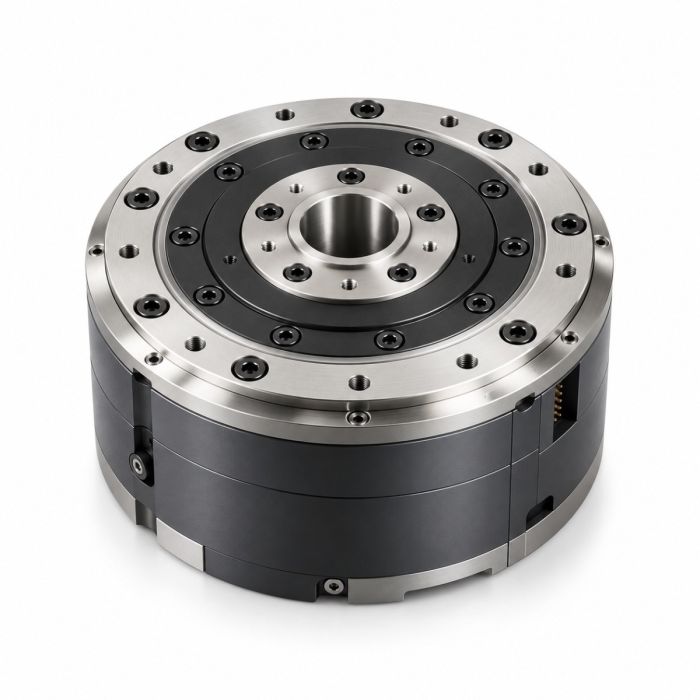
The second difference is shape. At Φ102×59mm, the module is short for its diameter, which suits joints where the axis must stay close to the body, such as shoulders and hips. A flat, round form is easier to place inside a limb than a long cylinder.
The third is control precision. A 17bit encoder resolution and a repeatability of ≤0.1° give a controller fine position information and a joint that returns to the same angle again and again. That helps with repeatable manipulation, gait tuning and any task where small angular errors add up along the length of a limb.
Finally, there is the question of how this version compares with its siblings. Each named version suits a different joint. If your design needs a different size or torque class, the Xynova PR21-100-140-HS Rotary Actuator, the Xynova PR43-120-600-HB Rotary Actuator and the Xynova PR64-110-500 Rotary Actuator are the nearby options to compare. Figures belong to each version, so read the table on each page rather than carrying numbers across.
Why do the planetary gearbox and software matter for a humanoid joint?
A planetary gearbox spreads the load over several gear contacts and keeps the input and output on the same axis, which is why it is common in compact joints. Xynova's version is developed in-house and optimized for high-burst movements. With a gear ratio of 20, the motor's speed is reduced and its torque multiplied, giving a no-load speed of 150r/min and a peak torque of 130Nm at 48V input.
Software is the other half of a joint. A well-built actuator is of little use if it is awkward to command. The upper-level software and its API interfaces are designed so that several actuators can be coordinated and controlled together, which is what a multi-joint robot needs.
Who is the Xynova PR20-102-130-HS for?
The first group is humanoid robot developers. Teams building a full-size or half-size humanoid need compact, strong joints in large numbers, and a module with this torque density fits limb joints where space and weight are tight.
The second group is research laboratories and universities. Academic groups working on legged locomotion, whole-body control or manipulation often build prototypes with custom joint layouts. A module with API-driven software and a 17bit encoder suits that kind of work.
The third group is integrators of advanced robotic arms and exoskeleton-style systems, who value a low-mass joint with good repeatability. The fourth is educators and mechatronics teams who want a serious actuator for advanced training platforms.
If your joint needs are smaller, such as wrists or fingers, look at the Xynova PRH19-57-25-HS Rotary Actuator. For linear motion, the linear actuators from the same maker are listed in the Robot Actuators category, together with the rest of the selection.
What is the Xynova PR20-102-130-HS used for?
- Humanoid limb joints. Shoulders, hips and other joints where compact size and torque density matter.
- Manipulation research. Arms and grippers that need repeatable positioning at a fine angular level.
- Legged robot prototypes. Joints that must handle short, high-burst movements such as stepping and recovery.
- Multi-actuator coordination work. Systems in which many joints are commanded together through the API interfaces.
- Laboratory and teaching platforms. Test benches and advanced mechatronics courses that need a real humanoid-grade actuator.
- Custom robotic integration. One-off machines and pilot builds where a self-contained drive module saves design time.
Pricing and Availability
The Xynova PR20-102-130-HS Rotary Actuator is sold by quotation, and this page carries no price. Tell us your quantity, your target application and the controller you plan to use, and we will prepare a quotation for you. Delivery, customs and support are arranged with the quotation, so you know the full picture before you commit. The actuator is available on this page.
Frequently Asked Questions
What input voltage does the PR20-102-130-HS use?
It runs from a 48V input. Plan your power supply and battery system around that voltage.
How much torque does it deliver?
The peak torque is 130Nm, and the torque density is 113Nm/kg.
How heavy and how large is it?
The module weighs 1.2kg and measures Φ102×59mm.
How precise is the positioning?
The encoder resolution is 17bit and the repeatability is ≤0.1°.
Can several actuators be controlled together?
Yes. Xynova's in-house upper-level software has a rich set of API interfaces, which makes it easy to coordinate and control multiple actuators.
What torque range does the actuator family cover?
The Xynova family covers 6.7-500Nm, so that the needs of all joints can be met. The PR20-102-130-HS is the version with 130Nm of peak torque.
Where can I buy the Xynova PR20-102-130-HS and what does it cost?
You can request it through this page. Cost is given by quotation, based on your quantity and project, so send us your requirements and we will respond with a quotation.
Summary
The Xynova PR20-102-130-HS Rotary Actuator answers the humanoid designer's central problem: how to get strong joints without paying for them in weight. With 130Nm of peak torque, 1.2kg of mass, a planetary gearbox with a gear ratio of 20, a 17bit encoder and repeatability of ≤0.1°, it is a compact module for limbs that must be light and precise. Xynova, a core component supplier for humanoid robots, adds in-house software with API interfaces for coordinating many joints. For a quotation on this actuator, this page is the starting point.


