
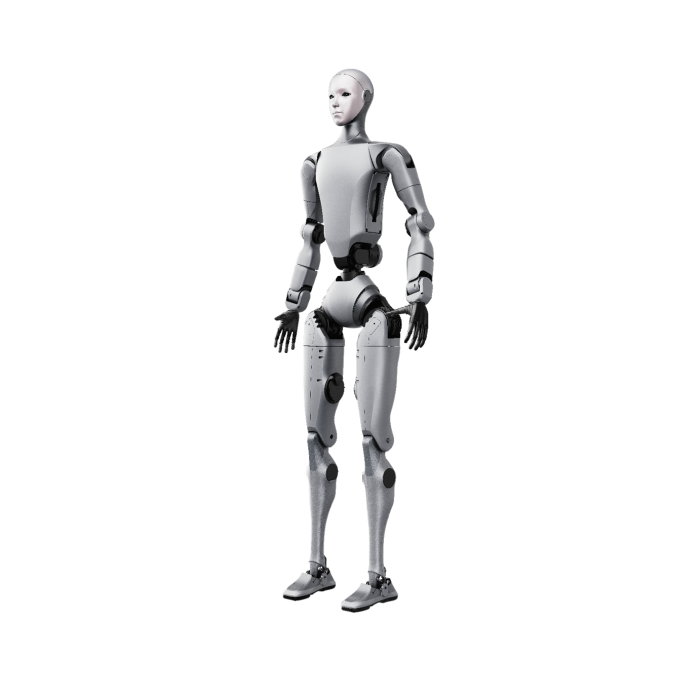
Unitree H2 EDU Standard Humanoid Robot
In stock
- BRAND:
- UNITREE ROBOTICS
- MODEL:
- H2-EDU-Standard
- PART #:
- H2-EDU-Standard
- ORIGIN:
- China
- Warranty:
- 12 MONTHS
- AVAILABILITY:
- SUBJECT TO AVAILABILITY
- SKU:
- Unitree-H2-EDU-Standard
Unitree H2 EDU Standard Humanoid Robot
A humanoid robot is only as useful as the lab that can make it do something new. The Unitree H2 EDU Standard Humanoid Robot is built around that idea: a full-size walking body with a second computer left free for your own code, and no hands fitted so that you decide what goes on the end of the arms.
The product is available through this page, by quotation.
Background
Unitree Robotics and the H2 line
Unitree Robotics is a company that builds legged robots, and its humanoid range has grown out of that experience with balance, joint actuation and motion control. The H2 family is sold in several versions: H2 BASIC, H2 EDU STANDARD, H2 EDU SMART and H2 Plus. They share one body architecture and differ in how much is fitted and how open the platform is to the people who use it.
The EDU name points to universities, research institutes and development teams. Those buyers care less about a finished demonstration and more about access: access to the computing, to the joints and to the software layer, so that their own work can run on a real machine.
Where the EDU Standard sits
The H2 EDU Standard is the entry point of the EDU line. It carries two computing units: a Core i5 that runs the robot's own functions, and a Core i7 dedicated to user development. Secondary development is supported, so your algorithms do not compete with the code that keeps the robot upright.
It ships without robotic hands. That keeps the configuration focused on the body, the legs, the arms and the compute, and leaves the choice of end effector to the project. Teams that want a different starting point can look at the SMART versions, such as the Unitree H2 EDU SMART A Humanoid Robot, or browse the whole Unitree H2 EDU category.
Technical Specifications
| Specification | Value |
|---|---|
| Version | H2 EDU Standard |
| Standing dimensions | 1820 x 456 x 218 mm |
| Weight with battery | Approximately 70 kg |
| Total degrees of freedom | 31 |
| Thigh + calf length | 1045 mm |
| Materials | Aerospace-grade aluminum + titanium alloy + high-strength engineering plastics |
| Cooling | Local air cooling |
| Arm peak torque | 120 Nm |
| Leg peak torque | 360 Nm |
| Battery | 15 Ah (0.972 kWh) |
| Battery life | Approximately 3 h |
| Computing units | 2: Core i5 for the robot's functions, Core i7 for user development |
| Computing for custom development | PC2: Intel Core i7 |
| High-performance computing module | Up to Jetson AGX Thor (2070 TOPS) |
| Vision sensor | Wide-angle humanoid binocular camera |
| Voice interaction | Array microphones + high-power speaker |
| Connectivity | Wi-Fi 6, Bluetooth 5.2 |
| Secondary development | Yes |
| Robotic hands | Not included |
| Removable smart battery | Yes |
| Manual remote controller | Yes |
| Charger | Yes |
Specifications as published by the manufacturer; confirmed against the datasheet at quotation.
The manufacturer has not published the top speed, the IP rating, the charging time, the operating temperature, the noise level, the hand payload or the software and SDK version; they are confirmed at quotation.
What makes the H2 EDU Standard different from a ready-to-demonstrate humanoid?
Most people meet a humanoid robot as a finished act: it walks, it waves, it performs. The EDU Standard is configured for a different job. Its second computer, the Core i7, is reserved for the user, so a research group can run perception, planning or learning code without touching the processor that handles the robot's own functions. That separation is the main difference, and it matters whenever a controller under test might misbehave.
The body supports the work. With 31 degrees of freedom, a leg peak torque of 360 Nm and an arm peak torque of 120 Nm, the platform has joints to study and drive, not just to watch. The wide-angle humanoid binocular camera, the array microphones with a high-power speaker, and Wi-Fi 6 with Bluetooth 5.2 cover sensing, speech and networking out of the box.
The frame is made from aerospace-grade aluminum, titanium alloy and high-strength engineering plastics, cooled locally by air. The battery is a removable smart unit of 15 Ah (0.972 kWh), and the battery life is approximately 3 h. A charger and a manual remote controller come with the robot, so the first session does not wait on accessories.
Why are no hands included, and does that limit the robot?
The absence of hands is a choice, not a gap. Many research projects begin with locomotion, whole-body control or vision, where hands add cost and complexity before they add value. Others need a specific gripper or hand that no catalog default would match. Leaving the wrists free lets the buyer plan around the real task.
It does mean this configuration is not the right answer for a team that wants to grasp objects on day one. For that need, compare the SMART versions on this store, for example the Unitree H2 EDU SMART B Humanoid Robot, and read their configuration on their own pages. If you have a manipulation plan, describe it when you request your quotation.
Who is the H2 EDU Standard for?
Universities and research institutes are the clearest fit. A lab that teaches control, reinforcement learning or human-robot interaction needs a full-size platform with an open development path, and the dedicated Core i7 gives students a place to work that is separate from the robot's own functions.
Corporate R&D teams and system integrators form the second group. They use a humanoid to test whether a workflow, a sensor stack or a software pipeline suits a human-shaped machine before committing to a product. For them, the two-computer layout and secondary development support shorten the time from idea to a running experiment.
Training centers and demonstration programs in the Caribbean and beyond may also find a place for it, particularly where the goal is to show students a working bipedal robot and let them program it. Buyers who want hands fitted from the start should look at the other versions in the Unitree H2 EDU category instead.
What is the H2 EDU Standard used for?
- Locomotion research: study walking, balance and whole-body control on a platform with 31 degrees of freedom.
- Algorithm development: run your own code on the dedicated Core i7 without disturbing the robot's core functions.
- Perception projects: build vision work on the wide-angle humanoid binocular camera.
- Voice and interaction studies: use the array microphones and high-power speaker for speech-based experiments.
- Teaching and training: give students a full-size humanoid to program in courses on robotics and control.
- Integration trials: test custom end effectors, payloads and software before a larger deployment.
Pricing and Availability
Pricing for the Unitree H2 EDU Standard Humanoid Robot is given by quotation, based on your configuration and destination. Delivery, customs and support are arranged together with the quotation, so you see the whole picture before you decide. The Unitree H2 EDU Standard Humanoid Robot is available on this page.
Frequently Asked Questions
How many degrees of freedom does the H2 EDU Standard have?
The robot has 31 total degrees of freedom. The leg peak torque is 360 Nm and the arm peak torque is 120 Nm.
Does it come with robotic hands?
No. This configuration is supplied without robotic hands, so you choose the end effector that suits your project.
Can I run my own software on it?
Yes, secondary development is supported. A Core i7 computing unit is dedicated to user development, while a Core i5 handles the robot's functions.
How long does the battery last?
The battery life is approximately 3 h from a removable smart battery of 15 Ah (0.972 kWh). A charger is included.
What sensors and connectivity does it have?
It has a wide-angle humanoid binocular camera, array microphones and a high-power speaker. Connectivity is Wi-Fi 6 and Bluetooth 5.2.
How large and heavy is the robot?
Standing dimensions are 1820 x 456 x 218 mm, and the weight with battery is approximately 70 kg.
Where can I buy the Unitree H2 EDU Standard Humanoid Robot and what does it cost?
You can request it through this page, where it is supplied by quotation. The cost depends on your configuration and destination, and it is given in the quotation itself.
Summary
The Unitree H2 EDU Standard Humanoid Robot is less a finished performer than a workbench in human form: a full-size body with 31 degrees of freedom, a computer reserved for your own development, and empty wrists waiting for the hands your project needs. It suits teams that want to build something new rather than watch something familiar. If that describes your project, this page is the starting point.


