
Unitree H2 EDU SMART E Humanoid Robot
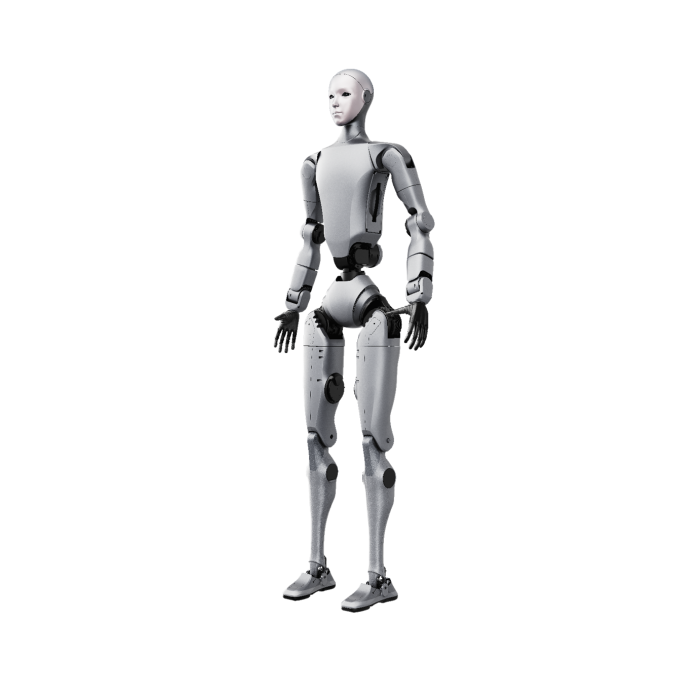
In stock
- BRAND:
- UNITREE ROBOTICS
- MODEL:
- H2-EDU-SMART-E
- PART #:
- H2-EDU-SMART-E
- ORIGIN:
- China
- Warranty:
- 12 MONTHS
- AVAILABILITY:
- SUBJECT TO AVAILABILITY
- SKU:
- Unitree-H2-EDU-SMART-E
Unitree H2 EDU SMART E Humanoid Robot
Plenty of machines can walk across a room; far fewer can tell how firmly they are holding a paper cup. The Unitree H2 EDU SMART E Humanoid Robot is built around that second ability, pairing a full-size bipedal frame with two tactile five-finger hands for teams that study how robots touch the world.
The product is available through this page, by quotation.
Background
Unitree and the H2 lineage
Unitree Robotics is known for bringing legged and humanoid platforms to universities, research institutes and development teams. The H2 family is its full-size humanoid line. It includes the H2 BASIC, the H2 EDU STANDARD, a series of H2 EDU SMART configurations lettered A to M that differ by hand setup, the H2 EDU SMART E with Dex5-1P tactile hands, and the H2 Plus.
The EDU designation matters to a buyer. Secondary development is supported on the EDU platform, which means the robot is meant to be programmed, extended and studied rather than used only as delivered.
Where the SMART E sits
Within the SMART series, the E configuration is defined by its hands. It carries two five-finger tactile Dex5-1P hands, each with a wrist-mounted RGB camera. Each hand offers 16 degrees of freedom and 94 pressure sensors. In practice this puts the emphasis on manipulation with tactile feedback: grasping, adjusting grip and handling objects where contact information is as valuable as vision.
Technical Specifications
The table combines the hand figures for the SMART E configuration with the body, power and sensing figures of the H2 EDU platform.
| Specification | Value |
|---|---|
| Hands (SMART E) | 2 × five-finger tactile Dex5-1P hands with wrist-mounted RGB cameras |
| Degrees of freedom per hand | 16 DoF |
| Pressure sensors per hand | 94 |
| Standing dimensions (H2 EDU) | 1820 x 456 x 218 mm |
| Weight with battery (H2 EDU) | Approximately 70 kg |
| Maximum leg joint torque | 360 N.m |
| Maximum arm joint torque | 120 N.m |
| Arm payload | Peak: ~15 kg; nominal: ~7 kg |
| Materials | Aerospace-grade aluminum + titanium alloy + high-strength engineering plastics |
| Battery | 15 Ah (0.972 kWh) |
| Battery life | Approximately 3 h |
| Vision sensor | Wide-angle humanoid binocular camera |
| Voice interaction | Array microphones + high-power speaker |
| Connectivity | Wi-Fi 6, Bluetooth 5.2 |
| Secondary development | Supported on EDU |
Specifications as published by the manufacturer; confirmed against the datasheet at quotation.
The manufacturer has not published the top walking speed, the IP rating, the camera resolution, the hand payload, the operating noise level, the charging time or the compute module included with the SMART E; they are confirmed at quotation.
What makes the SMART E different from the other H2 EDU SMART versions?
The lettered SMART versions are distinguished by their hand configuration, and the E is the one fitted with Dex5-1P tactile hands. Its identity is therefore not about walking or lifting, which belong to the shared H2 EDU body, but about what happens at the end of the arm.
Sixteen degrees of freedom per hand give the fingers room to shape around an object rather than simply clamp it. Ninety-four pressure sensors per hand then report how that contact is distributed. A wrist-mounted RGB camera on each hand adds a close view of whatever the fingers are about to touch, so a researcher can combine sight and touch from the same point of view.
This combination is useful when a task cannot be solved by position control alone. Picking up a fragile item, detecting slip or adjusting grip force all depend on contact data. If your work does not need that, another hand configuration may serve you better, and the Unitree H2 EDU category lets you compare the neighbors, including the Unitree H2 EDU SMART A Humanoid Robot and the Unitree H2 EDU SMART B Humanoid Robot.
What does the H2 EDU body give a development team?
The body is the same whichever hands are fitted. Joint torque reaches 360 N.m at the legs and 120 N.m at the arms, and the arm payload is a peak of about 15 kg with a nominal figure of about 7 kg. Standing dimensions are 1820 x 456 x 218 mm, and the weight with battery is approximately 70 kg. The structure uses aerospace-grade aluminum, titanium alloy and high-strength engineering plastics.
For perception and interaction, the platform carries a wide-angle humanoid binocular camera and array microphones with a high-power speaker. Wi-Fi 6 and Bluetooth 5.2 handle connectivity. The H2 EDU computing module goes up to Jetson AGX Thor with 2070 TOPS.
The 15 Ah battery stores 0.972 kWh and runs for approximately 3 h, so plan your sessions around that figure.
Who is the Unitree H2 EDU SMART E for?
The first segment is university and institute labs working on dexterous manipulation, tactile learning and imitation of human hand skills. For them the sensor-rich hands are the reason to choose this version.
The second segment is corporate research and development teams evaluating whether a humanoid can handle tasks that today need a human touch, such as handling delicate parts or tools. The EDU platform supports secondary development, so these teams can build their own software on top of the robot.
The third segment is educators and advanced training programs that want students to work with a real humanoid and real contact data. Buyers who need only a general platform for walking, gesture or demonstration work may find a different hand configuration sufficient. Compare the Unitree H2 EDU SMART F Humanoid Robot and the Unitree H2 EDU SMART G Humanoid Robot before deciding.
What is the Unitree H2 EDU SMART E used for?
- Tactile manipulation research: study grasping and in-hand adjustment with pressure data from 94 sensors on each hand.
- Learning from demonstration: record human actions and train policies that use both camera views and touch.
- Algorithm development: build and test control and perception software on a platform that supports secondary development.
- Teaching: give robotics students hands-on access to a full-size humanoid with a sensing-rich end effector.
- Human-robot interaction trials: use the microphones, speaker and cameras to test voice and gesture scenarios.
- Feasibility studies: evaluate whether a humanoid with dexterous hands can take on a task in your own environment.
Pricing and Availability
We do not print prices on this page. A quotation is the way to proceed: tell us your application, your hand and compute requirements and your location, and we respond with a written offer. Delivery, customs and support are arranged with the quotation. The Unitree H2 EDU SMART E Humanoid Robot is available on this page.
Frequently Asked Questions
What hands does the SMART E have?
It has two five-finger tactile Dex5-1P hands, each with a wrist-mounted RGB camera. Each hand has 16 DoF and 94 pressure sensors.
How long does the battery last?
The 15 Ah (0.972 kWh) battery runs for approximately 3 h.
How much can the arms lift?
The arm payload is a peak of about 15 kg and a nominal figure of about 7 kg.
Can I develop my own software for it?
Yes. Secondary development is supported on the EDU platform.
What computing module does the H2 EDU use?
The H2 EDU computing module goes up to Jetson AGX Thor with 2070 TOPS. Ask us about the module for your SMART E when you request a quotation.
How does it connect to a network?
It connects through Wi-Fi 6 and Bluetooth 5.2.
Where can I buy the Unitree H2 EDU SMART E Humanoid Robot and what does it cost?
You can buy it through this page by requesting a quotation. The cost depends on your configuration and destination, so it is given in the written quotation rather than printed here.
Summary
Walking is the easy part to show; touch is the hard part to do. The Unitree H2 EDU SMART E Humanoid Robot puts its distinction in the hands, with 16 DoF, 94 pressure sensors and a wrist camera on each side, on top of an EDU body that supports your own development. If dexterous, touch-aware manipulation is your research question, this page is the starting point.


