
Unitree H1-2 Dexterous Hand
In stock
- BRAND:
- UNITREE ROBOTICS
- PART #:
- H1-2 dexterous hand (develop by Unitree)
- ORIGIN:
- China
- AVAILABILITY:
- SUBJECT TO AVAILABILITY
- SKU:
- Unitree-H1-2-Dexterous-Hand
Unitree H1-2 Dexterous Hand
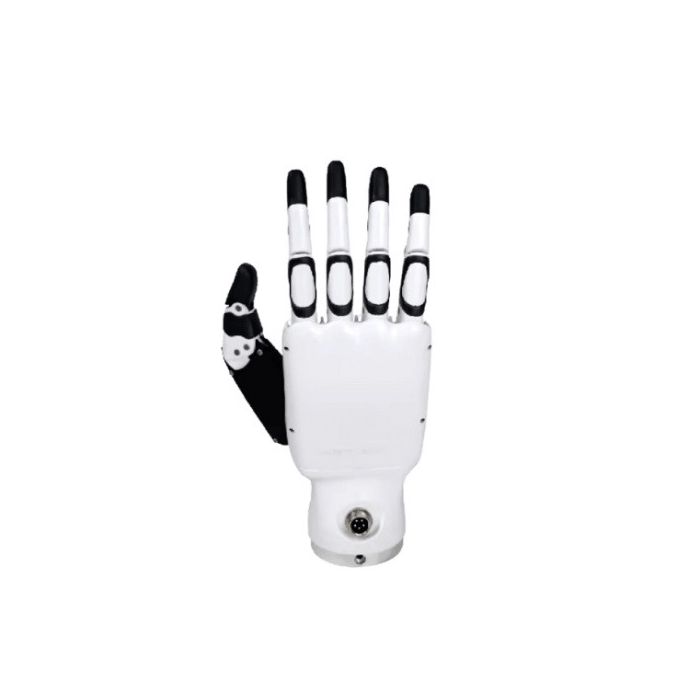
Most of what a humanoid robot does for anyone happens within a few inches of its wrists. Walking gets it to the workbench, but the hand decides whether anything gets done there. The Unitree H1-2 Dexterous Hand is the multi-jointed hand option for the H1-2 humanoid, built around touch sensing in every finger and a joint count suited to real manipulation research.
The product is available through this page, by quotation.
Background
Unitree and the H1 lineage
UNITREE ROBOTICS is a robotics maker whose humanoid platforms are used in laboratories, universities and development teams. The H1 humanoid is the full-size line, and the H1-2 is its later version, listed here at about 178CM in height. The sources for this product name two versions of the platform, H1 and H1-2, and the hand described on this page is the one tied to the H1-2.
A humanoid's body and its hands are usually judged separately. A body shows balance, gait and reach. Hands show whether a program can handle objects of different shapes, weights and textures. That is why Unitree offers hand modules as options on the robot instead of fixing a single end effector for every buyer. Teams can match the hand to the research question they are working on.
Positioning and key technology
This is a multi-jointed dexterous hand with at least 10 degrees of freedom. Its main distinction is sensing: each finger carries a haptic array sensor, and each finger has more than 20 sensor contacts. Together, those contacts give a control program a map of where and how an object touches the finger, which is the kind of information that grasp-adaptation and learning-based manipulation work depends on.
The robot can be equipped with 2 optional hand modules, one for each arm. For the H1-2, the options are the Dex5-1 or other ambidextrous hands. If you are comparing the wider range, the Hands category shows the other hands in the family.
Technical Specifications
| Specification | Value |
|---|---|
| Degrees of freedom | ≥10 |
| Hand modules per robot | 2 optional hand modules |
| Finger sensing | Haptic array sensors for each finger |
| Sensor contacts per finger | >20 |
| Maximum output torque of each finger joint | >0.7 Nm |
| Hand option on the H1-2 | Optional Dex5-1 or other ambidextrous hands |
| Robot height (H1-2) | About 178CM |
Specifications as published by the manufacturer; confirmed against the datasheet at quotation.
The manufacturer has not published the hand weight, the hand dimensions, the operating voltage, the communication interface, the payload per hand, the fingertip force, the positioning accuracy or what is in the box; they are confirmed at quotation.
What makes this hand different from a simple gripper?
A gripper opens and closes. It can pick up a box, and for many factory tasks that is enough. A dexterous hand with at least 10 degrees of freedom can do more: it can shape itself around an object, change its grip while the object is held, and take part in tasks where fingers must move independently. For a research team, that opens the door to work on in-hand manipulation, tool use and human-like grasp strategies.
The second difference is feedback. Each finger has its own haptic array sensor, and each finger has more than 20 sensor contacts. A hand without touch sensing depends on cameras and guesswork once its fingers close over an object, and the object often hides itself from the camera at exactly that moment. Touch data fills that gap. It lets a controller notice a slip, tell a firm grasp from a light one, and react without waiting for vision.
The third point is joint strength. Each finger joint has a maximum output torque of more than 0.7 Nm. That figure describes the joint, not the whole hand. If your application depends on lifting a particular weight, raise it when you request the quotation so we can check it for you.
How does the hand fit the H1-2 humanoid?
The H1-2 is the version this hand is listed for. The robot takes up to 2 optional hand modules, so a full pair is possible. The Dex5-1 or other ambidextrous hands are the options for the H1-2. If you want a sensor-equipped replacement or a single hand, the Unitree Dex5-1P Tactile Hand For H1-H1-2 (Left) is listed separately. Accessories for the platform are collected under Humanoid Accessories.
Because both H1 and H1-2 exist as versions, check that the hand you choose matches the robot you own or plan to order. Integration questions are best settled with the quotation, before any commitment.
Who is the Unitree H1-2 Dexterous Hand for?
University and institute laboratories are the clearest fit. Teams working on imitation learning, tele-operation or tactile policy learning need hands that report contact, and a count above 20 contacts per finger gives them a rich signal to work with. Graduate students can use the same platform for teaching, because a humanoid with working hands makes abstract manipulation topics easy to see.
Corporate research groups form a second segment. Companies exploring humanoid concepts for logistics, inspection or service work often need to test whether a robot can handle their own parts and tools. A sensor-equipped hand lets them gather evidence before they decide on a larger program.
System integrators and developers form a third. They add their own software, vision and planning to the robot and need a hand that reports what it is doing. If your project calls for a different style of hand, look at the Unitree Dex5-S Pro 22-DOF Tactile Dexterous Hand, which is listed as a separate product with its own specification, or the three-finger hands listed for the G1 platform. Those are meant for other robots, so check compatibility before ordering.
This hand is probably not the right choice for a buyer who only needs a simple pick-and-place end effector. In that case a hand of this kind would add cost and programming effort without a matching benefit.
What is the Unitree H1-2 Dexterous Hand used for?
- Manipulation research: studying grasping, in-hand motion and object handling with a hand that has at least 10 degrees of freedom.
- Tactile learning: training models on contact data from the haptic array sensors in each finger.
- Tele-operation studies: letting an operator control the robot's hands and recording how the fingers respond to touch.
- Teaching and demonstration: showing students how a humanoid hand senses, grips and releases real objects.
- Prototype task testing: checking whether a humanoid can handle a company's own parts, tools or containers before a wider rollout.
- Dual-hand experiments: using two optional hand modules on one H1-2 for tasks that need both hands working together.
Pricing and Availability
This page does not list prices. Quotation is the way to buy: tell us the robot version, the number of hand modules and your intended use, and we will respond with a quotation. Delivery, customs and support are arranged with the quotation. The Unitree H1-2 Dexterous Hand is available on this page.
Frequently Asked Questions
How many degrees of freedom does the hand have?
It has at least 10 degrees of freedom, and it is a multi-jointed hand.
What kind of touch sensing does it have?
Each finger has a haptic array sensor, and each finger has more than 20 sensor contacts. This gives a controller contact information finger by finger.
How strong are the finger joints?
The maximum output torque of each finger joint is more than 0.7 Nm. Payload per hand and fingertip force are not listed on this page.
Can I fit two hands to one robot?
Yes. The robot can be equipped with 2 optional hand modules.
Which hands are options for the H1-2?
The Dex5-1 or other ambidextrous hands. Ask us which one suits your configuration.
What is the weight, size or voltage of the hand?
Those figures are not listed on this page, and neither are the communication interface or the positioning accuracy. Ask for them with your quotation request.
Where can I buy the Unitree H1-2 Dexterous Hand and what does it cost?
You can buy it through this page by requesting a quotation. The cost depends on your configuration and is given in the quotation, not on this page.
Summary
A humanoid's usefulness is decided at the fingertips, and the Unitree H1-2 Dexterous Hand is aimed squarely at that point. It offers at least 10 degrees of freedom, haptic array sensors on every finger, more than 20 contacts per finger and more than 0.7 Nm of torque in each finger joint, with room for 2 hand modules on the H1-2. If this hand fits your research, teaching or integration plans, this page is the starting point.
Specifications
General
What's included
Related Products
Out of stock


