
Unitree GD01 Manned Transformable Mecha Robot
In stock
- BRAND:
- UNITREE ROBOTICS
- ORIGIN:
- China
- Warranty:
- 6 MONTHS
- AVAILABILITY:
- SUBJECT TO AVAILABILITY
- SKU:
- Unitree-GD01
Unitree GD01 Manned Transformable Mecha Robot
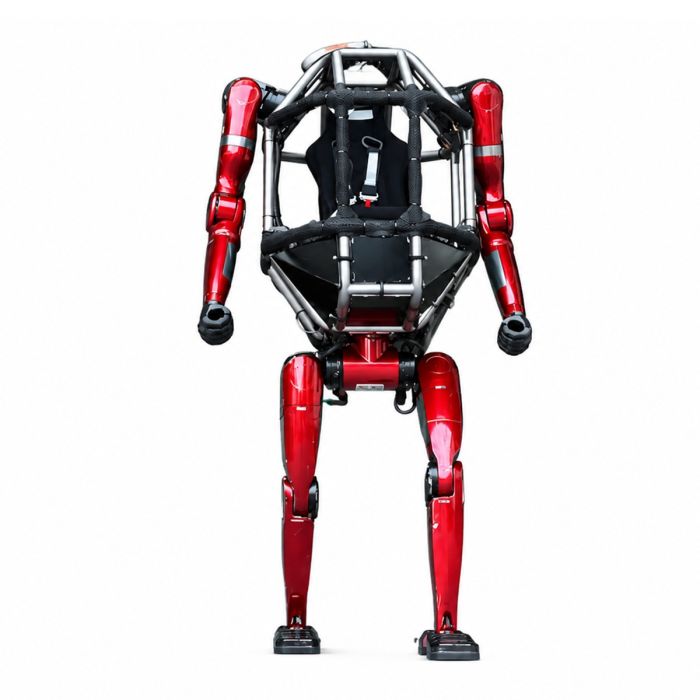
Most legged machines keep their operators at a safe distance, watching from behind a screen or a barrier. The Unitree GD01 Manned Transformable Mecha Robot reverses that arrangement: the pilot climbs inside, sits in the torso, and goes where the legs go. It walks upright like a humanoid, then folds into a four-legged stance when the ground turns rough. That makes it less a robot to be supervised than a vehicle to be driven.
The product is available through this page, by quotation.
Background
Unitree and its in-house approach
Unitree Robotics is best known for legged and humanoid machines, and its recent growth shows how fast that field is moving. The company's annual revenue reached 1.708 billion yuan in 2025, a year-on-year surge of 335.4%, driven by the growth of its humanoid robot business. That scale matters for a product as ambitious as the GD01, because a manned machine leans on every part of the supply chain at once.
One reason Unitree can attempt it is vertical integration. Over 90 percent of the parts, including motors, reducers and controllers, are made in-house. A company that designs its own actuators and controllers can tune them to a specific machine rather than adapting off-the-shelf components. The GD01 also uses hollow-axis joint technology, which hides all the wiring inside the core of the joint. Cables that run through the joint instead of around it are less exposed and less likely to snag on a machine that bends, folds and works in rough surroundings.
Where the GD01 sits among robots
The GD01 is defined as a transformable civilian vehicle. A pilot enters an open cockpit located in its torso and controls the machine from there. It can walk on two legs in a humanoid configuration or shift to a four-legged stance for navigating uneven ground.
Its sensing and software follow the same logic. 3D LiDAR and depth cameras build a wide, all-around picture of the surroundings, which lets the pilot see the machine's situation rather than only what lies ahead. On the software side, Unitree uses Embodied AI via the UnifoLM model as physical common sense. The product is still in its first generation at this stage, and Unitree itself sees plenty of room for imagination. Buyers are looking at the start of a category, not a mature one.
For readers who want a smaller, non-manned point of comparison, the Bipedal Humanoids category shows the walking machines from which this design grew.
Technical Specifications
| Specification | Value |
|---|---|
| Product | Unitree GD01 Manned Transformable Mecha Robot |
| Vehicle classification | Transformable civilian vehicle |
| Height | About 2.8 meters |
| Total weight with passenger | About 500 kilograms |
| Cockpit | Open cockpit in the torso |
| Locomotion modes | Two-legged humanoid walking; four-legged stance |
| Transformation | Folds its legs, adjusts its center of gravity and transitions to quadruped form within seconds |
| Sensors | 3D LiDAR and depth cameras |
| Control software | Embodied AI via the UnifoLM model |
| Joint technology | Hollow-axis joints with wiring inside the core |
| In-house manufacturing | Over 90 percent of parts, including motors, reducers and controllers |
| Generation | First generation |
Specifications as published by the manufacturer; confirmed against the datasheet at quotation.
The manufacturer has not published the battery capacity, the battery life, the top speed, the payload, the degrees of freedom, the power system, the range, the dimensions in quadruped mode, the contents of the box or the IP rating; they are confirmed at quotation.
What makes the GD01 different from a conventional legged robot?
The first difference is the person inside. A typical legged robot is operated from a distance, so the operator sees through cameras and acts through a controller. In the GD01, the pilot sits in the torso and shares the machine's position and motion. For work where judgment on the spot matters, that changes how the machine is used.
The second difference is the ability to change shape. The GD01 folds its legs, adjusts its center of gravity and moves into quadruped form within seconds, then keeps moving without external assistance across uneven terrain. A two-legged stance suits tight, human-scaled spaces, while a four-legged stance suits broken or irregular ground. Having both in a single chassis means the pilot is not forced to choose one compromise for the whole day.
The third difference is the classification. The GD01 is a transformable civilian vehicle, not a lab platform or a research humanoid. That positioning shapes how a buyer thinks about it: as equipment for sites and operations, with a pilot, rather than as a development kit.
How should a buyer read a first-generation product?
The GD01 is still in its first generation. For a buyer, that is both a reason for interest and a reason for care. Early machines in a new category tend to define what the category becomes, and the people who work with them first learn what the machine does well. Battery, speed, payload and range decide whether the machine suits a given job, so raise them in your request before planning a deployment.
Height is one example. The machine measures about 2.8 meters, and a site needs to check clearances for doors, ceilings, transport and the route the machine will take. Weight with a pilot aboard is about 500 kilograms, which matters for floors, ramps and lifting equipment. These are planning questions best settled with the supplier early.
Who is the Unitree GD01 for?
The GD01 is aimed at industrial operations, emergency rescue and cultural tourism. Each of those groups has a different reason to look at it.
Industrial operators will see a machine that carries a person into places where wheels struggle and where a remote robot lacks the operator's direct view. Emergency services will see a pilot-carrying platform that can change stance for rubble and uneven ground; teams planning that kind of work may also want to browse the Emergency Response category for complementary equipment. Cultural tourism operators, such as attractions, exhibitions and theme venues, will see a machine that draws a crowd as soon as it stands up.
The GD01 is less suitable for buyers who need a small, low-cost walking platform for study or coding practice. Those buyers are better served by the smaller humanoids in the Bipedal Humanoids category.
What is the Unitree GD01 used for?
- Industrial operations. A piloted legged machine that works in places where the ground is uneven and a person's direct judgment is valuable.
- Emergency rescue. Moving across rough, broken terrain in quadruped form, with the pilot inside the machine.
- Cultural tourism. Attractions and exhibitions that want a walking, transforming machine as a centerpiece.
- Terrain access. Reaching ground that wheeled vehicles find difficult, using the four-legged stance.
- Confined, human-scale spaces. Walking upright in humanoid configuration where a quadruped would not fit the layout.
- Early-adopter evaluation. Learning what a first-generation manned legged platform can do for your operation.
Pricing and Availability
We do not print prices on this page. A quotation is the way to buy the GD01. Delivery, customs and support are arranged together with the quotation. Send your request and the details of your site, and the Unitree GD01 Manned Transformable Mecha Robot is available on this page.
Frequently Asked Questions
Does the GD01 carry a pilot?
Yes. A pilot enters an open cockpit located in the torso and controls the machine from there.
How tall is the GD01 and how much does it weigh?
It measures about 2.8 meters in height. Its total weight after carrying a passenger is about 500 kilograms.
Can it change shape?
Yes. It can fold its legs, adjust its center of gravity and transition into a quadruped form within seconds. It then continues moving without external assistance across uneven terrain.
What sensors does it use?
It uses 3D LiDAR and depth cameras to build a wide view of its surroundings. Embodied AI via the UnifoLM model serves as its physical common sense.
Which industries is it aimed at?
It is aimed at industrial operations, emergency rescue and cultural tourism.
What should I check before planning a deployment?
Start with the site: a height of about 2.8 meters and a weight of about 500 kilograms with a pilot aboard affect doors, floors, ramps and transport.
Where can I buy the Unitree GD01 and what does it cost?
You can request it through this page. The cost is given by quotation, which also covers delivery, customs and support, and we do not list a price here.
Summary
The Unitree GD01 takes the usual relationship between robot and operator and turns it inside out. The pilot rides in the torso, the machine walks upright or drops to four legs, and sensors and Embodied AI help it keep its footing. It is a first-generation machine from a company that builds most of its own parts, aimed at industrial work, rescue and tourism. If a manned, transformable legged vehicle fits your plans, this page is the starting point.


