
Unitree G1-D Ultimate D U9 Wheel Base Dual-Arm Humanoid Robot
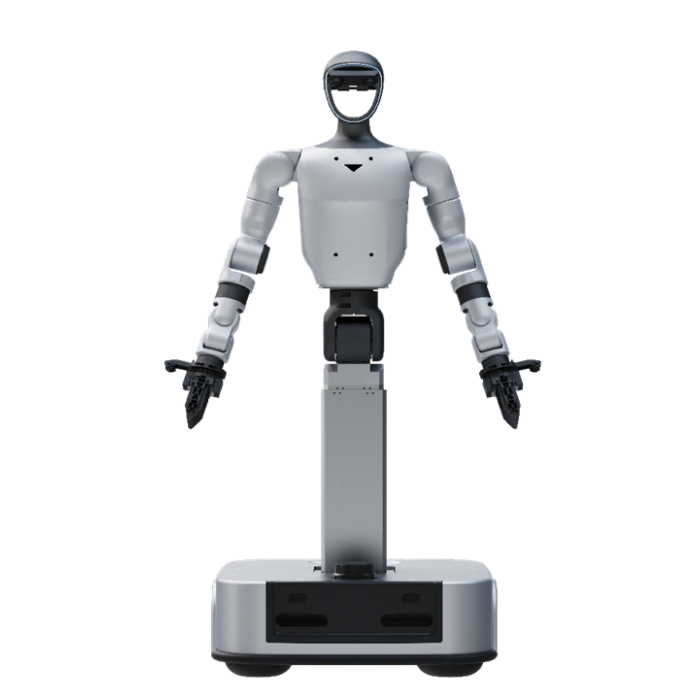
In stock
- BRAND:
- UNITREE ROBOTICS
- MODEL:
- U9
- PART #:
- G1-D-U9
- ORIGIN:
- China
- Warranty:
- 12 MONTHS
- AVAILABILITY:
- SUBJECT TO AVAILABILITY
- SKU:
- Unitree-G1-D-U9
Unitree G1-D Ultimate D U9 Wheel Base Dual-Arm Humanoid Robot
A robot that can reach the top shelf but cannot get to the next bench is only half a helper. The Unitree G1-D Ultimate D U9 Wheel Base Dual-Arm Humanoid Robot is built around closing that gap: two arms on a lifting column, a waist that bends and turns, and a wheeled chassis that carries the whole upper body from one workstation to the next.
This product is available through this page, by quotation.
Background
Unitree and the G1-D line
Unitree Robotics is best known for legged robots and humanoids, and its machines are common in university labs, research institutes and development teams that need a hardware platform they can program rather than a closed appliance. The G1-D line takes a different route from a walking humanoid. Instead of legs, it places a humanoid upper body with two arms on a base, so the work is manipulation and not balance.
Within the line, the sources name a Standard group and an Ultimate group. The Standard versions use a fixed base, while this Ultimate D U9 version sits on a wheel base. Every figure in this article belongs to the Ultimate version described here, and none is borrowed from a sibling.
Positioning of the Ultimate D U9
The Ultimate D U9 combines three motion systems in one body: a two-axis waist, a lifting column and a differential-drive chassis. The arms each have 7 degrees of freedom, the waist has 2, the column has 1 and the base has 2. Together they let the robot change its working height, lean and turn at the torso, and reposition itself on the floor without a person moving it.
Sensing is split between the head, the wrists and the chassis. A head HD binocular camera and two wrist HD cameras serve the manipulation task, while the chassis carries its own set of sensors for moving through a room. For teams that collect demonstration data, a teleoperation system with a sampling rate of 60Hz and a latency below 100ms is part of the published specification.
Technical Specifications
| Specification | Value |
|---|---|
| Arm degrees of freedom | 7×2 |
| Waist degrees of freedom | 2 |
| Column degrees of freedom | 1 |
| Base degrees of freedom | 2 |
| Dimensions at minimum column height | 1260x525x570mm |
| Dimensions at maximum column height | 1680x525x570mm |
| Vertical workspace | 0-2m |
| Waist range of motion | Z-axis: ±155°, Y-axis: -2.5° to +135° |
| Lifting accuracy | ±0.5mm |
| Maximum mobility speed | 1.5m/s |
| Chassis drive type | Differential drive, supports 360° in-place rotation |
| Chassis sensors | LiDAR *1 + Depth Camera *2 + Physical Collision Sensor *2 + Low-Obstacle Detection Sensor *2 |
| Perception sensors | Head HD Binocular Camera *1 + Wrist HD Camera *2 |
| Basic computing power | 8-core High-performance CPU |
| Optional high computing power module | Multiple brands and models available such as Orin NX 16GB (100TOPS), etc. |
| Connectivity | Wi-Fi 6, Bluetooth 5.2 |
| System teleoperation latency | <100ms |
| Teleoperation sampling rate | 60Hz |
Specifications as published by the manufacturer; confirmed against the datasheet at quotation.
The manufacturer has not published the IP rating, the hand weight, the operating temperature, the charging time or the arm reach; they are confirmed at quotation.
What makes the wheel base different from a fixed-base G1-D?
A fixed-base robot has to wait for the work to arrive. Samples, parts and tools must be brought to its station, and anything outside its reach stays out of reach. The wheel base removes that limit. With differential drive and 360° in-place rotation, the Ultimate D U9 can turn where it stands, which matters in narrow aisles and between benches, and it can travel at up to 1.5m/s between stations.
The chassis sensors are what make that movement practical. A LiDAR, two depth cameras, two physical collision sensors and two low-obstacle detection sensors give the base several ways to notice what is around it, including objects close to the floor that a higher camera might miss. Developers can use these inputs for navigation and obstacle handling in their own software.
If your task stays at one workstation, a fixed-base version may be all you need, and the Unitree G1-D Standard A U1 Fixed base Dual-Arm Humanoid Robot is the place to start comparing. If the work moves around a room, the wheel base is the reason to choose this version.
How does the lifting column change what the robot can do?
The column gives the robot a vertical workspace of 0-2m. Its overall height runs from 1260x525x570mm at the lowest setting to 1680x525x570mm at the highest, so the footprint stays the same while the upper body rises and falls. That is useful when one task happens at floor level and the next is on a high shelf.
Lifting accuracy is published as ±0.5mm, which speaks to how precisely the column can be positioned before the arms begin work. Combined with a waist that rotates ±155° around the Z-axis and tilts from -2.5° to +135° on the Y-axis, the robot can approach an object from different heights and angles without moving the base at all.
For comparison within the Ultimate group, you can also look at the Unitree G1-D Ultimate A U6 Wheel Base Dual-Arm Humanoid Robot, and confirm with us which configuration details differ before you decide.
Who is the Unitree G1-D Ultimate D U9 for?
University and institute labs are the most natural buyers. A wheeled, dual-arm platform with published degrees of freedom and a teleoperation system suits groups working on manipulation, imitation learning and whole-body coordination, where the same hardware must serve many experiments.
Integrators and automation teams form a second group. They can evaluate the robot in a mock-up of a real site, such as a laboratory, a small warehouse or a service area, before committing to a larger program. The optional high computing power module, with models such as Orin NX 16GB (100TOPS) mentioned in the specification, lets them match onboard processing to their software.
Educators and demonstration teams can use it to show how perception, motion and teleoperation fit together in one machine. Buyers whose work stays at a single station, or who want a lower-complexity entry point, should look at the fixed-base versions in the Unitree G1-D category.
What is the Unitree G1-D Ultimate D U9 used for?
- Manipulation research. Two 7-degree-of-freedom arms, a waist and a column give researchers a rich platform for studying reaching and bimanual tasks.
- Teleoperated data collection. A 60Hz sampling rate and latency below 100ms support operators who record demonstrations for training.
- Mobile laboratory assistance. The wheel base carries the arms between benches, shelves and test stations.
- Height-varied handling. The 0-2m vertical workspace covers floor-level and high-shelf tasks with one body.
- Navigation and obstacle development. LiDAR, depth cameras and collision and low-obstacle sensors give developers inputs for movement software.
- Teaching and demonstration. A humanoid upper body with visible cameras and wireless connectivity makes robotics concepts easy to show a class or an audience.
Pricing and Availability
We do not list prices for this robot; quotation is the way to buy it. Tell us the configuration you need, including any optional computing module, and we will prepare a quotation. Delivery, customs and support are arranged together with the quotation. The Unitree G1-D Ultimate D U9 Wheel Base Dual-Arm Humanoid Robot is available on this page.
Frequently Asked Questions
How many degrees of freedom does the robot have?
Each arm has 7, giving 7×2 for the arms. The waist has 2, the column has 1 and the base has 2.
How high can it work?
The vertical workspace is 0-2m. The overall dimensions are 1260x525x570mm at minimum column height and 1680x525x570mm at maximum.
How does the robot move around?
It uses a differential-drive chassis that supports 360° in-place rotation, with a maximum mobility speed of 1.5m/s.
Which sensors does it carry?
The head has an HD binocular camera and each wrist has an HD camera. The chassis adds a LiDAR, two depth cameras, two physical collision sensors and two low-obstacle detection sensors.
What computing options are there?
The basic configuration has an 8-core high-performance CPU. An optional high computing power module is offered in several brands and models, such as Orin NX 16GB (100TOPS).
Can it be teleoperated and connected wirelessly?
Yes. System teleoperation latency is below 100ms with a 60Hz sampling rate, and connectivity is Wi-Fi 6 and Bluetooth 5.2.
Where can I buy the Unitree G1-D Ultimate D U9 and what does it cost?
You can buy it through this page by requesting a quotation. The cost depends on the configuration you choose, and we confirm it in the quotation instead of listing a price here.
Summary
The idea behind the Unitree G1-D Ultimate D U9 is simple: bring the arms to the work, and bring them at the right height. A wheel base with 360° in-place rotation, a column with a 0-2m vertical workspace, a two-axis waist and two 7-degree-of-freedom arms turn one platform into something that can serve a whole room. For research groups, integrators and teaching teams that need that reach, this page is the starting point.


