
Unitree G1-D Ultimate B U7 Wheel Base Dual-Arm Humanoid Robot
In stock
- BRAND:
- UNITREE ROBOTICS
- MODEL:
- U7
- PART #:
- G1-D-U7
- ORIGIN:
- China
- Warranty:
- 12 MONTHS
- AVAILABILITY:
- SUBJECT TO AVAILABILITY
- SKU:
- Unitree-G1-D-U7
Unitree G1-D Ultimate B U7 Wheel Base Dual-Arm Humanoid Robot
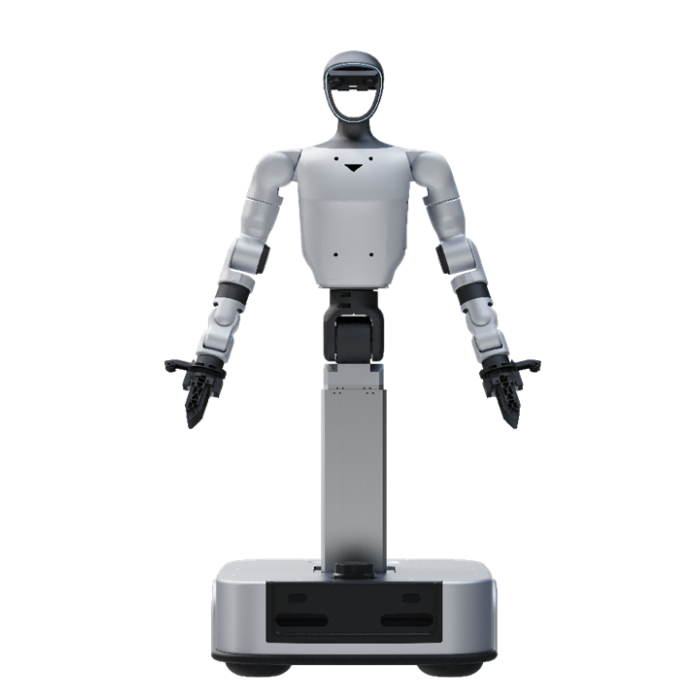
A humanoid upper body is only as useful as the place it can stand. Two arms and a head camera mean little if the robot cannot get to the bench, the shelf or the cart. The Unitree G1-D Ultimate B U7 Wheel Base Dual-Arm Humanoid Robot answers that with a wheeled chassis and a lifting column under a dual-arm torso, so the workspace comes to the arms and the arms can be raised or lowered to meet it.
The Unitree G1-D Ultimate B U7 Wheel Base Dual-Arm Humanoid Robot is available through this page, by quotation.
Background
Unitree Robotics and the G1-D line
Unitree Robotics is the brand of Yushu Technology Co., Ltd., a company known in the robotics trade for legged and humanoid platforms that research groups and integrators buy for development work. The G1-D family carries that experience into a different format. Instead of a walking body, the G1-D puts a dual-arm humanoid upper body on a base built for work at a fixed station or around a room.
The family comes in two broad groups. The Standard versions use a fixed base, and the Ultimate versions use a wheel base. This product, the Ultimate B U7, belongs to the wheel-base group. The full family can be browsed in the Unitree G1-D category.
Positioning and key technology
The central idea of the Ultimate version is a mobile lifting design that combines wheels and lifting mechanisms. The wheels move the whole robot from place to place. The lifting column changes the height of the torso and arms, so the same machine can work at a low table and at a higher shelf.
The chassis uses a differential drive and supports 360° in-place rotation. In practice this means the robot can turn on the spot in a narrow aisle or in front of a bench without a wide turning arc. On the sensing side, the chassis carries a LiDAR, depth cameras, physical collision sensors and low-obstacle detection sensors, while the upper body carries a head HD binocular camera and an HD camera at each wrist. An 8-core high-performance CPU provides the basic computing power.
Technical Specifications
| Specification | Value |
|---|---|
| Version | G1-D (Ultimate) |
| Mobile operation design | Mobile lifting design that combines wheels and lifting mechanisms |
| Chassis drive type | Differential drive, supports 360° in-place rotation |
| Overall dimensions (min. column height) | 1260x525x570mm |
| Overall dimensions (max. column height) | 1680x525x570mm |
| Total weight (incl. battery) | Approx. 90kg |
| Max. single arm payload | Approx. 3kg |
| Chassis sensors | LiDAR *1 + Depth Camera *2 + Physical Collision Sensor *2 + Low-Obstacle Detection Sensor *2 |
| Perception sensors | Head HD Binocular Camera *1 + Wrist HD Camera *2 |
| Basic computing power | 8-core High-performance CPU |
| Battery life | Approx. 6 hours |
| Column lifting speed | Approx. 60mm/s |
Specifications as published by the manufacturer; confirmed against the datasheet at quotation.
The manufacturer has not published the ingress protection rating, the chassis battery voltage, the maximum climbable slope, the operating temperature, the charger specification, the wheel and chassis motor power, the camera resolution or the hand degrees of freedom for each end effector; they are confirmed at quotation.
What makes the wheel base different from a fixed base?
A fixed-base G1-D is installed at one station. It suits a task that always happens in the same place, such as a single bench or a single line position. The wheel-base Ultimate version is built for work that is spread over several places, or for a space that changes from day to day.
Three features carry that difference. First, the differential drive with 360° in-place rotation lets the robot reposition without a large clear area. Second, the chassis sensor set of LiDAR, two depth cameras, two physical collision sensors and two low-obstacle detection sensors gives the base the means to observe its surroundings as it moves. Third, the lifting column moves the torso between the minimum and maximum column heights, at an approximate speed of 60mm/s, so reach is not fixed at one level.
These are the reasons to choose the wheel base. If your task never leaves one station, a fixed-base sibling such as the Unitree G1-D Standard C U3 Fixed base Dual-Arm Humanoid Robot may fit better. The Ultimate version is the one to consider when the robot has to travel.
How does the lifting column change what the arms can do?
Arm reach is only part of manipulation. Height decides which surfaces the hands can reach comfortably, and a robot with a fixed torso height has to be matched to one working level. The lifting column here moves the torso, so the overall dimensions change from 1260x525x570mm at minimum column height to 1680x525x570mm at maximum column height. The footprint of 525x570mm stays the same in both positions.
With a maximum single arm payload of approx. 3kg, the platform is aimed at light objects: containers, tools, sample holders and similar items. The two wrist HD cameras and the head HD binocular camera give the operator or the software views from the hands and from the head, which matters when a grasp is judged by what the wrist sees. At approx. 90kg including battery, the robot is a floor-standing machine and should be planned for as such when you consider transport and handling.
Who is the Unitree G1-D Ultimate B U7 for?
Research laboratories are the clearest segment. A team studying dual-arm manipulation, teleoperation or learning from demonstration gets a humanoid upper body that can be brought to different experimental setups, with an approx. 6 hour battery life for a working session.
Universities and training centers form a second segment. A wheeled humanoid is a practical teaching platform because students can work on navigation, perception and manipulation on the same robot.
System integrators and pilot-project teams are a third. They can use the platform to test whether a mobile dual-arm approach suits a customer task before committing to a purpose-built cell.
If your application is stationary, look at the fixed-base versions, for example the Unitree G1-D Standard A U1 Fixed base Dual-Arm Humanoid Robot. If you want to compare within the wheel-base group, the Unitree G1-D Ultimate A U6 Wheel Base Dual-Arm Humanoid Robot is the other listed Ultimate version, and we can go through the differences with you when you request a quotation.
What is the Unitree G1-D Ultimate B U7 used for?
- Dual-arm manipulation research. Two arms with wrist cameras give a basis for studying bimanual grasping and handling.
- Teleoperation and data collection. Head and wrist camera views support remote operation and the recording of demonstrations for later learning.
- Mobile navigation experiments. LiDAR and depth cameras on the chassis allow work on mapping, obstacle handling and movement through a space.
- Teaching in robotics courses. One platform covers drive, sensing, lifting and manipulation in a single classroom or lab exercise.
- Light pick-and-place trials. With an approx. 3kg payload per arm, it can be used to test handling of small, light items at different heights.
- Pilot evaluations for integrators. A mobile dual-arm unit helps test whether an application justifies a larger deployment.
Pricing and Availability
We do not publish prices on this page. Quotation is the way to buy: tell us your configuration needs, your location and your timeline, and we will respond with a quotation. Delivery, customs and support are arranged together with the quotation. The Unitree G1-D Ultimate B U7 Wheel Base Dual-Arm Humanoid Robot is available on this page.
Frequently Asked Questions
What is the drive type of the chassis?
The chassis uses a differential drive and supports 360° in-place rotation. It is combined with a lifting mechanism in a mobile lifting design.
How tall is the robot?
The overall dimensions are 1260x525x570mm at minimum column height and 1680x525x570mm at maximum column height.
How much can each arm carry?
The maximum single arm payload is approx. 3kg.
How long does the battery last?
Battery life is approx. 6 hours, and the weight of approx. 90kg already includes the battery.
Which sensors does it carry?
The chassis has one LiDAR, two depth cameras, two physical collision sensors and two low-obstacle detection sensors. The upper body has one head HD binocular camera and two wrist HD cameras.
Is there a fixed-base version?
Yes. The G1-D family includes fixed-base Standard versions, which you can compare in the Unitree G1-D category.
Where can I buy the Unitree G1-D Ultimate B U7 and what does it cost?
You can buy it through this page by requesting a quotation. The cost depends on your configuration and delivery destination, so it is given in the quotation and not printed here.
Summary
A humanoid is of limited use if it can only work where it was bolted down. The Unitree G1-D Ultimate B U7 Wheel Base Dual-Arm Humanoid Robot addresses this with a differential-drive chassis that rotates 360° in place, a lifting column between 1260mm and 1680mm overall height, two arms with an approx. 3kg payload each, and a sensor set on both the chassis and the upper body. It suits laboratories, universities and integrators who need a mobile dual-arm platform and want to take it to the work. For a quotation, or to compare it with the other versions in the family, this page is the starting point.


