
Unitree G1 Competition Humanoid Robot
In stock
- BRAND:
- UNITREE ROBOTICS
- PART #:
- G1-Comp
- ORIGIN:
- China
- AVAILABILITY:
- SUBJECT TO AVAILABILITY
- SKU:
- Unitree-G1-Comp
Unitree G1 Competition Humanoid Robot
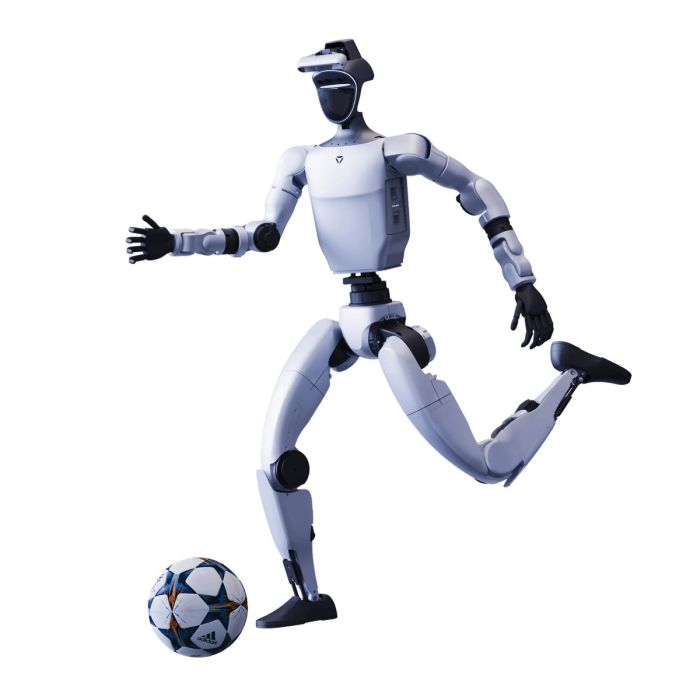
Every football team keeps a playbook; a robot football team keeps a code repository. The Unitree G1 Competition Humanoid Robot is the machine on which that repository gets its answer, with legs to carry the plan onto the pitch, a pair of sensors to read the game and an onboard computer to make the decisions in real time.
The Unitree G1 Competition Humanoid Robot is available through this page, by quotation.
Background
Unitree and the G1 family
Unitree was established in 2016 and has advanced to mass production of robot dogs and androids. That history matters to a buyer in practical ways. A manufacturer that builds legged machines in volume has already learned how to make joints, actuators and batteries that survive repeated use, and the humanoid line draws on that experience.
The G1 name covers more than one version. The sources for this product name the G1, the G1 EDU and the G1-Comp. This page concerns the G1-Comp only, and every figure below belongs to that version alone.
What the G1-Comp is built to do
Unitree presents the G1-Comp as a football icon designed for competitions. The positioning is specific: the robot is tuned for a stadium rather than for a laboratory bench or a showroom floor. It carries a built-in YOLO11 real-time target detection algorithm, which provides a rich stadium information interface, so the robot can see the ball, the goal and the other players without the team writing a vision stack from scratch.
Behind that interface sits an Orin NX development computing unit that provides 100TOPS of AI computing power. A depth camera and a 3D LiDAR supply the sensing. Secondary development is supported, and the robot is compatible with the ROS ecosystem, which means teams can bring their own behaviors, planners and tools to it.
Technical Specifications
| Specification | Value |
|---|---|
| Positioning | Football icon designed for competitions |
| Dimensions standing (H x W x T) | 1320x450x200mm |
| Dimensions folded (H x W x T) | 690x450x300mm |
| Weight (with battery) | About 35kg+ |
| Total degrees of freedom | 25-45 |
| Head degrees of freedom | 2 |
| Single leg degrees of freedom | 6 |
| Maximum knee joint torque | 120N·m |
| Arm maximum load | About 3Kg |
| Development computing unit | Orin NX, 100TOPS AI computing power |
| Sensing | Depth camera, 3D LiDAR |
| Connectivity | WiFi 6, Bluetooth 5.2 |
| Battery | Smart Battery (Quick Release) 9000mAh |
| Charger | 54V 5A |
| Battery life | About 2h |
| Secondary development | Yes |
| Simulation environment | Isaac gym, Mujoco |
| Visual recognition API | Built-in YOLO11 real-time target detection algorithm |
| ROS support | Compatible with ROS ecosystem |
| Shell | Aluminum alloy and high-strength engineering plastics |
Specifications as published by the manufacturer; confirmed against the datasheet at quotation.
The manufacturer has not published the maximum walking speed, the IP rating, the camera model, the contents of the box or the operating temperature; they are confirmed at quotation.
What makes the G1-Comp different from a general-purpose humanoid?
A general-purpose humanoid is built to be adequate at many tasks. The G1-Comp is built around one demanding setting, and the facts show where that focus lands. The visual recognition interface is aimed at the stadium. The simulation environments, Isaac gym and Mujoco, are named in the specification, so a team can train and test behavior virtually before it ever touches a real pitch.
The mechanical side supports that focus. Each leg has 6 degrees of freedom, the head has 2, and the knee joint reaches a maximum torque of 120N·m. Those are the joints that matter when a robot has to turn, kick and recover its balance. The shell is covered with aluminum alloy and high-strength engineering plastics, a sensible choice for a machine that will meet other robots and the ground more often than a lab robot would.
Logistics count in competition as well. The robot stands 1320x450x200mm and folds to 690x450x300mm, so a team can move it between venues in a much smaller package than its standing size suggests. The Smart Battery is a quick-release type of 9000mAh, which lets a crew swap power between sessions, and the battery life is about 2h.
How does the G1-Comp support your own development work?
Many teams buy a humanoid because they want to write the behavior themselves. The G1-Comp supports secondary development and is compatible with the ROS ecosystem, so existing robotics tools and habits carry over. The Orin NX computing unit gives 100TOPS of AI computing power for perception and decision code, and WiFi 6 and Bluetooth 5.2 handle communication with laptops, tablets and field equipment.
Sensing comes from a depth camera and a 3D LiDAR, giving the software both image data and range data to work with. Combined with the built-in YOLO11 detection, a team can begin with the supplied interface and replace parts of it as its own methods mature. The arms carry a maximum load of about 3Kg, which is enough to consider simple handling experiments alongside the sport itself.
Who is the Unitree G1 Competition Humanoid Robot for?
University and school teams entering robot football will find the clearest fit, since the robot is positioned for competitions and brings its own vision interface and simulation support. Research groups in AI, locomotion and human-robot interaction can use it as a physical test bed for algorithms that have so far lived only in simulation.
Technical institutes and training centers in the Caribbean can use it to give students hands-on practice with ROS, perception and control on a real bipedal machine. Event organizers and science museums may also want a robot that draws a crowd and can be shown moving and responding. Buyers who need a different G1 version, such as the G1 or the G1 EDU, should ask about it when requesting a quotation, because the figures on this page belong to the G1-Comp alone.
What is the Unitree G1 Competition Humanoid Robot used for?
- Robot football competition. The purpose the manufacturer names, with a stadium information interface built in.
- Simulation-to-real training. Behavior developed in Isaac gym or Mujoco can be tested on the physical robot.
- Computer vision research. The built-in YOLO11 detection and the depth camera give a working base for perception projects.
- Locomotion and balance studies. Six degrees of freedom per leg and strong knee torque support gait and recovery experiments.
- ROS-based teaching. Compatibility with the ROS ecosystem lets classes use familiar tools on a humanoid.
- Public demonstrations. A folding, transportable humanoid suits exhibitions, school visits and technology showcases.
Pricing and Availability
Pricing is provided by quotation, tailored to your project and your location. Delivery, customs and support are arranged with the quotation, so you know the full picture before you commit. To start, send your request and the configuration you need, and the Unitree G1 Competition Humanoid Robot is available on this page.
Frequently Asked Questions
What is the G1-Comp designed for?
Unitree describes it as a football icon designed for competitions. It is built for robot football, with a stadium-oriented vision interface.
How tall is it, and can it be transported easily?
It stands 1320x450x200mm and folds to 690x450x300mm. With the battery it weighs about 35kg+.
What computing power does it carry?
The development computing unit is an Orin NX that provides 100TOPS of AI computing power. Sensing comes from a depth camera and a 3D LiDAR.
How long does the battery last?
The battery life is about 2h from the Smart Battery (Quick Release) of 9000mAh. The charger is rated 54V 5A.
Can I program it myself?
Yes. Secondary development is supported, the robot is compatible with the ROS ecosystem, and simulation is available in Isaac gym and Mujoco.
Are the walking speed and the IP rating listed?
No, neither appears among the figures for this robot, and the same goes for the camera model, the box contents and the operating temperature. Ask for them when you request your quotation.
Where can I buy the Unitree G1 Competition Humanoid Robot and what does it cost?
You can request it through this page. The cost is given in a quotation prepared for your configuration and destination.
Summary
A robot football team wins with a good playbook, and the playbook only counts once a machine can run it on the pitch. The Unitree G1 Competition Humanoid Robot supplies that machine: 6-degree-of-freedom legs, a 120N·m knee joint, an Orin NX with 100TOPS, a depth camera and 3D LiDAR, built-in YOLO11 detection, and open development through ROS and two simulation environments. It folds for travel and swaps its battery quickly. For teams, schools and labs across the Caribbean, this page is the starting point.
Specifications
General
What's included
Related Products
Out of stock