
Unitree D1-T Teleoperation Robot Arm
In stock
- BRAND:
- UNITREE ROBOTICS
- MODEL:
- GO2 SERVO ROBOTIC ARM
- ORIGIN:
- China
- AVAILABILITY:
- SUBJECT TO AVAILABILITY
- SKU:
- Unitree-D1-T
Unitree D1-T Teleoperation Robot Arm
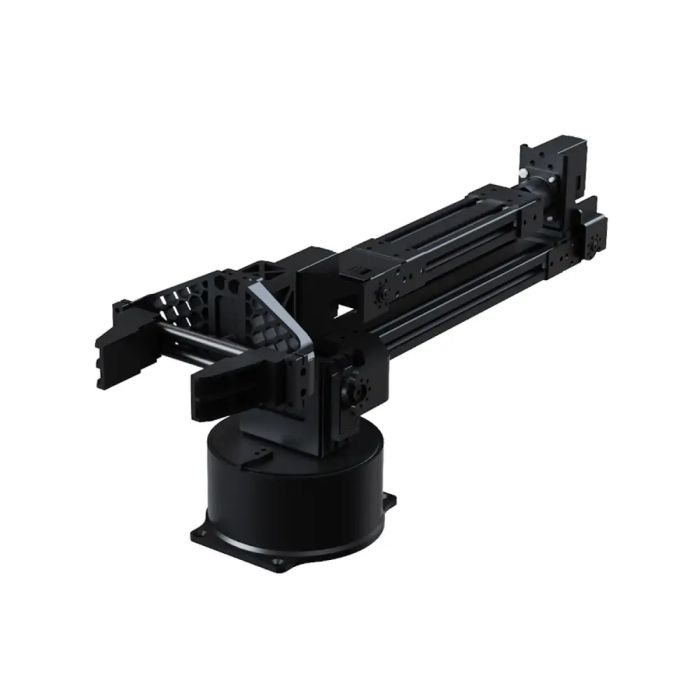
A robot arm that learns from people is only as good as the demonstrations it is shown. The Unitree D1-T Teleoperation Robot Arm is made for that exchange: a human guides, the arm follows, and every motion becomes data a robot can learn from later. It is a light, approachable arm for teams who want to start teaching and testing sooner, not a heavy machine that needs a cage and a long commissioning plan.
The product is available through this page, by quotation.
Background
The company behind the arm
Unitree is the brand of Yushu Technology Co., Ltd., a company known in robotics for legged robots and for the arms, grippers and accessories that extend them. Its products tend to reach universities, research labs and integrators because they are built to be programmed, extended and experimented with, not only run as shipped.
The D1-T carries the model designation D1 and sits in the company's arm line. That line exists for a simple reason: a mobile robot that can walk or roll but cannot touch anything is limited, and an arm closes that gap. Buyers in the Caribbean who already follow Unitree's quadrupeds will find the arm a natural next step, and the Unitree Arms category shows the wider range of manipulation hardware.
Positioning and key technology
Unitree positions the D1-T as a leading choice for embodied intelligent assistants, aimed at data acquisition and continuous learning. In practice that means an arm used to collect demonstrations, train models and then test what was learned on real objects.
The arm is a true six-axis design: six joints plus a gripper, which adds one degree of freedom and gives more flexibility of movement in space. The body is aluminum alloy, and the arm stays lightweight. It is driven by bus servo motors and offers position control, velocity control and force control, so the same hardware can serve a gentle learning exercise or a more demanding application project.
Developers can work at two levels. Low-level and high-level interfaces allow direct control of the servo motor as well as access to advanced functions. The arm can also be connected to external devices such as cameras and mobile robot chassis, so it can be combined with different scenes and applications.
The D1-T is offered in two kit editions: the Dual-Arm AI Teleoperation Kit (Standard Edition) and the Quad-Arm AI Teleoperation Kit (Full Edition). The kit names point to the number of arms involved, which matters for bimanual work and for larger teleoperation setups.
Technical Specifications
| Specification | Value |
|---|---|
| Model | D1 |
| Weight | About 2.37Kg |
| Material | Aluminum alloy |
| Arm length | 670mm |
| Reach | 550mm (gripper not included); 670mm (gripper included) |
| Degrees of freedom | Six joints and a gripper |
| Payload | 500g |
| Motor type | Bus Servo |
| Control modes | Position control, velocity control, force control |
| Power | 60W |
| Power supply | 24V 2.5A (MAX 5A) |
| Interface | DC5.5-2.1 (power supply) + RJ45 (communication) + Type-C (serial port debugging) |
Specifications as published by the manufacturer; confirmed against the datasheet at quotation.
The manufacturer has not published the repeatability, the joint travel ranges, the joint speed, the operating temperature, the ingress protection rating, the box contents of a single arm or the software SDK support; they are confirmed at quotation.
What makes the D1-T different from a typical desktop arm?
Many small arms are built as demonstrators: they move, they look good on a bench, and they offer little beyond a fixed set of motions. The D1-T is aimed at a different job. Its control modes cover position, velocity and force, and its interfaces reach down to the servo motor itself. A researcher can therefore treat it as an open platform instead of a closed appliance.
Weight is the second difference. At about 2.37Kg in an aluminum alloy body, the arm is easy to place on a bench, mount on a mobile base or move between rooms. That matters for teams who share equipment between a classroom and a lab, or who test an idea on a chassis before committing to a final design.
The third difference is the kit structure. Because the D1-T is sold in a dual-arm and a quad-arm edition, a buyer is not limited to a single arm doing a single task. Two arms allow two-handed demonstrations, and the larger edition is meant for fuller teleoperation setups.
How does the D1-T connect to other hardware?
The arm takes power through a DC5.5-2.1 connector, communicates over RJ45, and offers a Type-C port for serial port debugging. That mix is practical: a network cable for the control loop and a simple port for bringing up and checking the arm.
Beyond the arm's own ports, it can be connected to external devices such as cameras and mobile robot chassis. A camera gives the system eyes for recording demonstrations, and a chassis gives it mobility. Buyers who already operate Unitree legged robots may also want to browse the Quadruped Accessories category when planning a complete system, and the related Unitree Go2 Servo Robotic Arm D1 page may help with comparison.
Who is the Unitree D1-T for?
University labs and research groups are the clearest fit. They need an arm that can be programmed at several levels, that supports force control, and that is light enough to reconfigure often. Graduate students working on imitation learning or data collection will recognize the workflow the D1-T is designed for.
Educators and training centers form a second group. A six-axis arm with a gripper teaches kinematics, control and sensing in one device, and the learning-oriented control modes suit a wide range of classroom scenarios.
System integrators and developers of embodied intelligent assistants are a third group. They can combine the arm with cameras and mobile chassis to prototype an application before moving to a final design. Teams that need two-handed work should look at the Dual-Arm AI Teleoperation Kit (Standard Edition), while those planning a larger teleoperation setup should consider the Quad-Arm AI Teleoperation Kit (Full Edition).
The arm is less suited to buyers who need a heavy payload. The payload is 500g, so it is a tool for light objects, learning tasks and research, not for heavy handling.
What is the Unitree D1-T used for?
- Teleoperation data collection: an operator guides the arm through grasps and placements so the motions can be recorded for later learning.
- Embodied intelligence research: labs use the arm to test how a robot learns to manipulate objects through continuous learning.
- Teaching robotics: students practice position, velocity and force control on a real six-axis arm with a gripper.
- Mobile manipulation: the arm is connected to a mobile robot chassis so a moving platform can also pick and place light items.
- Vision-guided tasks: an external camera is added to support recording, inspection or object handling experiments.
- Application prototyping: developers use the low-level and high-level interfaces to build and test new functions before a final design.
Pricing and Availability
No prices are listed here, because the right configuration depends on the kit edition and on what you plan to connect. Request a quotation and tell us whether you need the dual-arm or the quad-arm edition, and what host hardware you have in mind. Delivery, customs and support are arranged with the quotation, so you see the whole picture at once. The Unitree D1-T Teleoperation Robot Arm is available on this page.
Frequently Asked Questions
How much can the D1-T lift?
The payload is 500g. It is intended for light objects, learning tasks and research work.
How far can the arm reach?
Reach is 550mm without the gripper and 670mm with the gripper included. The arm length is 670mm.
What control modes does it offer?
It offers position control, velocity control and force control. Low-level and high-level interfaces give direct access to the servo motor and to advanced functions.
What does it need for power and communication?
The power supply is 24V 2.5A (MAX 5A) through a DC5.5-2.1 connector, and the arm is rated at 60W. Communication runs over RJ45, and a Type-C port handles serial port debugging.
Can I add a camera or mount it on a mobile base?
Yes. The arm can be connected to external devices such as cameras and mobile robot chassis.
Which kit editions exist?
There is a Dual-Arm AI Teleoperation Kit (Standard Edition) and a Quad-Arm AI Teleoperation Kit (Full Edition). Tell us which one you need when you request a quotation.
Where can I buy the Unitree D1-T Teleoperation Robot Arm and what does it cost?
You can buy it through this page, by quotation. The cost depends on the kit edition and the delivery arrangements, and it is given with the quotation.
Summary
The D1-T starts from a simple idea: teaching a robot is a human activity, and the hardware should make it easy. A light aluminum alloy arm with six joints and a gripper, three control modes, open interfaces and two kit editions gives researchers, educators and developers a practical platform for collecting demonstrations and building on them. The payload and reach make clear that it is made for learning and light manipulation. If that is the kind of work you have in mind, this page is the starting point.
Specifications
General
Physical
Shipping
What's included
Related Products
Out of stock


