
PUDU T300 Towing
In stock
- BRAND:
- PUDU ROBOTICS
- PART #:
- PUDU T300 Towing
- ORIGIN:
- China
- AVAILABILITY:
- SUBJECT TO AVAILABILITY
- SKU:
- PUDU-T300-Towing
PUDU T300 Towing
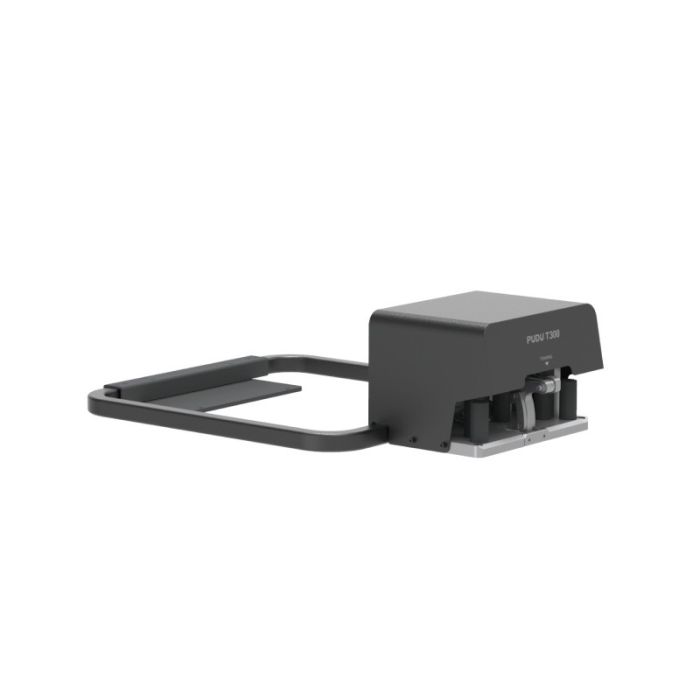
Every plant has a cart that somebody pushes, again and again, from the same station to the same dock. The PUDU T300 Towing is built to take that walk over. It hitches to a wheeled carrier, brings it to the destination, lets go and heads off to the next job, so the carts you already own keep their place in the workflow.
The product is available through this page, by quotation.
Background
Pudu Robotics and the T300 platform
PUDU ROBOTICS is a maker of service and industrial robots, with delivery robots, cleaning robots and mobile platforms in its range. The T300 is its industrial autonomous mobile robot (AMR), and it is a modular design. The manufacturer lists delivery, lifting, towing and following capabilities as accessories on the same base machine. Three versions are named in the sources: PUDU T300 Standard, PUDU T300 Lifting and PUDU T300 Towing.
This modular idea matters to a buyer. A site does not have to commit to one single way of moving goods. The platform carries the navigation, the battery and the safety functions, while the accessory decides what the robot does at the point of handover. You can learn more about the maker's other machines in the Pudu category.
What the towing version is for
The towing version is aimed at facilities where wheeled carts and trolleys are already the standard way to move material. Instead of replacing those carriers with a new platform, the robot pulls them. The manufacturer gives the towing capability as 400 kg.
Navigation uses VSLAM and Lidar SLAM, two mapping methods that let the robot locate itself in a building and plan its route. For obstacle detection the robot relies on LiDAR sensors and depth cameras. The robot complies with ISO 3691-4, the safety standard for driverless industrial trucks. It also offers auto-charging and a quick battery swap for 24/7 operations, and elevator integration for multi-floor tasks.
Technical Specifications
The table shows each figure with the version it is published for. Where a figure belongs to the Standard or the Lifting version, it is not a figure for the Towing version.
| Specification | Value | Version |
|---|---|---|
| Towing capability | 400 kg | PUDU T300 Towing |
| Navigation methods | VSLAM & Lidar SLAM | T300 platform |
| Safety standard | Complies with ISO 3691-4 | T300 platform |
| Battery capacity | 30Ah | T300 platform |
| Charging time | 2h (from 0% to 90%) | T300 platform |
| Run-time (no load) | 12 h | PUDU T300 Lifting |
| Maximum speed | 1.2 m/s (3.94 ft/s) | PUDU T300 Lifting |
| Machine weight | 81 kg (178.57 lbs) | PUDU T300 Lifting |
| Machine weight | 65 kg (143.3 lbs) | PUDU T300 Standard |
| Machine dimensions | 83.5 cm x 50 cm x 135 cm (32.8 in x 19.6 in x 53.1 in) | PUDU T300 Standard |
| Threshold crossing height | Maximum 20 mm (0.78 in) | T300 platform |
| Groove crossing width | Maximum 35 mm (1.37 in) | T300 platform |
| Path clearance | Minimum 60 cm (23.6 in) | T300 platform |
Specifications as published by the manufacturer; confirmed against the datasheet at quotation.
The manufacturer has not published the weight and dimensions of the towing attachment, the IP rating, the operating temperature for the towing version, the list of compatible towing hitches or the contents of the box; they are confirmed at quotation.
How does towing differ from carrying a load on the robot?
A robot that carries goods on its own platform is limited by that platform. Its shelf or tray decides what fits, and every new kind of load may need a new fixture. A towing robot turns this around. The carrier is the cart, and the cart can be whatever the site already uses. The robot only has to connect to it, move it and release it.
The source describes the towing capability as 400 kg. For a site, the practical meaning is that a loaded cart or a short train of carts can be moved by the robot without a person on the handle. The same T300 platform also exists in a Standard version and a Lifting version, so the choice between them comes down to how your goods travel today.
Navigation is the other half of the answer. With VSLAM and Lidar SLAM the robot works from maps of the building, and it can be sent between zones without tracks or guide tape. LiDAR sensors and depth cameras help it detect obstacles on the way, and ISO 3691-4 compliance gives safety teams a recognized standard to check against.
Can it work around the clock and across floors?
Yes, the platform is built with that in mind. The manufacturer lists auto-charging and a quick battery swap for 24/7 operations. The battery capacity is 30Ah and the charging time is 2h from 0% to 90%. The run-time with no load of 12 h is published for the Lifting version, so ask for the towing figure when you request a quotation.
For buildings with several levels, elevator integration for multi-floor tasks is listed. The platform can cross a threshold of up to 20 mm and a groove up to 35 mm wide, and it needs a path clearance of at least 60 cm. These are useful numbers when you walk a route and look for door sills, expansion joints and narrow passages.
Who is PUDU T300 Towing for?
The first group is factories that move parts, packaging and finished goods on carts between stations. The labor to be saved there is plain push and pull work, repeated many times a shift. The second group is warehouses and distribution areas with rolling carriers for kitting, returns or transfers between zones. The third is facilities with several floors, where elevator integration lets one robot serve more than one level.
If your goods are boxes or totes that you would rather place directly on the robot, a towing version may not be the best fit, and the Standard or Lifting version of the T300 may suit you better. For lighter loads there is also the PUDU T150 Light-Payload Industrial Delivery Robot. Our team can help you compare these options for your own routes.
What is PUDU T300 Towing used for?
- Line-side delivery. Bring carts of components to the production line on a steady route.
- Kitting transfers. Move prepared kit carts from the kitting area to the stations that need them.
- Work-in-progress transfer. Pull carts of semi-finished goods between departments.
- Returns and empties. Take empty carts and returned goods back to where they start.
- Warehouse zone-to-zone moves. Link receiving, storage and dispatch areas without a driver.
- Multi-floor logistics. Use elevator integration to carry carts between floors of the same building.
Pricing and Availability
We do not list prices on this page. A quotation is the way to ask about this robot, and it lets us match the configuration to your carts and your routes. Delivery, customs and support are arranged with the quotation. PUDU T300 Towing is available on this page.
Frequently Asked Questions
How much can PUDU T300 Towing pull?
The manufacturer gives the towing capability as 400 kg.
How does the robot find its way?
It navigates with VSLAM and Lidar SLAM, and it uses LiDAR sensors and depth cameras for obstacle detection.
Which safety standard does it meet?
It complies with ISO 3691-4, the safety standard for driverless industrial trucks.
How long does charging take?
Charging takes 2h from 0% to 90%. The robot also supports auto-charging and a quick battery swap for 24/7 operations.
Can it use elevators?
Yes, elevator integration for multi-floor tasks is listed among its functions.
What obstacles can it cross?
It can cross a threshold up to 20 mm (0.78 in) high and a groove up to 35 mm (1.37 in) wide. It needs a path clearance of at least 60 cm (23.6 in).
Where can I buy PUDU T300 Towing and what does it cost?
You can request it through this page, by quotation. Cost depends on the configuration and the project, so we give it with the quotation and not here.
Summary
The idea behind this robot is simple: the cart is already there, and the walking is what gets automated. PUDU T300 Towing pulls up to 400 kg, navigates with VSLAM and Lidar SLAM, complies with ISO 3691-4 and supports 24/7 operation through auto-charging and a quick battery swap. If your carts are the backbone of your material flow and you want them to move without someone pushing them, this page is the starting point.


