
PUDU Robotics D9 Humanoid Robot
In stock
- BRAND:
- PUDU ROBOTICS
- PART #:
- D9
- ORIGIN:
- China
- AVAILABILITY:
- SUBJECT TO AVAILABILITY
- SKU:
- Pudu-Robotics-D9
PUDU Robotics D9 Humanoid Robot
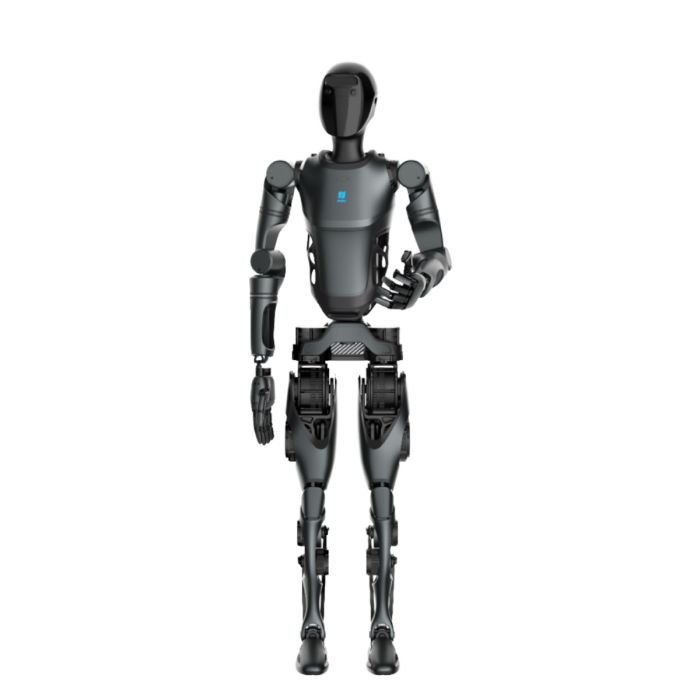
Plenty of robots can carry a tray down a clear aisle. Far fewer can walk into a room, climb the steps, and then use their hands once they arrive. The PUDU Robotics D9 Humanoid Robot belongs to that second group: an adult-sized bipedal machine that stands 170 cm tall and is meant to work in spaces that were built for people, not for robots.
The PUDU Robotics D9 Humanoid Robot is available through this page, by quotation.
Background
The company and its lineage
PUDU Robotics is best known for service robots that work in restaurants, hotels, and commercial buildings, including delivery and cleaning machines. The D9 grows out of that background in real-world deployment. It sits within the company's X-Lab line, and you can browse related research platforms on the X-Lab page.
Moving from wheeled service machines to a walking humanoid is a natural step for a company that already knows how people and robots share a workplace. Corridors, doors, counters, and shelves all assume a human body. A robot with a human-scale body, two arms, and hands is one way to meet those spaces on their own terms.
Positioning and key technology
The D9 is a full-sized bipedal humanoid, and you will find it among the Bipedal Humanoids in our catalog. Three technologies define it.
The first is locomotion. The bipedal structure lets the D9 walk at speeds comparable to an adult, reaching up to 2 m/s on flat surfaces. It can navigate stairs, slopes, and other challenging urban terrains.
The second is perception and navigation. The D9 uses a visual semantic navigation system with high-accuracy sensors, which builds a real-time 3D semantic map. That gives the robot a fuller understanding of its surroundings than a plain obstacle map would.
The third is manipulation. Two 7-degree-of-freedom robotic arms end in PUDU DH11 dexterous hands. Each hand has 12 tactile sensing regions, 6 active degrees of freedom, and 5 passive degrees of freedom. Visual, tactile, force, and auditory sensors feed AI models for multimodal interaction, so the robot can combine what it sees, hears, and feels.
Technical Specifications
| Specification | Value |
|---|---|
| Height | 170 cm (66.93 inches) |
| Weight | 65 kg (143.30 pounds) |
| Leg length | Thigh 325 mm (12.80 inches); calf 383 mm (15.08 inches) |
| Arm length | Arm 580 mm (22.83 inches); hand 220 mm (8.66 inches) |
| Degrees of freedom | Total 42; single leg 6; single arm 7 |
| Maximum joint torque | 352 N·m |
| Maximum payload | 20 kg (44.09 pounds); single arm 10 kg (22.05 pounds) (testing environment) |
| Sensors | RGB, RGBD, tactile sensors, IMU |
| Computing power | 275 TOPS |
| Battery | 15 Ah (0.72 kWh) |
| Maximum walking speed | Up to 2 m/s on flat surfaces |
| Dexterous hand (PUDU DH11) | 12 tactile sensing regions; active DOF 6; passive DOF 5 |
Specifications as published by the manufacturer; confirmed against the datasheet at quotation.
The manufacturer has not published the battery runtime per charge, the charging time, the IP rating, the operating system, the connectivity options, the contents of the box, or the operating temperature range; they are confirmed at quotation.
What makes the D9 different from a wheeled robot?
A wheeled platform is hard to beat on a smooth, open floor. It is simple, stable, and efficient. The trouble starts where the building stops being smooth: a step, a threshold, a slope, a stair landing. The D9 is built for exactly those places, since it can navigate stairs, slopes, and other challenging urban terrains on two legs.
The legs are also a statement about scale. With a 170 cm frame, a thigh of 325 mm, and a calf of 383 mm, the D9 moves through space in proportions close to an adult's. Six degrees of freedom in each leg give it the joint range to do that, and a maximum joint torque of 352 N·m provides the strength behind the movement.
The other difference is in the hands. A simple gripper opens and closes. The DH11 hand has 12 tactile sensing regions, so the robot can feel contact rather than only see it, which matters when an object is fragile, slippery, or awkward. Combined with 7-degree-of-freedom arms, that is what lets the D9 go beyond walking into handling.
How much can the D9 carry and think?
The published maximum payload is 20 kg in a testing environment, with 10 kg per arm. That is a useful capacity for moving bins, parcels, and equipment, though real tasks depend on the object, the grip, and the surface. Please raise your specific loads when you request a quotation.
On the computing side, the D9 offers 275 TOPS, which supports its perception, semantic mapping, and multimodal AI models. Its sensor set includes RGB and RGBD cameras, tactile sensors, and an IMU. The battery is rated at 15 Ah (0.72 kWh).
Who is the PUDU Robotics D9 Humanoid Robot for?
Research laboratories and universities will find a full-sized platform for studying embodied intelligence, bipedal locomotion, and tactile manipulation. The sensor set and the dexterous hands give students and engineers something real to work with.
Companies exploring automation in human-built workplaces, such as hotels, hospitality venues, campuses, and commercial buildings, can use the D9 as a pilot platform to test how a walking, hand-equipped robot fits their routines.
Developers of AI and robotics applications will value the multimodal sensing and the 275 TOPS of computing power as a base for experiments in perception and interaction.
If your spaces are mostly flat and you do not need legs, a wheeled humanoid may suit you better. In that case, look at the PUDU D7 Wheeled Humanoid Robot. If you need stairs, slopes, and two walking legs, the D9 is the one to consider.
What is the PUDU Robotics D9 Humanoid Robot used for?
- Research and education. A full-sized bipedal platform for studying walking, balance, and embodied AI.
- Dexterous manipulation trials. Tactile DH11 hands let teams test grasping of objects of different shapes and firmness.
- Material handling pilots. Two arms with a published maximum payload of 20 kg in testing can move boxes and equipment.
- Multi-level building navigation. Stairs and slopes are part of what the D9 is designed to handle.
- Human-robot interaction. Visual, tactile, force, and auditory sensing support multimodal interaction experiments.
- Semantic mapping and perception work. Real-time 3D semantic mapping gives developers a way to study how a robot understands a space.
Pricing and Availability
We do not publish prices for the D9. Every project is different, so we quote it individually. Please send us your use case, your site conditions, and your quantity, and we will come back with a quotation. Delivery, customs, and support are arranged together with the quotation. The PUDU Robotics D9 Humanoid Robot is available on this page.
Frequently Asked Questions
How tall and heavy is the D9?
The D9 stands 170 cm (66.93 inches) tall and weighs 65 kg (143.30 pounds).
How fast can it walk?
It can reach up to 2 m/s on flat surfaces. It can also navigate stairs, slopes, and other challenging urban terrains.
How many degrees of freedom does it have?
The total is 42 degrees of freedom. Each leg has 6 and each arm has 7.
What can its hands do?
Each arm ends in a PUDU DH11 dexterous hand with 12 tactile sensing regions, 6 active degrees of freedom, and 5 passive degrees of freedom. This supports touch-aware grasping.
How much can it lift?
The maximum payload is 20 kg (44.09 pounds), with 10 kg (22.05 pounds) per single arm, in a testing environment.
What computing power does it have?
The D9 provides 275 TOPS of computing power, along with RGB, RGBD, tactile, and IMU sensors.
Where can I buy the PUDU Robotics D9 Humanoid Robot and what does it cost?
You can request it through this page, by quotation. We do not list a price here, because the cost depends on your project, and we confirm it in the quotation.
Summary
The D9 is built for the moment after the robot arrives: the stairs, the doorway, the object that has to be picked up and held. A 170 cm bipedal body, 42 degrees of freedom, 275 TOPS of computing power, and tactile DH11 hands all point toward working in human spaces. For teams ready to test that idea, this page is the starting point.


