
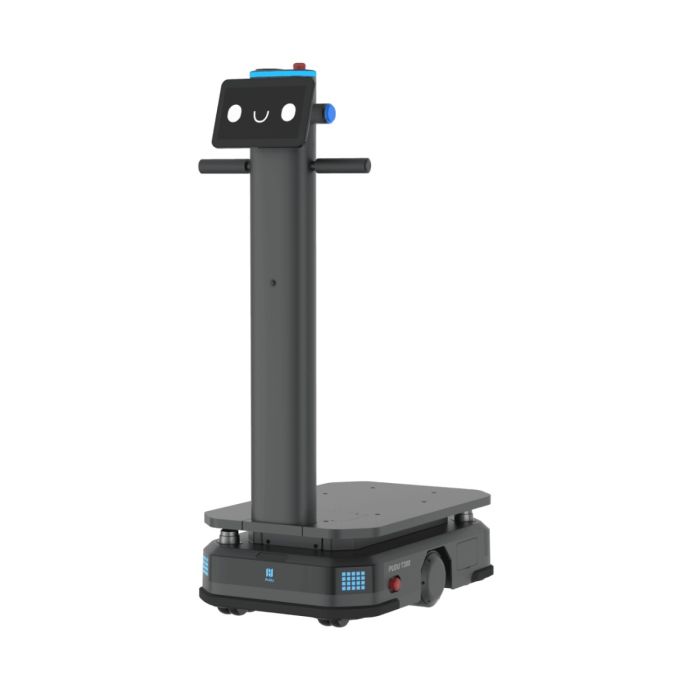
PUDU T150 Light-Payload Industrial Delivery Robot
In stock
- BRAND:
- PUDU ROBOTICS
- MODEL:
- T150
- ORIGIN:
- China
- AVAILABILITY:
- SUBJECT TO AVAILABILITY
- SKU:
- PUDU-T150
PUDU T150 Light-Payload Industrial Delivery Robot
A robot that needs a new floor plan is a robot that never leaves the pilot phase. The PUDU T150 Light-Payload Industrial Delivery Robot takes the opposite approach: it maps the space it is given, reads that space with cameras and LiDAR, and goes to work in the aisles that already exist. For plants and warehouses across the Caribbean, where floor space is often tight and buildings were not designed around automation, that is a practical place to start.
The PUDU T150 is available through this page, by quotation.
Background
PUDU Robotics and the industrial line
PUDU Robotics is best known for service robots that carry dishes and deliveries in restaurants and hotels. The T-series brings that experience in autonomous movement into industrial settings, where the loads are heavier, the floors are harder and the safety expectations are stricter. Within the series, the T150 is the light-payload model. It is meant for repetitive, short-haul work such as moving parts, totes and small loads between stations. Heavier loads are handled by other models in the family, such as the PUDU T600 Heavy-Payload Industrial Delivery Robot, and the PUDU T300 Standard Industrial Delivery Robot sits alongside it in the same line.
The T150 comes in two configurations. The Standard version is built for point-to-point material delivery. The Lifting version adds a lifting function for automated integration and more advanced workflows. Both share the same navigation approach, the same power options and the same safety foundation.
Navigation and deployment technology
The T150 combines VSLAM with LiDAR SLAM. Dual RGBD cameras and 360° dual LiDAR feed AI-driven, multi-level navigation and obstacle avoidance, which gives the robot precise positioning and stable operation in complex industrial environments. Mapping is done onboard, and several robots can network with each other themselves. No local servers or network deployment are needed. For a site without a dedicated IT team, that removes a good part of the usual work in bringing an autonomous robot online.
Operation is handled at the robot. An onboard touchscreen running a proprietary OS lets staff dispatch tasks, switch modes and change configuration directly. The robot also works with button pagers and PUDU Link, and it can be integrated through an API when a plant wants to connect it to its own systems.
Technical Specifications
| Specification | Value |
|---|---|
| Machine dimensions (Standard) | 835mm×500mm×1350mm (32.8 in × 19.7 in × 53.1 in) |
| Machine weight (Standard) | 65KG (143.4lbs) |
| Machine weight (Lifting) | 81KG (178.57lbs) |
| Maximum payload (Standard) | 150KG (330.7 lbs) |
| Lifting height (Lifting) | 60mm (2.36 in) |
| Maximum operating speed (Standard) | 0.2~1.2 m/s (0.66~3.94 ft/s) |
| Minimum passable width (Standard) | 60cm (23.6 in) |
| Operating time | 12h (no-load) |
| Charging time | 2h (0%-90%) |
| Step-climbing capability | 20 mm (0.79 in) |
| Gap-crossing capability | 35 mm (1.38 in) |
| Operating environment | 0 ℃~ 40 ℃ (32°F ~ 104°F) |
| Navigation method (Standard) | VSLAM + LiDAR SLAM |
| Sensors | Dual RGBD cameras, 360° dual LiDAR |
| Safety certification | ISO 3691-4 standards, industrial-specific CE certification |
| Power options | Rapid battery swapping, auto-charging, wired power |
| IoT integration | E-gate Control, Elevator Control, Call with pager, PUDU Link |
Specifications as published by the manufacturer; confirmed against the datasheet at quotation.
The manufacturer has not published the ingress protection rating, the package contents, the noise level, the battery type and voltage, the cargo deck dimensions, the Wi-Fi and network connectivity details or the maximum slope; they are confirmed at quotation.
What makes the PUDU T150 different from a fixed conveyor or a manual cart?
A conveyor moves one thing along one path, and changing that path means construction. A manual cart goes anywhere, but it needs a person behind it. The T150 sits between the two. It follows routes stored in its map, and those routes can change when the layout does. With a minimum passable width of 60cm (23.6 in), it fits aisles where larger vehicles would not. It can cross a 20 mm (0.79 in) step and a 35 mm (1.38 in) gap, which covers many of the thresholds, expansion joints and floor seams found between production areas.
Uptime is the second difference. The T150 offers rapid battery swapping, auto-charging and wired power. A site can let the robot top itself up between runs, swap a battery to keep it moving, or plug it in. The robot runs for 12h with no load and charges from 0% to 90% in 2h. That gives a planner room to build a shift pattern around it instead of around its limits.
Third, it speaks to the building. E-gate Control, Elevator Control, calling with a pager and PUDU Link let it pass through access gates and use elevators, so a route does not have to stop at a door or a floor change.
What does the Lifting version add to the Standard version?
The Standard version is the point-to-point model. It carries up to 150KG (330.7 lbs), weighs 65KG (143.4lbs) and moves at 0.2~1.2 m/s (0.66~3.94 ft/s). The Lifting version weighs 81KG (178.57lbs) and has a maximum lifting height of 60mm (2.36 in). It is designed for material lifting and transport tasks in industrial and warehouse environments, and for automated integration and more advanced workflows.
The lift is modest in height, but it changes how the robot can hand over loads. Where a Standard unit simply carries a load from A to B, a Lifting unit can take part in a handover that is built into the process. Buyers should be clear about which workflow they want before choosing. Payload, speed and passable width are listed above for the Standard version only, and we do not apply those figures to the Lifting version.
Who is the PUDU T150 for?
Manufacturers with many short, repeated trips are the natural fit: electronics and light assembly plants, parts staging areas and plants where component carts move between stores and lines. Warehouses with small-item storage, picking and distribution routes also benefit, because the loads are modest and the routes are regular.
Operations managers who want to start small will value the onboard mapping and the lack of server or network deployment. Several robots can be added over time and will network with each other. Sites with elevators or electronic gates between zones will want the IoT functions. Safety officers will note the ISO 3691-4 standards and the industrial-specific CE certification.
Choose the Standard version for straightforward point-to-point delivery. Choose the Lifting version when the process needs the robot to raise loads or connect to automated stations. If the loads are far heavier than a light-payload robot is built for, look at the PUDU T600 Heavy-Payload Industrial Delivery Robot, and browse the full range under Factory Robots.
What is the PUDU T150 used for?
- Intralogistics loop delivery. Runs a fixed circuit between stores, lines and dispatch so staff stay at their stations.
- Component and parts delivery. Brings small parts to the line on request, called by pager or dispatched from the touchscreen.
- Inter-line handling. Moves work-in-progress between production areas, including through gates and in elevators.
- Replenishment and retrieval. Restocks stations and returns empty containers without a person making the walk.
- Warehouse picking and distribution. Carries picked items to packing or staging areas along repeatable routes.
- Lifting and transport tasks. With the Lifting version, raises loads by 60mm (2.36 in) as part of an integrated workflow.
Pricing and Availability
Pricing depends on the version, the number of units and the integration the site needs, so it is given by quotation and not listed. Send us your application, your route layout and your preferred version, and we will respond with a quotation. Delivery, customs and support are arranged with the quotation. The PUDU T150 Light-Payload Industrial Delivery Robot is available on this page.
Frequently Asked Questions
How much can the PUDU T150 carry?
The Standard version has a maximum payload of 150KG (330.7 lbs). For the Lifting version, ask us when you request your quotation.
How long does it run on a charge?
It runs for 12h with no load and charges from 0% to 90% in 2h. Loaded runtime depends on the application.
How does it find its way around?
It uses VSLAM combined with LiDAR SLAM, with dual RGBD cameras and 360° dual LiDAR. Mapping is done onboard, and several robots can network themselves without local servers.
Can it work with elevators and gates?
Yes. The T150 supports E-gate Control and Elevator Control, and it can be called with a pager or through PUDU Link. API integration is also supported.
What safety standards does it meet?
It meets ISO 3691-4 standards and holds industrial-specific CE certification.
What temperature range can it work in?
The operating environment is 0 ℃~ 40 ℃ (32°F ~ 104°F), which suits most indoor industrial and warehouse spaces.
Where can I buy the PUDU T150 and what does it cost?
You can buy it through this page, by quotation. The cost depends on version, quantity and integration, and we send it in the quotation, not as a listed price.
Summary
The T150 answers the corridor problem in a plain way: it takes the layout as it is, maps it and does the repetitive carrying that ties up skilled staff. The Standard version covers point-to-point delivery, and the Lifting version adds a 60mm (2.36 in) lift for integrated workflows. Safety certification, flexible power options and building integration make it practical for a working plant. If you are weighing a first step into autonomous delivery, this page is the starting point.


