
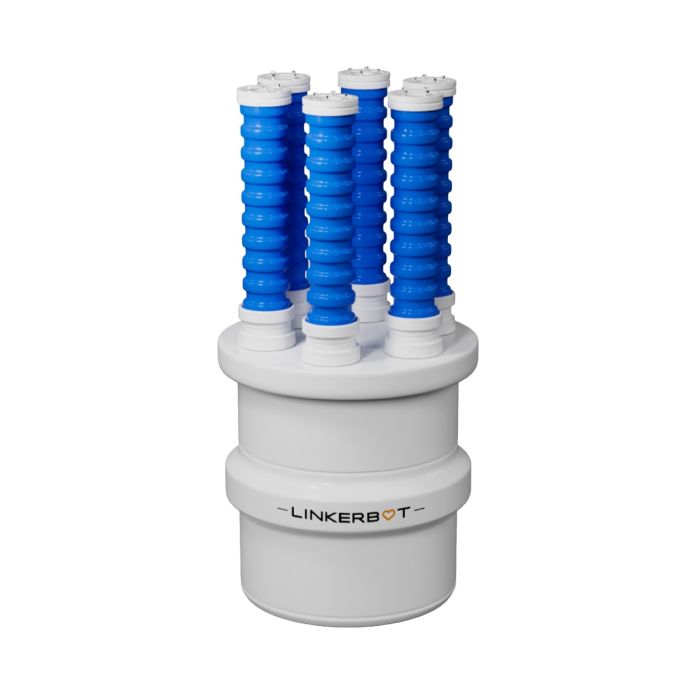
Linkerbot Linker Hand J42 Industrial Grade 6 Finger Claw
In stock
- BRAND:
- LINKERBOT
- PART #:
- Linker Hand J42
- ORIGIN:
- China
- AVAILABILITY:
- SUBJECT TO AVAILABILITY
- SKU:
- Linkerbot-Linker-Hand-J42
Linkerbot Linker Hand J42 Industrial Grade 6 Finger Claw
Most robot hands are built to answer a question about a part. The Linkerbot Linker Hand J42 Industrial Grade 6 Finger Claw is built to ask one: how much control does a manipulation task really need? With six fingers and a degree-of-freedom range that runs from 18 up to 42, it gives engineers room to try simple postures and very complex ones on the same piece of hardware.
The product is available through this page, by quotation.
Background
The company and its lineage
The Linker Hand J42 comes from Linkerbot Technology Co., Ltd., a Chinese company that develops high-DOF multi-finger robot hands. Its Linker Hand series serves three audiences: education, research and industry. The series combines a high number of degrees of freedom with high precision.
Within the series, the J42 is the industrial multi-finger model with the most extensive finger configuration. Other members of the family take different routes. You can compare it with the Linkerbot Linker Hand L20 Pro Version or the Linkerbot Linker Hand L30 Cable Driven Version, and our Robot Hands category shows the wider range.
Across the whole series, CAN, RS485 and USB communication are supported, and the hands work with ROS, the Robot Operating System. For the J42 itself, the communication interface is USB.
Positioning and key technology
The J42 is an industrial multi-finger model with up to 42 degrees of freedom and a six-finger configuration. It is well suited to research and experiments that need complex multi-finger control. That tells you where it sits: it is not a simple pick-and-place jaw, but a platform for work where finger coordination is the point.
Its drive method is rope drive. In a rope-driven hand, the force that moves the fingers is carried by cables, which allows the finger structure to stay slim. Many teams in manipulation research choose this approach when they want a hand with many joints without placing a motor in every knuckle.
The joint configuration is 9 to 42 active joints, alongside the 18 to 42 degrees of freedom. These are ranges, so the exact figure depends on the configuration you specify. The operating voltage is DC24V ±10%, a common supply level in industrial cells.
Technical Specifications
| Specification | Value |
|---|---|
| Model | Linker Hand J42 |
| Configuration | Six fingers |
| Drive method | Rope drive |
| Communication interface | USB |
| Degrees of freedom | 18 to 42 |
| Joint configuration | Active 9 to 42 |
| Operating voltage | DC24V ±10% |
| Repeat positioning accuracy | ±0.20mm |
| Grip force (four fingers) | 5N |
| Grip force resolution | 0.7N |
Specifications as published by the manufacturer; confirmed against the datasheet at quotation.
The manufacturer has not published the weight, the dimensions, the maximum payload, the fingertip force per finger, the tactile sensors, the power consumption and current, the finger joint ranges and speeds, the contents of the box, the ingress protection rating, the operating temperature or the mounting interface; they are confirmed at quotation.
What makes the J42 different from other Linker Hand models?
The main difference is range. The J42 is the model in the series that offers up to 42 degrees of freedom and a six-finger layout. A hand with fewer joints is easier to program and easier to integrate, and for many tasks that is the right trade. The J42 goes the other way: it gives you the largest number of controllable joints, so you can study how a hand should move before you decide how much of that movement a production task requires.
The second difference is that the J42 comes as a range rather than a single fixed build. Degrees of freedom run from 18 to 42, and active joints from 9 to 42. For a research group, this means a conversation about configuration is part of the purchase. You describe the experiments you plan, and the quotation settles which configuration fits them.
The third is the drive. Rope drive keeps the actuation away from the fingers themselves, which is one reason a hand with this many joints can remain practical. The repeat positioning accuracy is ±0.20mm and the grip force resolution is 0.7N, which are the figures that matter when you want repeatable, graded contact rather than a simple open-and-close action.
How strong is the grip, and what should I know before planning a task?
The grip force is 5N for four fingers, with a resolution of 0.7N. Those two numbers describe a hand tuned for fine, controlled contact. They do not describe a heavy-duty gripper for large or dense loads, and the maximum payload is a question for your quotation. If your work involves delicate objects, careful regrasping or experiments in finger coordination, the figures point the right way. If you need to lift something heavy, ask about payload before committing to a design.
Plan the electrical side with the supply in mind: DC24V ±10%. Ask for power consumption and current when you size the supply. The same applies to the mounting interface, which determines how the hand attaches to your arm or fixture.
Who is the Linker Hand J42 for?
Research laboratories are the clearest fit. A team studying dexterous manipulation, learning-based control or in-hand motion gets a wide joint range on a single platform, and the series-wide ROS compatibility fits the tools those teams already use.
University departments and teaching programs in robotics can use it where students need to see what multi-finger control involves, not only to run a gripper. Industrial development groups, such as those prototyping advanced manipulation before choosing a production end effector, are the third segment. The J42 is an industrial multi-finger model, and its DC24V supply suits that setting.
If your task needs less complexity, a different model may serve you better, so compare the L20 Pro Version and the L30 Cable Driven Version linked above. For wider industrial context, see our Industrial Robots category.
What is the Linker Hand J42 used for?
- Dexterous manipulation research: studying how many joints and fingers a task needs, using a hand with a wide joint range.
- Multi-finger control experiments: testing coordination strategies where complex finger control is required.
- Teaching robotics: showing students the real challenges of controlling a high-DOF hand.
- Industrial prototyping: trying advanced manipulation concepts before settling on a production end effector.
- Graded-contact handling: working with objects where a fine grip force resolution matters.
- Repeatable positioning trials: evaluating finger placement in tasks that rely on the repeat accuracy.
Pricing and Availability
We do not print prices on this page. A quotation is the way to buy the Linkerbot Linker Hand J42, and it lets us settle the configuration you need. Delivery, customs and support are arranged with the quotation. The Linkerbot Linker Hand J42 Industrial Grade 6 Finger Claw is available on this page.
Frequently Asked Questions
How many degrees of freedom does the J42 have?
It offers 18 to 42 degrees of freedom, with 9 to 42 active joints. The exact figure depends on the configuration.
How is the hand driven?
It uses rope drive, in which cables carry the force that moves the fingers.
Which communication interface does the J42 use?
The J42 uses USB. The Linker Hand series as a whole supports CAN, RS485 and USB, and works with ROS.
What supply voltage does it need?
The operating voltage is DC24V ±10%.
How precise is it?
The repeat positioning accuracy is ±0.20mm, and the grip force resolution is 0.7N. The grip force for four fingers is 5N.
Are the weight, payload and IP rating available?
Not yet on this page. Ask for the ones your project depends on when you request your quotation.
Where can I buy the Linkerbot Linker Hand J42 and what does it cost?
You can request it through this page, by quotation. We do not list a price here; the quotation covers the configuration, delivery, customs and support.
Summary
The Linker Hand J42 is a hand that asks a question before it answers one: how much dexterity does your task need? With six fingers, 18 to 42 degrees of freedom, rope drive and a repeat accuracy of ±0.20mm, it gives research and industrial teams a wide space in which to find out. The grip is fine rather than heavy, so ask for weight and payload with your quotation. If that matches your work, this page is the starting point.


