
LimX Tron 1 Education Edition Multi-Modal Biped Robot
In stock
- BRAND:
- LIMX
- MODEL:
- TRON 1 EDUCATION EDITION
- ORIGIN:
- China
- AVAILABILITY:
- SUBJECT TO AVAILABILITY
- SKU:
- LimX-Tron-1-Edu
LimX Tron 1 Education Edition Multi-Modal Biped Robot
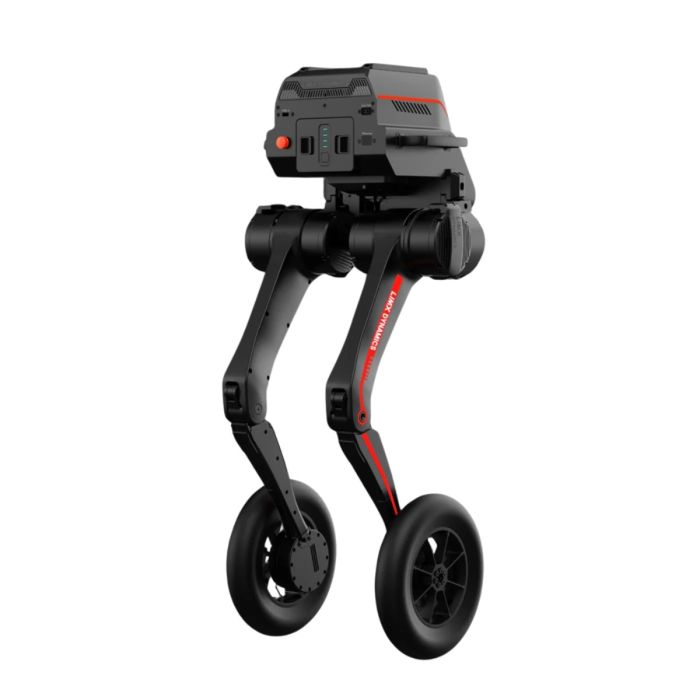
A walking robot is usually a promise made at the factory: the feet it ships with are the feet it keeps. The LimX Tron 1 Education Edition Multi-Modal Biped Robot breaks that promise on purpose. One pair of legs, three kinds of foot-end, and a computer on board that a student can program in Python. For a teaching lab that has to stretch one machine across many experiments, that is a different way to spend a budget.
The product is available through this page, by quotation.
Background
LimX and the Tron line
LimX builds legged and humanoid robots for research and embodied-intelligence work. Its catalog runs from this compact biped up to full-size humanoids, and the Tron 1 sits at the approachable end of that range. It is a machine a university group can put on a bench, rather than a project that needs a dedicated hall. If you want to see how the family fits together, the LimX category shows the other models, and the Research Robots category places them next to other platforms built for laboratories.
The Tron 1 comes in two versions: the Standard Edition and the Education Edition. This article is about the Education Edition, and every figure below belongs to that version only. The Standard Edition has its own page at LimX Tron 1 Standard Edition Multi-Modal Biped Robot, and its figures should be read there, not here.
What multi-modal means on this robot
The key idea is the foot-end. The Education Edition uses a Three-In-One modular design for multi-modal algorithm development. In practical terms, the robot can be fitted with a wheeled foot-end, a point-foot or a sole, and the box includes all three. Switching between them is efficient, so that different foot-ends can be combined flexibly. The hardware is recognized automatically and the software adapts to it.
Why does that matter? A control algorithm written for a point-foot is a different problem from one written for a flat sole or for wheels. Usually that means a different robot, a different set-up and often a different team. Here the comparison happens on a single platform. A student can run the same task on three foot-ends and see where the approach holds and where it fails, without rebuilding the experiment around a new machine.
Technical Specifications
| Specification | Value (EDU Ed.) |
|---|---|
| Foot-end design | Three-In-One modular design for multi-modal algorithm development |
| Dimensions | ≤ 392mm x 420mm x 845mm |
| Material | Aluminum Alloy + Industrial Plastic |
| Battery type | Ternary Lithium |
| Computer (CPU/Memory/Storage) | 12th Gen Intel i3/16G/512G |
| Peripheral expansion ports | USB 3.0 *1, GbE *1 |
| Operating environment | -5℃ to 40℃ (Operates in favorable weather conditions) |
| Development | Compatible with full-process development in Python; C++ not required |
Specifications as published by the manufacturer; confirmed against the datasheet at quotation.
The manufacturer has not published the IP rating, the camera resolution, the joint degrees of freedom, the wireless connectivity, the noise level or the battery weight; they are confirmed at quotation.
What makes the Tron 1 Education Edition different from a fixed-foot biped?
The first difference is the one already described: the foot-end is a variable, not a constant. In a fixed-foot machine, the mechanical design settles the locomotion question before the researcher has asked it. On the Tron 1 Education Edition the question stays open. The robot recognizes which foot-end is fitted, the software adapts, and the lab can compare modes under the same conditions with the same body.
The second difference is the way the machine is programmed. The Education Edition is compatible with full-process development in Python, and C++ is not required. That lowers the entry barrier for a class of students who know Python from data science or machine learning courses but have never written real-time robot code in a compiled language. A lecturer can spend lab hours on gait, balance and control rather than on toolchains.
The third difference is what sits inside the body. The computer is a 12th Gen Intel i3 with 16G of memory and 512G of storage, and the robot offers one USB 3.0 port and one GbE port for peripheral expansion. That is enough to connect a keyboard, a storage device or a network link, and to bring the machine into a lab network. The body is built from aluminum alloy and industrial plastic, and it measures no more than 392mm x 420mm x 845mm, so it fits on a standard workbench area and moves through a classroom without ceremony.
How does the Education Edition compare with the Standard Edition?
Both versions belong to the same Tron 1 family. The figures in this article are those of the Education Edition, and no Standard Edition figures are given here, so there is no side-by-side comparison of numbers. What the Education Edition offers is a Python-based development path, the Three-In-One foot-end design and the on-board computer described above.
If a buyer is unsure which edition matches the project, the sensible step is to read the Standard Edition page and then ask for a quotation that covers both. Questions about development access, in particular, are best settled in writing before the order. For projects that need a different form factor altogether, the LimX Tron 2 Multi-Form Embodied Robot is the next model in the line.
Who is the LimX Tron 1 Education Edition for?
The first group is university teaching labs. A single robot that can show three kinds of locomotion is easier to justify than three robots, and Python as the development language means more of the class can take part. The second group is research teams working on locomotion control, balance and learning-based methods, who want to test the same algorithm across foot-end types without changing the body. The third group is advanced developers and training centers that want a hands-on legged platform for workshops and demonstrations.
It is less suited to anyone who expects a finished service robot that works out of the box in rain or on rough outdoor ground. The operating environment is -5℃ to 40℃ in favorable weather conditions, so the robot is a bench and indoor-lab machine first. Teams who need a full-size humanoid should look at the LimX Oli EDU instead.
What is the LimX Tron 1 Education Edition used for?
- Locomotion research. Compare point-foot, sole and wheeled movement on one body, with the same control code as the starting point.
- University teaching. Give students a real legged robot that they program in Python, so lab time goes to ideas rather than to compilers.
- Algorithm development. Build and test multi-modal control methods, with the robot recognizing the fitted foot-end and adapting its software.
- Balance and gait studies. Observe how stability changes when the foot-end changes, and record the difference for coursework or papers.
- Demonstrations and outreach. Show visitors, funders or school groups how a biped moves, using the handheld remote controller supplied in the box.
- Prototyping with peripherals. Attach a device through the USB 3.0 port or link the robot to a network through the GbE port while testing ideas.
Pricing and Availability
The price of the Tron 1 Education Edition depends on the project, so it is handled by quotation and not printed on the page. Tell us how many units you need and where they are going, and we will answer with a written offer. Delivery, customs and support are arranged together with the quotation, so nothing is left to be discovered after the order. The box contents are the robot body, the wheeled foot-end, the point-foot, the sole, the battery, the battery charging dock, the handheld remote controller, the haulage rope and the roll cage, and the Tron 1 Education Edition is available on this page.
Frequently Asked Questions
What foot-ends come with the Education Edition?
The box includes the wheeled foot-end, the point-foot and the sole. The robot supports efficient switching between them, with automatic hardware recognition and software adaptation.
Which programming language does it use?
The Education Edition is compatible with full-process development in Python. C++ is not required.
What computer is inside?
It carries a 12th Gen Intel i3 with 16G of memory and 512G of storage. Peripheral expansion is through one USB 3.0 port and one GbE port.
How large is the robot?
Its dimensions are no more than 392mm x 420mm x 845mm. The body is made of aluminum alloy and industrial plastic.
What temperature range can it work in?
The operating environment is -5℃ to 40℃, in favorable weather conditions. It is intended for indoor and bench use.
What is in the box?
The robot body, the wheeled foot-end, the point-foot, the sole, the battery, the battery charging dock, the handheld remote controller, the haulage rope and the roll cage.
Where can I buy the LimX Tron 1 Education Edition and what does it cost?
You can request it through this page. The cost is given in a written quotation, which also covers delivery, customs and support.
Summary
Most bipeds ask a lab to accept the foot the factory chose. The LimX Tron 1 Education Edition lets the lab choose, with point-foot, sole and wheeled foot-ends in the box, automatic recognition and a Python development path on a 12th Gen Intel i3 computer. It is compact, built of aluminum alloy and industrial plastic, and made for benches, classrooms and research groups. To compare options or to ask for an offer, this page is the starting point.


