
LimX Oli Super Full-Size General Purpose Humanoid Robot
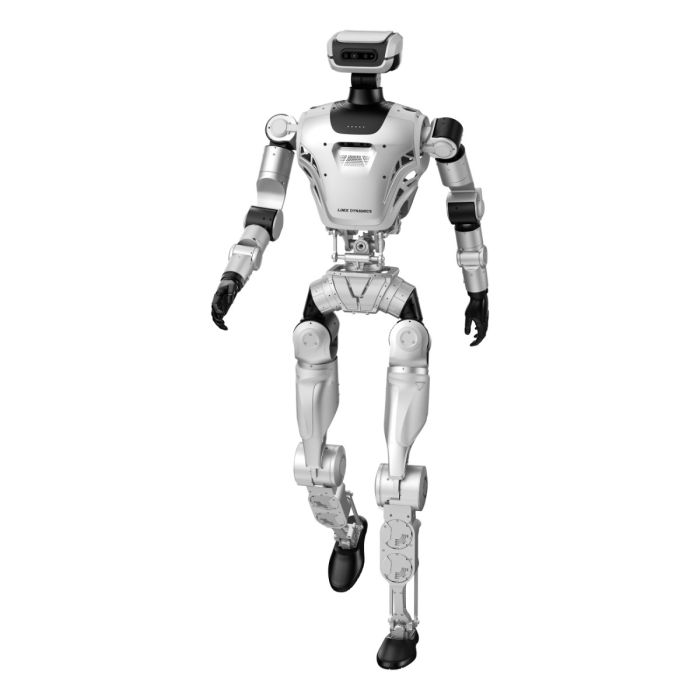
In stock
- BRAND:
- LIMX
- PART #:
- Oli Super
- ORIGIN:
- China
- AVAILABILITY:
- SUBJECT TO AVAILABILITY
- SKU:
- LimX-Oli-Super
LimX Oli Super Full-Size General Purpose Humanoid Robot
Strength usually costs endurance, and the LimX Oli Super Full-Size General Purpose Humanoid Robot is a plain example. It carries more torque, more joints and a heavier payload than the other Oli editions, and it asks for a shorter run between battery swaps in return. For a team that needs a humanoid to do real manipulation work rather than simply stand and walk, that is a trade worth understanding before you order.
The product is available through this page, by quotation.
Background
The company behind Oli
Oli comes from LimX Dynamics, a Shenzhen-based company focused on embodied intelligence and legged robotics. The phrase "embodied intelligence" matters here. It describes the idea that artificial intelligence learns best when it has a body, with joints, sensors and weight, and meets the physical world directly. A company working in legged robotics builds that body first and then gives researchers the tools to teach it.
Oli is offered in three editions: Lite, EDU and Super. The Super is the top of the range. If you are still deciding between editions, the LimX Oli Lite Full-Size General Purpose Humanoid Robot and the LimX Oli EDU Full-Size General Purpose Open Source Humanoid Robot are the natural comparisons.
Where the Super sits in the range
The Super is a full-size humanoid. It stands 175cm tall, against 165cm for the Lite and EDU, and it weighs 60kg, against 55kg. Its shoulders are 60cm wide, against 55cm. Those few centimeters give the arms a longer working envelope and the body a more convincing human scale. That helps when the robot is meant to reach shelves, benches and equipment that were laid out for people.
The larger body comes with a stronger drivetrain. Maximum motor torque is 250 N·m on the Super, compared with 150 N·m on the Lite and the EDU. Active degrees of freedom rise to 43, compared with 31 on the Lite and 33 on the EDU. The Super is the edition for teams that expect to push the hardware hard. Other humanoid options can be found under Humanoids.
Technical Specifications
| Specification | Value (Oli Super) |
|---|---|
| Height | 175cm |
| Weight | 60kg |
| Shoulder width | 60cm |
| Single-arm payload | 5kg |
| Maximum joint torque | 250 N·m |
| Total active degrees of freedom | 43 |
| Maximum walking speed | 5km/h |
| Battery | 9,500mAh lithium-ion polymer, swappable |
| Battery life | ~1.5h |
| Motion control compute | RK3588 with 16G RAM and 256G storage |
| Perception compute | Orin NX (100TOPS) with 16G |
| Depth cameras | Intel RealSense D435i |
| Connectivity | Wifi 6, Bluetooth 5.4, USB 3.0 / 3.2, 1,000Mbps RJ45 Ethernet |
| Simulation platforms | NVIDIA Isaac Sim, MuJoCo and Gazebo |
| End-effectors | Two-finger grippers and dexterous five-finger hands |
Specifications as published by the manufacturer; confirmed against the datasheet at quotation.
The manufacturer has not published the packed dimensions, the IP rating, the charging time for the Super, the operating temperature range, the included accessories list or the noise level; they are confirmed at quotation.
What makes Oli Super different from Oli Lite and Oli EDU?
The differences come down to muscle, reach and brains. The single-arm payload is 5kg on the Super, compared with 3kg on the Lite and EDU. That is the number that decides whether an arm can hold a tool or a loaded tray steadily instead of only demonstrating a motion. The higher joint torque and the larger number of active joints support the same goal: more demanding movements, more of the time.
The Super also carries a motion control computer built on the RK3588 with 16G RAM and 256G storage, and a perception computer, the Orin NX (100TOPS) with 16G. Splitting the work this way keeps locomotion and balance on one processor and vision and higher-level reasoning on another. Intel RealSense D435i depth cameras provide the depth sensing.
The price of that capability shows in endurance. The Super runs about 1.5 hours on a battery, while the Lite and EDU run about 2 hours. The battery is a 9,500mAh lithium-ion polymer pack that can be swapped, so a second pack lets a session continue instead of ending. Anyone planning a full day of trials should plan their battery rotation at the same time.
How does Oli Super fit into a research workflow?
A humanoid is only as useful as the software path around it. Oli supports NVIDIA Isaac Sim, MuJoCo and Gazebo, three simulation platforms that robotics teams already know. A team can develop and test behavior in simulation, then move to the real machine without changing its whole toolchain.
On the hardware side, the Super supports two-finger grippers and dexterous five-finger hands as end-effectors. That choice is significant. A two-finger gripper suits repeatable pick-and-place work, while a five-finger hand opens the door to research on dexterous manipulation. Connectivity covers Wifi 6, Bluetooth 5.4, USB 3.0 / 3.2 and a 1,000Mbps RJ45 Ethernet port, so the robot can join a lab network, stream sensor data or connect to external equipment with ordinary cables and protocols.
Who is Oli Super for?
The Super suits university laboratories and corporate research groups that work on whole-body control, manipulation and embodied AI, and that want the highest joint count and payload in the Oli family. It also suits system integrators who need a human-scale platform to test an application before committing to a larger program.
Teaching programs with a tighter budget or a gentler workload may be better served by another edition. The Oli EDU is the education-oriented edition, and the Oli Lite offers the same body size as the EDU with fewer joints. Choose the Super when payload, torque and joint count are the limiting factors in your project, and when a shorter battery run is acceptable.
What is Oli Super used for?
- Embodied AI research. Train and evaluate learning policies on a full-size body with 43 active degrees of freedom.
- Whole-body locomotion studies. Test walking and balance strategies at a speed of up to 5km/h.
- Mobile manipulation. Combine walking with arm work, using a single-arm payload of 5kg.
- Dexterous hand research. Fit five-finger hands and develop grasping behavior for objects of many shapes.
- Simulation-to-hardware transfer. Develop in Isaac Sim, MuJoCo or Gazebo, then verify on the real robot.
- Teaching and demonstration. Give students and visitors a human-scale humanoid to program, observe and discuss.
Pricing and Availability
Pricing for the Oli Super depends on the configuration and the project, so it is handled by quotation. Delivery, customs and support are arranged together with the quotation. Send us your requirements and the end-effector you have in mind, and we will come back with the details. The LimX Oli Super Full-Size General Purpose Humanoid Robot is available on this page.
Frequently Asked Questions
How tall is the Oli Super?
The Oli Super stands 175cm tall and weighs 60kg. The Lite and EDU editions are 165cm tall and weigh 55kg.
What can its arms carry?
The single-arm payload of the Super is 5kg. On the Lite and EDU it is 3kg.
How long does the battery last?
The Super runs for about 1.5 hours on its 9,500mAh lithium-ion polymer battery. The battery is swappable, so you can change packs to continue working.
Which simulation platforms does it support?
Oli supports NVIDIA Isaac Sim, MuJoCo and Gazebo. This lets teams work in simulation before moving to the real robot.
Which hands can it use?
The Oli supports two-finger grippers and dexterous five-finger hands as end-effectors.
What is the IP rating?
There is no IP rating figure for the Super at this time. Ask for it with your quotation request, together with the operating temperature range and the charging time.
Where can I buy the Oli Super and what does it cost?
You can buy the LimX Oli Super through this page by requesting a quotation. The cost depends on the configuration and the project, and it is provided with the quotation.
Summary
The Oli Super trades some running time for strength. It offers 43 active degrees of freedom, 250 N·m of maximum joint torque, a 5kg single-arm payload and a two-computer architecture, all in a human-scale body of 175cm. The price of that power is a battery life of about 1.5 hours, which a swappable pack helps to manage. For teams who need a humanoid that can do real work and be programmed with the simulation tools they already use, this page is the starting point.


