
LimX Oli EDU Full-Size General Purpose Open Source Humanoid Robot
In stock
- BRAND:
- LIMX
- MODEL:
- Oli EDU
- ORIGIN:
- China
- Warranty:
- 12 MONTHS
- AVAILABILITY:
- SUBJECT TO AVAILABILITY
- SKU:
- LimX-Oli-EDU
LimX Oli EDU Full-Size General Purpose Open Source Humanoid Robot
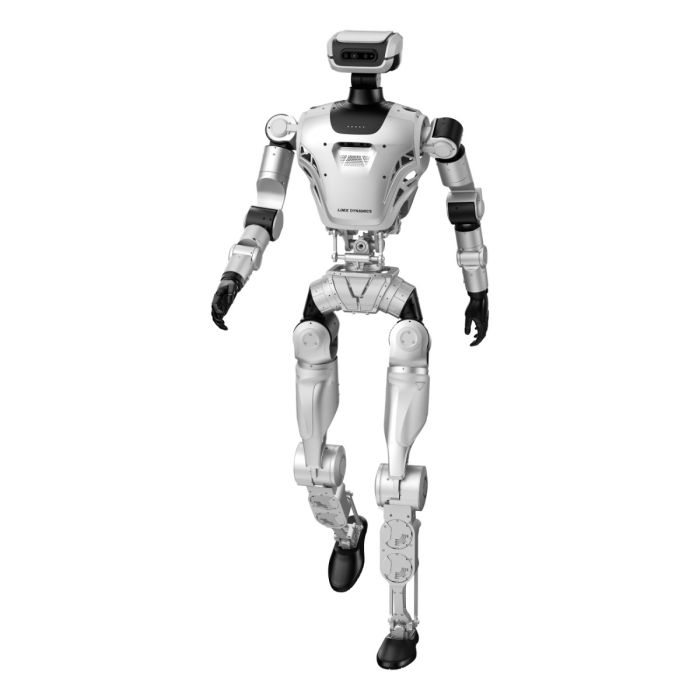
Doorways, desk heights, shelves and handrails: the built world is sized for people, and a robot that hopes to work in it has to be close to a person's size. The LimX Oli EDU Full-Size General Purpose Open Source Humanoid Robot is made on that premise. It stands 165 cm tall, and it is meant for the labs and classrooms where students and researchers learn what a body of that scale can do.
The product is available through this page, by quotation.
Background
LimX Dynamics and the Oli lineage
LimX Oli is the full-size, general-purpose humanoid robot from LimX Dynamics, a Shenzhen-based company focused on embodied intelligence and legged robotics. Embodied intelligence is the idea that software which perceives and decides is best developed in a physical body, where gravity, contact and delay are real. Legged robotics is where that idea meets its hardest tests, because a walking machine has to keep its balance in order to do anything else.
The Oli series comes in three versions: Lite, EDU and Super. They share the same full-size approach. The series stands 165 cm tall and offers up to 31 DoF, which gives more human-like postures and widens the range of possible motion. This article is about the EDU version. If you are comparing versions, the LimX Oli Lite Full-Size General Purpose Humanoid Robot and the LimX Oli Super Full-Size General Purpose Humanoid Robot are on their own pages.
Positioning of the EDU version
The EDU name points to education and research. A humanoid is often judged by how it looks in motion, but a teaching platform is judged by how easily people can work with it. For that reason the Oli series supports full Python development, a language that most students and many engineers already know. It also supports major simulation platforms: NVIDIA Isaac Sim, Mujoco, Gazebo, and others. A team can build and test behavior in simulation first, then take the same ideas to the physical robot.
The series also has a voice interaction system developed in-house. It supports natural bilingual conversation in Chinese and English, and voice-based control. For a course or a demonstration, that gives visitors and students a simple way to speak to the robot.
Technical Specifications
| Specification | Value |
|---|---|
| Product type | Full-Size General-Purpose Humanoid Robot |
| Height | 165 cm / 5′5″ |
| Shoulder width | 55 cm / 21.7 in |
| Arm length | 70 cm / 27.6 in |
| Degrees of freedom (Oli series) | Up to 31 DoF |
| Battery capacity | 9,500 mAh |
| Charger | 58.8 V / 10 A |
| Voice interaction (Oli series) | Natural bilingual (Chinese and English) conversation and voice-based control |
| Simulation platforms (Oli series) | NVIDIA Isaac Sim, Mujoco, Gazebo, etc. |
| Software development (Oli series) | Full Python development |
Specifications as published by the manufacturer; confirmed against the datasheet at quotation.
The manufacturer has not published the ingress protection rating, the charge time, the combined payload of both arms, the operating temperature range, the walking speed, the shipping dimensions or the operating system; they are confirmed at quotation.
What makes the Oli EDU different from a tabletop or small biped?
Scale is the first difference. A small biped is a fine tool for studying balance and gait, and the store carries several of them, including the LimX Tron 1 Education Edition Multi-Modal Biped Robot. A full-size humanoid is another kind of tool. At 165 cm with a 55 cm shoulder width and a 70 cm arm length, the Oli EDU has proportions close to an adult's. Reaching, leaning and standing at a bench become real questions about a body in a human space, rather than approximations scaled down from one.
The second difference is the range of motion. The Oli series offers up to 31 DoF. Each additional joint gives researchers another axis to plan, control and learn. A body with that many joints can hold postures that look natural, and it opens up research into whole-body coordination that a simpler machine cannot support.
The third difference is how the platform is meant to be used. It is described as general purpose, so it is not tied to one task, one tool or one workflow. Python development and the supported simulators mean a lab can bring in its own algorithms, whether those are learned policies, classical controllers or something in between, and test them on a single shared platform.
How does simulation support work with the Oli EDU?
Most humanoid projects begin on a screen. Running a controller in simulation is faster than running it on hardware, and a failure there costs nothing. The Oli series supports NVIDIA Isaac Sim, Mujoco and Gazebo, among others, which covers a good share of the platforms that research groups already use. A team that has built a simulation workflow can keep it and still target a physical body.
Together with full Python development, this gives a clear path. Write and train in simulation, then bring the work to the robot and see where the model and the real body disagree. That gap is where much of the learning happens, for students and for experienced researchers alike.
Who is the LimX Oli EDU for?
Universities and technical colleges are the clearest fit. A full-size humanoid gives a robotics or AI department something concrete for coursework, thesis projects and demonstrations, and the Python support keeps the entry barrier reasonable for students.
Research groups working on legged locomotion, whole-body control or embodied AI are a second segment. They need a body of human proportions on which to test ideas, and simulation support lets them move between virtual and physical trials. Browse the wider Research Robots range to see how the Oli fits next to other platforms.
Innovation labs, technology centers and training institutes form a third group. Their interest is often in showing what a humanoid can do and in preparing people to work with one. The bilingual voice interaction is useful there, since visitors can talk to the robot directly.
Teams that want a different balance of cost and capability should look at the Lite and Super versions on their own pages, and at the wider Bipedal Humanoids category. If you are unsure which version suits your program, ask us when you request a quotation.
What is the LimX Oli EDU used for?
- Humanoid robotics courses. Students learn kinematics, control and programming on a full-size body instead of a diagram.
- Embodied AI research. Researchers test perception and decision-making in a physical body of human proportions.
- Simulation-to-real work. Teams develop in Isaac Sim, Mujoco or Gazebo, then validate on the robot.
- Python-based development. Labs write control and behavior code in a language their students already use.
- Voice-controlled demonstrations. Visitors give commands and hold a conversation in Chinese or English.
- Human-scale environment studies. Groups examine how a humanoid fits spaces and tasks built around people.
Pricing and Availability
We do not print prices on this page. Every LimX Oli EDU is supplied by quotation, so that the offer matches your institution, your configuration and your destination. Delivery, customs and support are arranged with the quotation. Send us your request and the Oli EDU is available on this page.
Frequently Asked Questions
How tall is the LimX Oli EDU?
The Oli EDU stands 165 cm (5′5″) tall. Its shoulder width is 55 cm (21.7 in) and its arm length is 70 cm (27.6 in).
How many degrees of freedom does it have?
The Oli series offers up to 31 DoF, which allows more human-like postures and a wider range of motion.
Which simulation platforms does it support?
The Oli series supports NVIDIA Isaac Sim, Mujoco, Gazebo and others. Teams can develop in simulation first and then move to the physical robot.
What programming language can I use?
The Oli series supports full Python development. That makes the platform approachable for students and flexible for researchers.
Can the robot talk with people?
Yes. Its self-developed voice interaction system supports natural bilingual conversation in Chinese and English, as well as voice-based control.
What are the battery and charger specifications?
The battery capacity is 9,500 mAh and the charger is rated 58.8 V / 10 A.
Where can I buy the LimX Oli EDU and what does it cost?
You can buy it through this page by requesting a quotation. We do not list a price here; the quotation covers your configuration, delivery and support.
Summary
The Oli EDU starts from a simple idea: a robot meant to work in rooms made for people should be built at a human scale. It stands 165 cm tall, offers up to 31 DoF across the series, and speaks to developers through Python, major simulators and a bilingual voice system. It comes from LimX Dynamics, a Shenzhen-based company focused on embodied intelligence and legged robotics. For universities, research groups and training centers around the Caribbean that want a full-size humanoid to teach and test with, this page is the starting point.


