
Elephant Robotics Mercury X1 Wheeled Humanoid Robot (4011300003)
In stock
- BRAND:
- ELEPHANT ROBOTICS
- PART #:
- 4011300003
- ORIGIN:
- China
- Warranty:
- 12 MONTHS
- AVAILABILITY:
- ALLOW 4-6 WEEKS FOR DELIVERY
- SKU:
- Elephant-Robotics-4011300003
Elephant Robotics Mercury X1 Wheeled Humanoid Robot (4011300003)
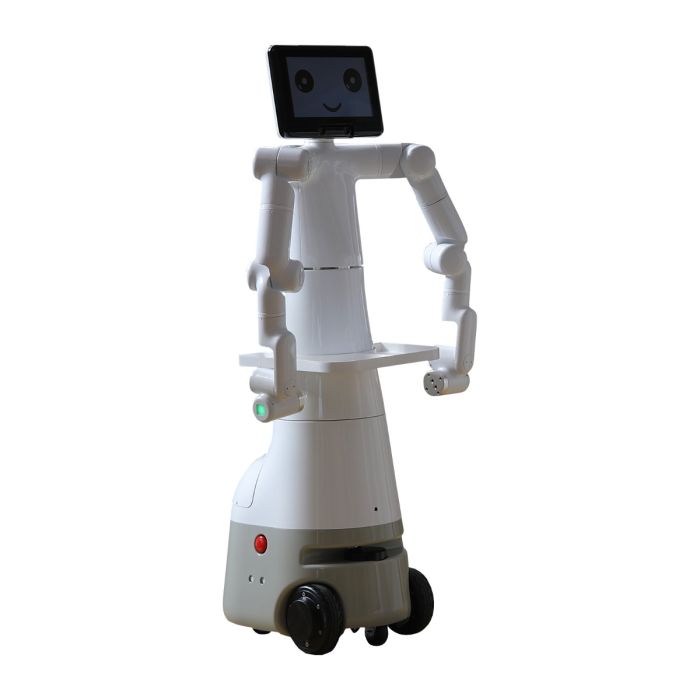
A robot arm that can only reach what someone has carried to it is a limited colleague. The Elephant Robotics Mercury X1 Wheeled Humanoid Robot (4011300003) removes that limit: it puts a two-armed upper body on a powered base, so the work no longer has to be brought to the machine. For teams in the Caribbean who want to study embodied intelligence in real rooms rather than on a bench, that is the whole point.
The product is available through this page, by quotation.
Background
Elephant Robotics and the Mercury family
Elephant Robotics builds compact collaborative arms and mobile platforms aimed at education, research and light commercial development. The Mercury line is its humanoid branch. Within it, the Mercury B1 is the dual-arm upper body, and the Mercury X1 is that same B1 combined with a high-performance mobile base. The Mercury A1 belongs to the same family. If you want to compare the family members, see the Mercury Humanoid Robot A1 and the Mercury Humanoid Robot B1.
This lineage matters to a buyer. The arms are not a one-off design bolted to a cart. They come from a robot that already exists as its own product, and the X1 adds mobility to it. Teams that start with the upper body can understand the X1 as a natural extension of it.
A wheeled humanoid for embodied intelligence
The Mercury X1 is a wheeled dual-arm humanoid robot designed for embodied intelligence applications. Embodied intelligence means that software is tested through a physical body that senses, moves and handles objects, instead of only running in simulation. Wheels are a practical choice for this. They keep the machine steady, they are simpler to operate than legs, and they let the arms concentrate on manipulation.
The base uses direct drive motors. The main control is a Jetson Orin Nano SUPER 8GB, with an ESP32 acting as the arm sub controller. The mobile sensors are LIDAR, ultrasonic radar and 2D vision. Taken together, this gives developers a platform that can perceive its surroundings, compute on board and act with both hands.
You can browse related machines in the Wheeled Humanoids and Humanoids categories.
Technical Specifications
| Specification | Value |
|---|---|
| Product type | Wheeled dual-arm humanoid robot |
| Composition | Mercury B1 dual-arm robot + high-performance mobile base |
| Degree of freedom | 19DOF |
| Product height | 1.18m |
| Net weight | 55KG |
| Working voltage | 24V |
| Battery life | 8 hours |
| Maximum payload | 1KG |
| Repeatability | ± 0.05mm |
| Maximum operating speed | 1.2m/s |
| Maximum climbing angle | 15° |
| Maximum climbing height | 2CM |
| Storage space | 15L |
| Main control | Jetson Orin Nano SUPER 8GB |
| AI performance | 67 TOPS |
| Arm sub controller | ESP32 |
| Mobile sensors | LIDAR, Ultrasonic Radar, 2D Vision |
| Screen | 9-inch Touching Screen |
| Microphone | Line array 4 microphones, 5m 180° pickup |
| Communication | WIFI / Network port / Bluetooth / USB serial port |
| IO | 24V 6 Input, 6 Output |
| ROS support | ROS1 and ROS2, with RVIZ simulation environment support |
| Operating systems | Windows, Linux, MAC supported |
Specifications as published by the manufacturer; confirmed against the datasheet at quotation.
The manufacturer has not published the battery capacity, the charging time, the IP rating, the package contents, the arm reach, the operating temperature, the power consumption or the chassis dimensions; they are confirmed at quotation.
What makes the Mercury X1 different from a bench-mounted dual-arm robot?
The first difference is range. A fixed arm works inside a small sphere around its base. The X1 carries its arms through a room at up to 1.2m/s, so a single machine can serve several stations, fetch an object from one table and place it on another, or approach a person instead of waiting for one. The base can climb a slope of 15° and step over a height of 2CM, which covers many door thresholds and cable covers that stop smaller carts.
The second difference is autonomy in the loop. The Jetson Orin Nano SUPER 8GB delivers 67 TOPS of AI performance on board, so perception models can run on the robot itself. With LIDAR, ultrasonic radar and 2D vision on the base, and a 9-inch touch screen and a four-microphone array for interaction, the platform is set up for both navigation and conversation with the people around it.
The third difference is precision at the hands. Repeatability is ± 0.05mm, and the maximum payload is 1KG. That points to careful handling of light objects such as sample containers, small parts, tools for demonstrations and teaching items, not heavy lifting. A 15L storage space on the machine gives it somewhere to carry items between stations.
Does the Mercury X1 work with the software I already use?
It supports both ROS1 and ROS2 and provides RVIZ simulation environment support, so robotics teams can work in the frameworks they already know and test motion in simulation before they move the hardware. The operating systems supported are Windows, Linux and MAC, which means a mixed laboratory or classroom does not have to standardize its laptops first.
For connections, the robot offers WIFI, a network port, Bluetooth and a USB serial port. For equipment on the machine, there is 24V IO with 6 inputs and 6 outputs, and the working voltage is 24V. That makes it possible to attach simple switches, indicators or small actuators without a separate controller. The battery life is 8 hours, long enough for a full teaching session or a day of demonstrations between charges.
Who is the Mercury X1 for?
Universities and technical institutes in the region are the clearest fit. A mobile humanoid lets students and researchers work on manipulation, navigation and human-robot interaction on one machine, and the ROS support keeps coursework and publications within familiar tools. Research and development groups in companies can use it to prototype service tasks before deciding on a production design.
Integrators and innovation labs will value the on-board compute and the open communication options. Showrooms, visitor centers and training facilities can use the touch screen, microphones and mobility for guided demonstrations.
If your work is concentrated at a single workstation and you do not need to travel, the dual-arm upper body alone may be enough; look at the Mercury Humanoid Robot B1. The X1 is the right choice when the robot itself must move between places.
What is the Mercury X1 used for?
- Embodied intelligence research: test perception, planning and control on a physical body that moves and manipulates.
- Teaching robotics: give students one platform for navigation, arm control and ROS practice.
- Mobile manipulation prototyping: fetch and place light objects across a room.
- Human-robot interaction studies: use the touch screen and microphone array to build voice and display interfaces.
- Demonstrations and exhibitions: present a walking-pace humanoid assistant at events and visitor centers.
- Simulation to hardware testing: move code from RVIZ simulation onto the real robot using ROS1 or ROS2.
Pricing and Availability
We do not print prices on this page. Quotation is the way to buy: tell us your application and quantity, and we prepare an offer. Delivery, customs and support are arranged with the quotation. The Mercury X1 Wheeled Humanoid Robot (4011300003) is available on this page.
Frequently Asked Questions
What is the Mercury X1 made of?
It is a Mercury B1 dual-arm robot combined with a high-performance mobile base. Together they form a 19DOF wheeled humanoid.
How long does the battery last?
The battery life is 8 hours, enough for a full teaching session or a day of demonstrations.
How much can the robot carry?
The maximum payload is 1KG, and the robot has a 15L storage space. It is intended for light objects, not heavy loads.
Which software does it support?
It supports ROS1 and ROS2, with RVIZ simulation environment support, and runs with Windows, Linux and MAC systems.
Can it move over uneven floors?
The maximum climbing angle is 15° and the maximum climbing height is 2CM. The maximum operating speed is 1.2m/s.
What sensors does the robot carry?
The mobile sensors are LIDAR, ultrasonic radar and 2D vision. For voice interaction there is a line array of 4 microphones with 5m 180° pickup, and a 9-inch touch screen.
Where can I buy the Mercury X1 and what does it cost?
You can buy it through this page by requesting a quotation. The cost depends on your quantity and delivery needs, and it is given in the quotation, not printed here.
Summary
The Mercury X1 answers a simple question: what if the research robot could go to the work? With 19DOF, two arms, a 67 TOPS on-board computer, LIDAR, ultrasonic radar and 2D vision, and 8 hours of battery life, it moves a manipulation lab out of the fixed corner and into the real room. For universities, developers and demonstration teams in the Caribbean, this page is the starting point.


