
Elephant Robotics Mercury Humanoid Robot B1 (4011300002)
In stock
- BRAND:
- ELEPHANT ROBOTICS
- PART #:
- 4011300002
- ORIGIN:
- China
- AVAILABILITY:
- SUBJECT TO AVAILABILITY
- SKU:
- Elephant-Robotics-4011300002
Elephant Robotics Mercury Humanoid Robot B1 (4011300002)
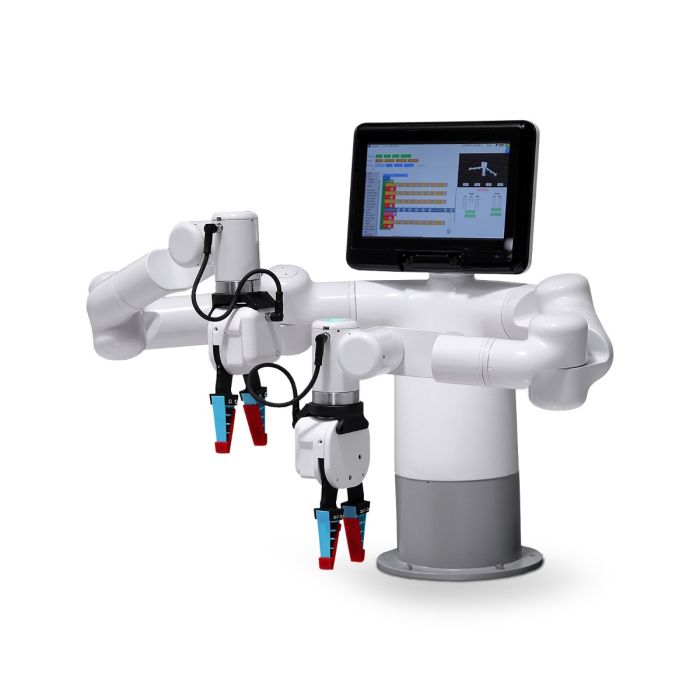
What if the quickest way to teach a robot a task were simply to do the task yourself? The Elephant Robotics Mercury Humanoid Robot B1 (4011300002) is built around that idea. Paired with the myController S570 exoskeleton controller, it achieves 1:1 motion replication, so an operator's movements become the robot's movements. For labs, classrooms and demonstration spaces, that turns abstract talk about embodied intelligence into something you can see and try.
The product is available through this page, by quotation.
Background
Elephant Robotics and the Mercury line
Elephant Robotics is a robotics manufacturer known for compact, accessible machines aimed at education, research and light automation. Its catalog runs from small collaborative arms to mobile platforms and humanoid designs. Within that catalog, the Mercury series is the humanoid family, and the Mercury B1 sits beside the Elephant Robotics Mercury Humanoid Robot A1 (4011300001) and the Elephant Robotics Mercury X1 Wheeled Humanoid Robot (4011300003).
The series supports major programming languages and popular simulation platforms such as ROS, Moveit, Gazebo and Mujoco. For a team that already works in those tools, the B1 does not ask for a new workflow. It fits into the one the team already has.
Positioning and key technology of the Mercury B1
The Mercury B1 is a compact humanoid platform with 17 degrees of freedom and a maximum working radius of 450mm. Its product size is 200*192.5*537mm, and it is built from carbon fiber, aluminum alloy and engineering plastics. Joints use a harmonic reducer, a common choice where smooth, precise motion matters, and each joint is held by an electromagnetic friction plate brake.
Repeatability is stated as ± 0.05mm and the maximum payload as 1KG. Those figures place the robot in the precision-oriented, light-load class. It is a platform for careful manipulation, teaching and prototyping, and it is not meant for heavy lifting.
On the computing side, the B1 carries a 6-core NVIDIA Carmel Arm®v8.2 64-bit CPU with 6MB L2 + 4MB L3 at 1.9GHz, a 512 core NVIDIA Volta architecture GPU with 64 Tensor Cores, and a computing power of 67 TOPS. A 9-inch touching screen gives the operator a direct way to interact with the robot.
Technical Specifications
| Specification | Value |
|---|---|
| Product size | 200*192.5*537mm |
| Working voltage | 24V |
| Degrees of freedom | 17DOF |
| Maximum working radius | 450mm |
| Maximum payload | 1KG |
| Net weight | 8KG |
| Repeatability | ± 0.05mm |
| Reduction mechanism | Harmonic Reducer |
| Joint brake | Electromagnetic friction plate |
| Computing power | 67 TOPS |
| Main controller CPU | 6-core NVIDIA Carmel Arm®v8.2 64-bit CPU 6MB L2 + 4MB L3 1.9GHz |
| Main controller GPU | 512 core NVIDIA Volta architecture GPU with 64 Tensor Cores,1100MHz |
| Screen | 9-inch Touching Screen |
| Material | Carbon fiber, Aluminum alloy, Engineering plastics |
| 3D camera | Orbbec Deeyea |
| Microphone | Line array 4 microphones,5m 180° pickup |
| I/O | 24V 6 Input, 6 Output |
| Communication | CAN Bus/WIFI/Network port/Bluetooth/USB serial port |
Specifications as published by the manufacturer; confirmed against the datasheet at quotation.
The manufacturer has not published the battery capacity, the operating time, the IP rating, the box contents, the operating temperature or the power consumption; they are confirmed at quotation.
Which Mercury B1 figures should I compare before ordering?
The sources describe the Mercury B1 in more than one way, so compare carefully. One specification page gives 8KG net weight and 67 TOPS of computing power, with the CPU and GPU listed in the table above. A shop page lists 11.2KG and 21 TOPS. A version with a Jetson Orin Nano 8GB is listed at 40 TOPS.
These figures belong to different descriptions of the product, and none should be mixed with another. If weight or computing power decides your purchase, for example because of a mounting limit or a vision workload, state that in your request so the right configuration is settled when your quotation is prepared.
How does the exoskeleton controller change the way you use the B1?
Most robot programming happens at a keyboard. You write a trajectory, test it, correct it and test it again. The myController S570 exoskeleton controller adds a second path. The operator wears or holds the controller and moves, and the robot reproduces that motion one to one. For tasks that are hard to describe in code but easy to demonstrate, such as handing over an object or arranging items on a bench, this is a faster way to explore what the robot can do.
It also makes the platform easy to show to visitors. A student who sees their own gesture mirrored by the robot understands the idea of teleoperation immediately. On the software side, the B1 supports both ROS1 and ROS2, with RVIZ simulation environment support. A team can therefore rehearse in simulation, then move to the physical robot, or collect demonstrations by exoskeleton control and process them in the tools it already uses.
Who is the Mercury B1 for?
University labs and research groups are the clearest fit. They need a humanoid form with 17 degrees of freedom, repeatable positioning of ± 0.05mm, and an open software environment with ROS, Moveit, Gazebo and Mujoco. Technical schools and training centers can use the same features to teach kinematics, vision and control on real hardware instead of simulation alone.
Developers prototyping service robots will value the 3D camera, the four-microphone array and the touching screen, which together cover seeing, hearing and interacting. Exhibition and demonstration organizers can use the humanoid form and the exoskeleton pairing to draw attention.
Buyers who need to move a heavy load should look elsewhere, since the maximum payload is 1KG. Teams that want a different humanoid configuration can look at the Mercury A1 (4011300001) or the Mercury X1 Wheeled Humanoid Robot (4011300003), and compare them against their own requirements.
What is the Mercury B1 used for?
- Research in embodied intelligence: a humanoid platform on which perception, planning and manipulation algorithms can be tested on real hardware.
- Teleoperation and demonstration: with the myController S570, an operator's motion is replicated one to one for precise control.
- Simulation-to-real development: work in ROS, Moveit, Gazebo or Mujoco, then run the result on the robot.
- Teaching robotics: classes on joints, reducers, brakes, sensors and communication buses, using a machine students can see and handle.
- Vision and voice interaction: use the Orbbec Deeyea 3D camera and the line array microphones to build interactive applications.
- Exhibitions and demonstrations: a compact humanoid with a touching screen that presents robotics to visitors in a clear and engaging way.
Pricing and Availability
We do not publish prices on this page. Please request a quotation, stating your intended use, the configuration you need and any accessories such as the exoskeleton controller. Delivery, customs and support are arranged together with the quotation, so you receive one clear answer for your location. The Mercury Humanoid Robot B1 (4011300002) is available on this page.
Frequently Asked Questions
How many degrees of freedom does the Mercury B1 have?
The Mercury B1 has 17 degrees of freedom, with a maximum working radius of 450mm.
What payload can it carry?
The maximum payload is 1KG. The B1 is made for light, precise handling and not for heavy loads.
Which software does it work with?
It supports ROS1 and ROS2 with RVIZ simulation environment support. The Mercury series also supports ROS, Moveit, Gazebo and Mujoco.
Can I control it by moving my own arms?
Yes. Paired with the myController S570 exoskeleton controller, the robot achieves 1:1 motion replication for precise control.
What sensors and interfaces does it include?
It has an Orbbec Deeyea 3D camera, a line array of 4 microphones,5m 180° pickup, and a 9-inch touching screen. Its I/O is 24V with 6 inputs and 6 outputs, and communication runs over CAN Bus, WIFI, network port, Bluetooth and USB serial port.
Are battery life and the IP rating available?
Those figures are not published, and neither are the operating time and operating temperature. Please ask for them when you request a quotation.
Where can I buy the Mercury B1 and what does it cost?
You can request it through this page. The cost is given in a quotation prepared for your configuration and location, and no price is listed here.
Summary
The Mercury B1 earns its place through one idea: a robot that learns from a person's movements as readily as from code. It has 17 degrees of freedom, a harmonic reducer, ± 0.05mm repeatability, a 3D camera, a microphone array, and support for ROS1, ROS2 and the common simulation platforms. It suits labs, classrooms and demonstration spaces that value precision over payload. If that matches your plans, this page is the starting point.


