
Elephant Robotics myBuddy 280 Pi (4010100014)
In stock
- BRAND:
- ELEPHANT ROBOTICS
- MODEL:
- MYBUDDY 280 Pi
- PART #:
- 4010100014
- ORIGIN:
- China
- AVAILABILITY:
- SUBJECT TO AVAILABILITY
- SKU:
- Elephant-Robotics-4010100014
Elephant Robotics myBuddy 280 Pi (4010100014)
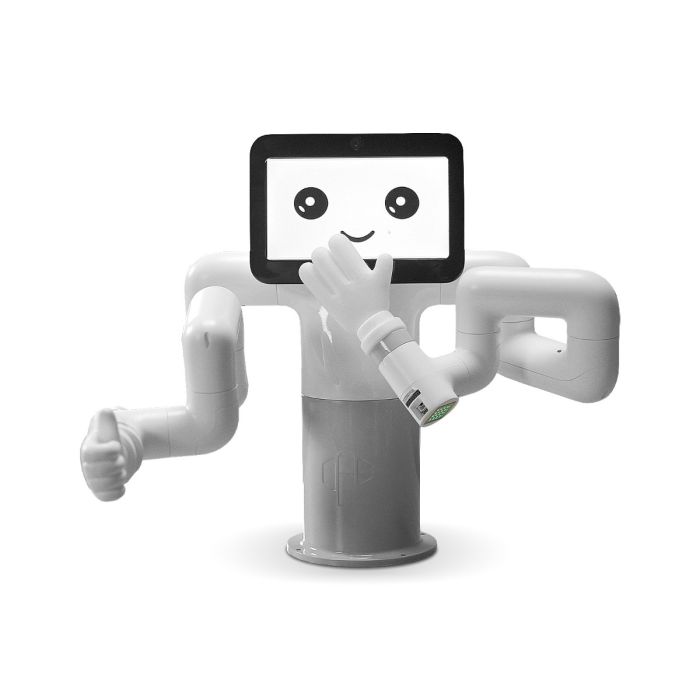
A robot that can look at you, find an object on the table and then reach for it with a hand on each side is a different kind of teaching tool from a single arm bolted to a plate. The Elephant Robotics myBuddy 280 Pi (4010100014) is built around that idea: two arms, a screen, two cameras and a Raspberry Pi 4 brain in one tabletop cobot that you can program from block code up to ROS.
The product is available through this page, by quotation.
Background
The company and the lineage
Elephant Robotics is the brand behind this cobot, and it supplies a family of compact robot arms, mobile platforms and humanoid-style machines to schools, laboratories and developers. Its catalog is wide, and you can see more of it in the Elephant category or across the full Shop. If you are comparing the myBuddy against a single, larger arm from the same maker, the Elephant Robotics myCobot Pro 630 Robot Arm (4010200011) is one page worth opening.
The myBuddy line takes the idea of a small collaborative arm and doubles it. Instead of one limb that reaches a point in space, the myBuddy offers two limbs that work in the same space, which is the situation many service-style tasks eventually call for. The 280 Pi model is the version controlled by a Raspberry Pi 4 single board computer.
Positioning and key technology
The myBuddy 280 Pi is aimed at people who want to learn, prototype and demonstrate rather than simply move parts. Its core technology is a combination of three things. First, the arms, with a working radius of 280mm for a single arm and a maximum payload of 250g. Second, the sensing, with a 7-inch interactive display screen and two 2-million-pixel HD cameras. Third, the software, with a built-in ROS development environment that includes RVIZ and MOVEIT cases.
The Raspberry Pi 4 (2GB or 4GB RAM) controls the display and communicates with the ESP32 modules. That arrangement will feel familiar to anyone who has worked with maker hardware, and it keeps the platform approachable for students while still leaving room for serious development.
Technical Specifications
| Specification | Value |
|---|---|
| Working radius (single arm) | 280mm |
| Maximum payload (single arm) | 250g |
| Repeatability | 0.5MM |
| Degrees of freedom | 13 |
| Display | 7-inch interactive display screen |
| Cameras | Two 2-million-pixel HD cameras |
| Controller computer | Raspberry Pi 4 (2GB or 4GB RAM) |
| I/O | 3.3V I/O ports and Lego ports |
| Power supply | 24V/9.2A |
| Life span | 500 hours |
| Weight | 3 kg |
| Operating system compatibility | Android, Windows, macOS, Linux |
| Programming | myBlockly, ROS, Python |
| In the box | myBuddy 280 cobot, power supply with DC connector, user manual |
Specifications as published by the manufacturer; confirmed against the datasheet at quotation.
The manufacturer has not published the dimensions, the IP rating, the operating temperature, the noise level, the joint speed or a net weight; they are confirmed at quotation.
What makes the myBuddy 280 Pi different from a single-arm cobot?
A single-arm desktop robot answers one question well: can the tool reach this point? The myBuddy 280 Pi lets you ask a richer one: how do two arms divide a job? Each arm has a working radius of 280mm and carries up to 250g, and the whole robot has 13 degrees of freedom. That is enough to practice handing an object from one side to the other, holding something with one hand while the other works, or simply showing a gesture.
It also brings its own senses and its own face. The 7-inch interactive display screen can show information to the person standing in front of the robot, and the two 2-million-pixel HD cameras give it eyes. The 45-degree camera below supports area location positioning, object recognition and QR code recognition, while the other camera can achieve face and body recognition. With a single arm you would normally add a screen, a camera and a computer yourself; here they are part of the product.
Finally, the platform is open where learners need it to be. The ROS development environment is built in, with RVIZ and MOVEIT cases, and the URDF configuration documents are open, so users can do secondary development on the robot model. For teams that want to move beyond block programming, that openness is the main reason to choose this model.
Which package of the myBuddy 280 Pi should you choose?
Five package options are offered: myBuddy; myBuddy+G Shape Base; myBuddy+Left Hand; myBuddy+Right Hand; and myBuddy+Left & Right Hand. The hand options are named yeah, point, praise and grab.
In practical terms, the plain myBuddy is the starting point for anyone who wants the arms, screen and cameras. The G Shape Base option is there for those who want the robot set up on a base. The hand options suit those who care about expressive gestures and demonstrations, with a single hand on the left or right, or one on each side. Tell us which package you need when you request a quotation.
Who is the myBuddy 280 Pi for?
Educators are the most natural audience. A classroom or training lab can use the robot to teach kinematics, vision and programming on a single machine, starting with myBlockly and moving up to Python and ROS. The compatibility with Android, Windows, macOS and Linux means that students can connect from the computers they already have.
Researchers and developers form a second group. The Raspberry Pi 4 controller, the open URDF files and the 3.3V I/O and Lego ports make it a convenient prototyping bench for human-robot interaction ideas, small vision tasks and two-arm coordination before moving to larger hardware.
A third group is demonstration and exhibition teams, such as innovation centers and trade-show stands, who want a robot that has a face, responds to people and can show a gesture. Buyers who need heavy payloads should note that the payload is 250g per arm.
What is the myBuddy 280 Pi used for?
- Robotics teaching. Students learn arm control, joint motion and two-arm coordination in one compact unit.
- ROS development. The built-in environment with RVIZ and MOVEIT cases gives teams a place to test ideas, and the open URDF files allow changes to the model.
- Vision experiments. The cameras support object and QR code recognition, area location positioning, and face and body recognition.
- Pick-and-place practice. Accessories such as a suction pump and grippers let the robot handle light objects for different applications.
- Human-robot interaction demos. The 7-inch screen and the hand options make the robot a lively presence at events and in labs.
- Maker projects. The 3.3V I/O ports and Lego ports allow custom add-ons and creative builds.
Pricing and Availability
We do not print prices on this page. Please request a quotation, and tell us the package you want and how many units you need. Delivery, customs and support are arranged together with the quotation, so that you know what to expect before you commit. The Elephant Robotics myBuddy 280 Pi (4010100014) is available on this page.
Frequently Asked Questions
What is the working radius and payload of the myBuddy 280 Pi?
The working radius of a single arm is 280mm, and the maximum payload is 250g. The repeatability is 0.5MM.
What controls the robot?
A Raspberry Pi 4 single board computer with 2GB or 4GB of RAM controls the display and communicates with the ESP32 modules.
How can I program it?
The programming options are myBlockly, ROS and Python. The built-in ROS environment includes RVIZ and MOVEIT cases, and the URDF configuration documents are open.
What can the cameras do?
The 45-degree camera below supports area location positioning, object recognition and QR code recognition. The other camera can achieve face and body recognition.
Which accessories does it work with?
It works with accessories such as a suction pump and grippers, so it can be adapted to different applications.
What is included in the box?
The box contains the myBuddy 280 cobot, a power supply with a DC connector and a user manual. The power supply rating is 24V/9.2A.
Where can I buy the myBuddy 280 Pi and what does it cost?
You can request it through this page, by quotation. We do not list prices here; send us your package and quantity and we will reply with a quotation.
Summary
The myBuddy 280 Pi makes the case that two arms teach more than one. With a 280mm working radius and a 250g payload per arm, a 7-inch screen, two HD cameras, a Raspberry Pi 4 controller and open ROS tools, it gives students, researchers and demonstration teams a compact way to work on two-arm tasks. If that is the kind of project you have in mind, this page is the starting point.


