
Dobot CRA Collaborative Robot (CR7A)
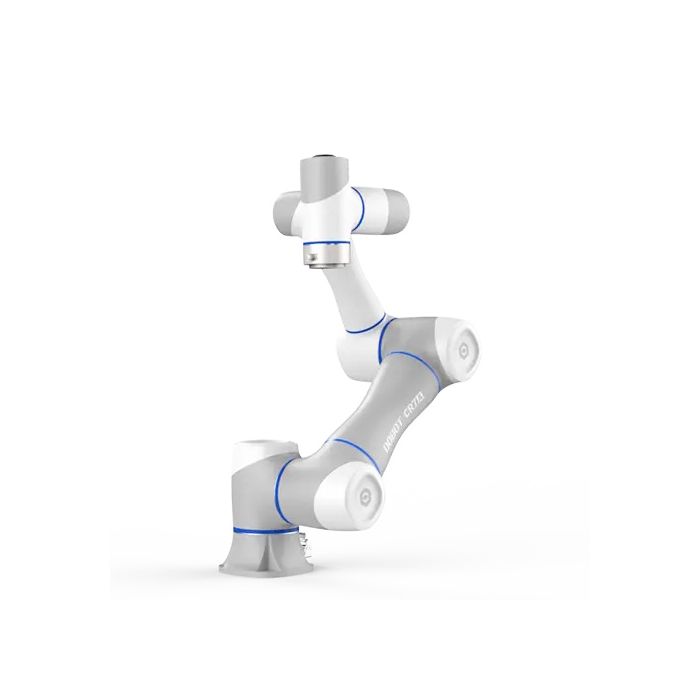
In stock
- BRAND:
- DOBOT
- PART #:
- 1200000188
- ORIGIN:
- China
- AVAILABILITY:
- SUBJECT TO AVAILABILITY
- SKU:
- Dobot-CR7A
Dobot CRA Collaborative Robot (CR7A)
Most collaborative robots ask you to choose between a gentle touch and a useful load. The Dobot CRA Collaborative Robot (CR7A) is built for buyers who refuse that trade: a 7 kg maximum payload and an 800mm working radius in an arm that is designed to share a floor with people, with a certified safety controller behind it.
The Dobot CRA Collaborative Robot (CR7A) is available through this page, by quotation.
Background
Dobot and the CRA series
The CR7A belongs to the CRA family from Dobot, a series of ten models, from the CR3A to the CR30A, with the CR5A, CR6AL, CR10A, CR12A, CR16A, CR16AL and CR20A in between. Each model addresses a different combination of load and reach, so a buyer can match the arm to the task instead of forcing one arm to do everything. You can browse the wider Dobot range and the Cobots category to see how the family sits alongside other products.
The CR7A is the model aimed at heavy-duty picking, packing, palletizing and welding, in the automotive, home appliance, logistics and metalworking industries. That is a demanding list for a collaborative arm, and it tells you where the CR7A is meant to earn its place: on the line, not only in the demonstration room.
Positioning and key technology
Three design choices define this arm. The first is the dual-channel end effector, an industry-first design that lets the CR7A connect directly to multiple end tools. For a cell that needs, say, a gripper and a sensor at the wrist, this keeps the tooling simpler.
The second is calibration. Each robot is calibrated with a laser calibration system, which gives an absolute positioning accuracy of under 0.4 mm. For programs that are moved from one arm to another, or for cells that must be rebuilt after maintenance, this matters as much as any repeatability figure.
The third is safety. The CR7A uses a stand-alone safety controller rated PLd Cat.3 with more than 20 safety functions, and the CRA series is certified with ISO 13849-1, ISO 10218-1 and ISO/TS 15066. If power is lost unexpectedly, the electromagnetic brake engages within 18 ms and holds the position within 1 mm, which protects both the equipment and the product being handled.
Technical Specifications
| Specification | Value (CR7A) |
|---|---|
| Maximum payload | 7 kg |
| Working radius | 800mm |
| Weight | 24.5 kg |
| Power consumption | 150W |
| Maximum linear speed | 2 m/s |
| Maximum joint speed | J1 / J2 180° /s; J3 180° /s; J4 / J5 / J6 223° /s |
| Range of motion | J1/J2/J4/J5/J6 ±360°; J3 ±160° |
| Absolute positioning accuracy | Under 0.4 mm |
| IP rating (robot body and control box) | IP54 |
| Noise | ≤ 70 dB |
| Working environment | 0° to 50° C |
| Installation orientation | Any angle |
| Materials | Aluminum alloy, ABS plastic |
| Cable length to control box | 5m |
| End effector I/O | 2 x AI, 2 x DO, 2 x DI (multiplexed with RS485) |
| Controller digital I/O | 24 digital IO ports with PNP and NPN switching |
| Communication | Modbus TCP/RTU, EtherNet/IP, PROFINET, and others |
| Software | DobotStudio Pro; Blockly and LUA script programming |
| Safety | PLd Cat.3 safety controller, 20+ safety functions; ISO 13849-1, ISO 10218-1, ISO/TS 15066 |
| Electromagnetic brake | Engages within 18 ms; holds position within 1 mm on power outage |
Specifications as published by the manufacturer; confirmed against the datasheet at quotation.
The manufacturer has not published the dimensions of the arm base, the supply voltage, the control box dimensions, the service life or the contents of the box; they are confirmed at quotation.
What makes the CR7A suited to heavy-duty cells?
The answer begins with the combination of payload and reach. A 7 kg maximum payload with an 800mm working radius covers the parts and tools that appear in picking, packing, palletizing and welding cells, and the 24.5 kg body is light enough to be handled when a cell is laid out or changed. With a power consumption of 150W, the arm itself is a modest load on the installation.
Motion is the second part. The joints turn at up to 180° per second on J1 to J3 and up to 223° per second on J4, J5 and J6, and the tool can travel at up to 2 m/s. Joints J1, J2, J4, J5 and J6 each rotate ±360°, while J3 covers ±160°, which gives the program a generous envelope to work in. Because the arm can be installed at any angle, it can be mounted on a floor, a wall, a ceiling or a tilted frame to suit the cell, rather than the cell being bent around the arm.
The third part is robustness. The robot body and the control box both reach IP54, the working environment runs from 0° to 50° C, and noise stays at or below 70 dB. The housing combines aluminum alloy and ABS plastic. For a plant in a warm, humid climate such as ours, a protected body and a quiet arm are practical advantages, not decoration.
How does the CR7A connect to the rest of the line?
Integration is where many cobot projects stall, so the connection options deserve attention. The controller offers 24 digital IO ports with support for PNP and NPN switching, which lets the arm work with sensors and devices wired either way. At the wrist, the end effector provides 2 x AI, 2 x DO and 2 x DI, multiplexed with RS485.
On the network side, the robot ships with standard communication methods including Modbus TCP/RTU, EtherNet/IP and PROFINET, among others. The control box connects to the arm through a 5m cable, which leaves room for placing the box outside the working area.
Programming runs through the DobotStudio Pro system software. Newer users can build programs with Blockly, while skilled developers can use LUA script programming for more intricate logic and advanced applications. Both routes live in one environment, so a team can start simple and grow without changing tools.
Who is the CR7A for?
Manufacturers in automotive, home appliance and metalworking plants are the clearest fit, because those industries are the ones this model is aimed at. A shop that welds or loads parts repeatedly, and that wants the arm to work close to operators without a full guarding cage, will find the certified safety controller a strong argument.
Logistics and packing operations are a second segment. Picking, packing and palletizing at a modest scale benefit from an arm that can be repositioned and reprogrammed as the product mix changes. The wide protocol support also suits integrators who must tie the arm into an existing PLC architecture.
Integrators and training centers are a third group. Having Blockly for beginners and LUA for developers means one platform can serve both teaching and production. If your task needs a lighter or heavier payload than the CR7A offers, look at the other models in the CRA family through the Cobots category, and ask us at quotation which model suits the job.
What is the CR7A used for?
- Heavy-duty picking. Lifting parts from bins, conveyors or fixtures within the 800mm working radius.
- Packing. Placing products into cartons and trays, with the dual-channel end effector holding more than one tool.
- Palletizing. Stacking boxes and parts at the end of a line, with a 7 kg maximum payload.
- Welding. Carrying a welding tool along a path with a positioning accuracy under 0.4 mm.
- Automotive and metalworking tasks. Handling and processing parts in automotive and metalworking plants.
- Home appliance and logistics work. Repetitive material handling where operators and the arm share space.
Pricing and Availability
We do not print prices on this page. Please request a quotation, and tell us the task, the tooling and the network you need to connect. Delivery, customs and support are arranged together with the quotation. The Dobot CRA Collaborative Robot (CR7A) is available on this page.
Frequently Asked Questions
What payload can the CR7A carry?
The maximum payload is 7 kg, with a working radius of 800mm. Remember to count the weight of your tool within that figure.
Can the CR7A be mounted on a wall or ceiling?
Yes. The installation orientation is any angle, so the arm can be mounted in the position that suits your cell.
What safety certifications does the CRA series hold?
The CRA series is certified with ISO 13849-1, ISO 10218-1 and ISO/TS 15066. The stand-alone safety controller is rated PLd Cat.3 and offers more than 20 safety functions.
What happens if the power fails?
The electromagnetic brake engages within 18 ms and holds the position within 1 mm. This protects the equipment and the product.
How is the CR7A programmed?
It uses DobotStudio Pro, with Blockly for graphical programming and LUA script programming for developers who need more control.
Is the CR7A protected against dust and water?
The robot body and the control box both achieve IP54. The working environment is 0° to 50° C.
Where can I buy the CR7A and what does it cost?
You can buy it through this page by requesting a quotation. The cost depends on your configuration and delivery, so it is given in the quotation and not printed here.
Summary
The CR7A answers the question of how to get a useful load from an arm that is safe to stand beside. It offers a 7 kg maximum payload, an 800mm working radius, IP54 protection, certified safety and flexible connections, and it speaks the protocols that plants already use. If this arm fits your cell, this page is the starting point.


