
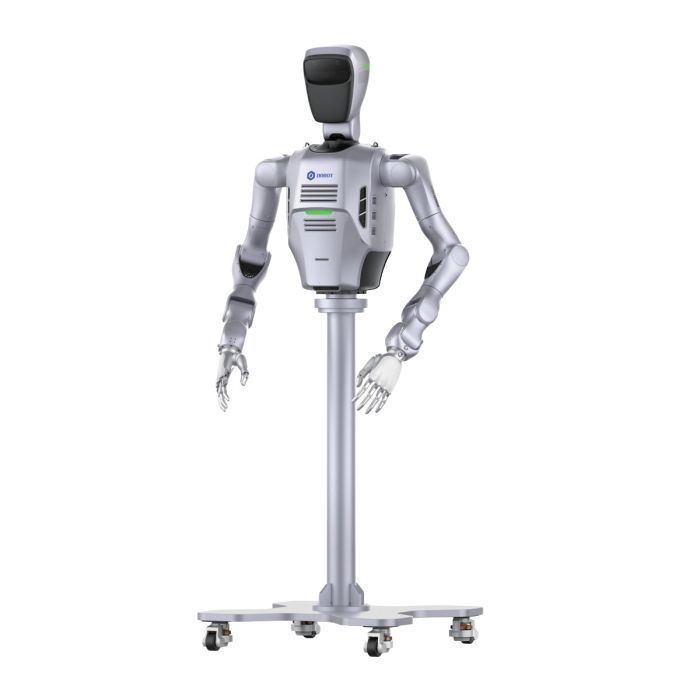
Dobot Atom D Upper Body Humanoid Robot
In stock
- BRAND:
- DOBOT
- MODEL:
- ATOM D
- ORIGIN:
- China
- AVAILABILITY:
- SUBJECT TO AVAILABILITY
- SKU:
- Dobot-Atom-D
Dobot Atom D Upper Body Humanoid Robot
Most humanoid demonstrations show a robot walking across a stage. Teams that train embodied AI usually need something else: a pair of capable arms, a head that sees well, and a steady flow of clean recordings. The Dobot Atom D Upper Body Humanoid Robot is shaped around that need, putting the human-like workspace at the center and leaving the walking to its siblings in the Atom family.
The Dobot Atom D Upper Body Humanoid Robot is available through this page, by quotation.
Background
Dobot and the Atom family
Dobot is best known for collaborative robot arms, desktop robots and education platforms. The Atom series is its step into humanoid robotics. DOBOT Atom is described as the world's first full-sized humanoid robot combining dexterous manipulation with straight-knee walking, and that goal of pairing capable hands with a natural gait sets the tone for the whole line.
The sources name four versions: ATOM Max, ATOM Trainer, ATOM D - Data Collection and ATOM D EDU. Each one points at a different kind of work. If you are comparing the family, the Dobot Atom Max Full-Size Embodied Al Humanoid Robot and the Dobot Atom Trainer have their own pages, and the wider range is gathered under Humanoids.
Where the Atom D sits in the line
The ATOM D - Data Collection version is optimized for large-scale data tasks. It carries 7-DoF dual arms and a 2-DoF head, with customizable end-effectors: dexterous hands or grippers, and wrist cameras. In other words, it is built to be operated, observed and recorded, again and again, in volume.
It belongs to the category of Upper Body Humanoids: robots that reproduce the head, torso and arms of a person, which is where most manipulation work happens. A mobile base is listed as an optional accessory for teams that need the robot to be placed or moved around a workspace.
Technical Specifications
| Specification | Value |
|---|---|
| Version described | ATOM D - Data Collection |
| Intended use | Large-scale data tasks |
| Arms | 7-DoF dual arms |
| Head | 2-DoF head |
| End-effectors | Customizable: dexterous hands or grippers, and wrist cameras |
| Head sensor | RGB-D camera x1 + Full HD binocular camera x1 |
| Depth camera | Intel RealSense D455, 6 m range |
| Binocular camera | 60 fps Full HD |
| Maximum end speed of arm | 1.5 m/s |
| Basic computing module | Intel i5 |
| Connectivity | Ethernet |
| Joint assembly actuators hollow alignment | Yes |
| SDK support | Supported |
| Optional accessories | Battery Pack 1x, Battery Charger 1x, 6-DoF Dexterous Hands 2x, 2-Finger Adaptive Grippers 2x, Wrist-Mounted RGB-D Cameras 2x, Mobile Base 1x |
Specifications as published by the manufacturer; confirmed against the datasheet at quotation.
The manufacturer has not published the IP rating, the operating temperature, the battery capacity, the power consumption, the dimensions beyond height or the payload per arm with hands fitted; they are confirmed at quotation.
What makes the Atom D different from the other Atom versions?
The difference is purpose. The Atom D - Data Collection version is tuned for producing recordings at scale. Its head carries an RGB-D camera and a Full HD binocular camera. The binocular camera runs at 60 fps and is designed to minimize VR/MR motion sickness while keeping image quality high. That detail matters when an operator wears a headset and steers the robot by teleoperation: a smooth, comfortable view lets people work longer and more accurately, and better operators produce better demonstrations.
The depth side is covered by an Intel RealSense D455 with a 6 m range, which gives the robot a view of the scene in three dimensions. Add the optional wrist-mounted RGB-D cameras, supplied as a pair, and each arm gets its own close-up view of whatever it is handling. Seeing the object from the head and from the hand at once is how many manipulation datasets are built.
For teams whose priority is a different one, the family offers other routes. The Atom Trainer and the Atom Max are separate products with their own pages, and their specifications should be read there rather than assumed from this one.
How does the Atom D handle data and integration?
The system supports Ethernet connectivity for efficient external data collection and processing. In practice that means a wired link between the robot and the machines that store, label or train on the data. An Intel i5 serves as the basic computing module, and an SDK is supported, so a lab can write its own software around the robot instead of working only with fixed tools.
The mechanical design helps with cabling. The joint assembly actuators are hollow-aligned, which is listed as a yes in the specifications. Hollow joints let cables run through the structure rather than around it, a feature that tends to matter in a robot whose arms move all day and whose wiring must survive thousands of repetitions.
The arms can reach a maximum end speed of 1.5 m/s. Hands and grippers are the part you choose: 6-DoF Dexterous Hands and 2-Finger Adaptive Grippers are both listed as optional accessories, each supplied as a pair. A lab working on fine in-hand manipulation and a lab working on pick-and-place can therefore configure the same platform differently.
Who is the Dobot Atom D for?
The first group is university and corporate research laboratories working on embodied AI. They need a repeatable platform that records human demonstrations and feeds a training pipeline, and they usually have engineers who will use the SDK.
The second group is companies building datasets for manipulation, such as robotics start-ups and industrial innovation teams. For them the value lies in volume: a robot designed for large-scale data tasks, with an Ethernet link to their processing infrastructure.
The third group is teams exploring teleoperation and VR or MR control. The binocular camera was designed with operator comfort in mind, so the Atom D suits projects where a person wears a headset and drives the robot for long sessions.
Buyers who mainly need a full-size robot for advanced research or industrial applications should look at the Dobot Atom Max first, and those whose work is framed around training should look at the Atom Trainer.
What is the Dobot Atom D used for?
- Teleoperated demonstration capture. An operator guides the dual arms while the robot records what its cameras and joints do.
- Building manipulation datasets. Repeated recordings with dexterous hands or grippers give training material for learning-based control.
- Embodied AI research. The SDK and the Intel i5 computing module let researchers run their own software on the platform.
- VR and MR control studies. The 60 fps Full HD binocular camera supports immersive operation with reduced motion sickness.
- Depth-aware perception work. The Intel RealSense D455 with its 6 m range, plus optional wrist RGB-D cameras, supports scene and object studies.
- End-effector comparison. Teams can test 6-DoF Dexterous Hands against 2-Finger Adaptive Grippers on the same arms.
Pricing and Availability
We do not publish prices on this page. Quotation is the way to buy: tell us the version, the end-effectors and the accessories you need, and we will prepare an offer. Delivery, customs and support are arranged with the quotation. The Dobot Atom D Upper Body Humanoid Robot is available on this page.
Frequently Asked Questions
What version of the Atom D is described here?
The figures on this page are for ATOM D - Data Collection. The sources also name an ATOM D EDU version, whose specifications are not covered here.
How many degrees of freedom do the arms and head have?
The dual arms are a 7-DoF system, and the head has 2 DoF.
Which cameras does the robot use?
The head carries an RGB-D camera and a Full HD binocular camera. The depth camera is an Intel RealSense D455 with a 6 m range, and the binocular camera runs at 60 fps.
Does it support custom software?
Yes. SDK support is listed as supported, and the robot connects through Ethernet for external data collection and processing.
Which accessories are optional?
Battery Pack, Battery Charger, 6-DoF Dexterous Hands, 2-Finger Adaptive Grippers, Wrist-Mounted RGB-D Cameras and a Mobile Base.
What are the payload and the IP rating?
This page gives no figure for either. Please ask for them when you request your quotation.
Where can I buy the Dobot Atom D and what does it cost?
You can request it through this page. The cost is given in a quotation prepared for your configuration, so no price is listed here.
Summary
The Dobot Atom D Upper Body Humanoid Robot answers a simple question: what if the most useful part of a humanoid is its upper body? With 7-DoF dual arms, a 2-DoF head, a RealSense D455 depth camera, a 60 fps binocular camera, Ethernet and an SDK, it is set up to turn human demonstrations into usable data. Hands, grippers, wrist cameras and a mobile base can be chosen to fit the work. For a quotation on the right configuration, this page is the starting point.


