
Dobot Dobot M1 Pro (Dobot M1 Pro)
In stock
- BRAND:
- DOBOT
- PART #:
- 1200000016
- ORIGIN:
- China
- AVAILABILITY:
- SUBJECT TO AVAILABILITY
- SKU:
- Dobot-Dobot-M1-Pro
Dobot Dobot M1 Pro (Dobot M1 Pro)
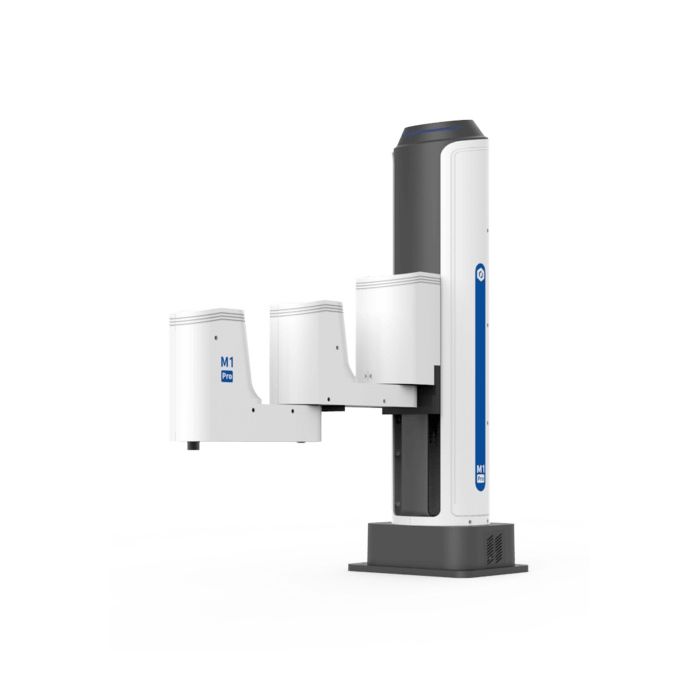
Some robots ask for a room of their own. The Dobot Dobot M1 Pro (Dobot M1 Pro) is built the other way around: a SCARA arm that carries its own control electronics and is meant to be set up on a workbench, connected to a laptop or tablet, and put to work. For workshops, labs and small production lines, that changes how quickly an automation idea becomes a running cell.
The product is available through this page, by quotation.
Background
The brand and the second generation
Dobot is a robotics brand whose range on this store runs from desktop automation to humanoid platforms. You can browse the wider range in the Dobot category. The M1 Pro sits in the industrial-arm part of that world, and the manufacturer describes it as the second-generation intelligent SCARA robot with a built-in dynamic algorithm.
A SCARA arm is a familiar shape in factories: rigid in the vertical direction, flexible in the horizontal plane, and well suited to picking up a part in one place and setting it down in another. Calling the M1 Pro a second-generation design tells a buyer that the concept has been refined, with the controller, the encoder interface and the programming tools all pulled into one package.
Positioning and key technology
Three ideas define this arm. The first is the built-in dynamic algorithm, which gives the robot its description as an intelligent SCARA. The second is the all-in-one compact design: the control box is integrated into the robot, so no additional wiring is needed. The third is the added encoder interface, which supports dynamic grabbing and tracking, multithread operation and on-the-fly IO controls to reduce motion cycle time.
Together, these make the M1 Pro a good match for conveyor-fed tasks, where parts keep moving while the arm works, and for compact stations where a separate cabinet would be an obstacle. Calibration is greatly simplified with scripting and graphical programming, and the arm connects by wire or wirelessly to PCs, tablets, smartphones and other terminal devices.
Technical Specifications
| Specification | Value |
|---|---|
| Product type | Second-generation intelligent SCARA robot with built-in dynamic algorithm |
| Model code | DT-M1-P4R15-01I |
| Weight | 15.7 kg |
| Maximum payload | 1.5 kg |
| Working radius | 400 mm |
| Repeatability | ±0.02 mm |
| Range of motion J1 | ±85° |
| Range of motion J3 | 5 mm ~ 245 mm |
| Maximum joint speed J3 | 1000 mm/s |
| Maximum joint speed J4 | 1000° /s |
| Rated voltage | 100 ~ 240V AC, 50/60 Hz |
| Rated power | 192W |
| Working temperature | 0℃~40℃ |
| IP rating | IP20 |
| Communication interface | TCP/IP, Modbus TCP, Modbus RTU |
Specifications as published by the manufacturer; confirmed against the datasheet at quotation.
The manufacturer has not published the ambient humidity range, the noise level, the maximum TCP speed or the colour options; they are confirmed at quotation.
What makes the M1 Pro different from a conventional SCARA setup?
In a traditional installation, the arm is one purchase and the controller is another. The two are joined by cables, and someone has to find room for the controller, route the wiring and make sure everything is connected correctly. The M1 Pro takes that step away. Its all-in-one compact design integrates the control box and removes the need for additional wiring, so the equipment you receive is a single working unit.
The second difference is the way it handles moving work. The added encoder interface supports dynamic grabbing and tracking, which matters whenever parts arrive on a belt rather than sitting still in a fixture. Combined with multithread and on-the-fly IO controls, the arm can respond while it moves instead of stopping to wait, which is how the manufacturer says motion cycle time is reduced.
The third difference is in the setup. Scripting and graphical programming give two ways in: a graphical route for people who prefer to build a sequence visually, and scripting for those who want finer control. Because the arm connects both by wire and wirelessly to PCs, tablets, smartphones and other terminal devices, the programming terminal can be whatever is at hand.
How does the M1 Pro connect to other equipment?
The communication interface covers TCP/IP, Modbus TCP and Modbus RTU. In practice, that means the arm can be reached over a standard network and can speak the Modbus protocols that many sensors, feeders, PLCs and small controllers already use. For a buyer, it is a short list but a practical one, since these are common languages in industrial automation.
On the electrical side, the rated voltage is 100 ~ 240V AC at 50/60 Hz, and the rated power is 192W. A supply range this wide is helpful for organizations that move equipment between sites or that are not sure which supply a future location will offer. The working temperature is 0℃~40℃, and the arm is IP20 rated, so it is designed for clean, indoor conditions rather than for washdown or dusty areas.
Who is the Dobot Dobot M1 Pro (Dobot M1 Pro) for?
The first group is small and mid-sized manufacturers who want a precise pick-and-place arm without building a cabinet-based cell. With a working radius of 400 mm and repeatability of ±0.02 mm, the arm is aimed at compact, accurate work rather than large reach or heavy lifting.
The second group is system integrators. A unit with the controller already inside, a clear communication interface and an encoder input for conveyor tracking is easier to place into a customer's line and easier to document. The third group is education and research: laboratories and technical schools that want students to program a real industrial-style arm, using graphical tools first and scripting later.
A fourth group is those who need a robot that works in tight stations such as assembly benches, test fixtures and small packing positions. With a maximum payload of 1.5 kg, the M1 Pro suits light parts and tools. If your project needs a humanoid or mobile platform rather than a fixed arm, the Dobot category lists the other options, and we are glad to help you compare.
What is the Dobot Dobot M1 Pro (Dobot M1 Pro) used for?
- Pick and place. Moving light parts from one position to another with a repeatability of ±0.02 mm.
- Conveyor tracking. Grabbing parts in motion using the encoder interface for dynamic grabbing and tracking.
- Light assembly. Placing and inserting small components, using the vertical stroke of 5 mm ~ 245 mm on the J3 axis.
- Machine tending. Loading and unloading small workpieces for neighboring machines through TCP/IP or Modbus signals.
- Teaching and training. Giving students hands-on experience with scripting and graphical programming on a real SCARA arm.
- Prototype cells. Building and testing a compact automation station quickly, since the control box is integrated and no extra wiring is needed.
Pricing and Availability
We do not publish prices on this page. Quotation is the way to proceed: tell us your application, your quantity and your location, and we will respond with an offer. Delivery, customs and support are arranged together with the quotation, so you know the full picture before you decide. The Dobot Dobot M1 Pro (Dobot M1 Pro) is available on this page.
Frequently Asked Questions
What type of robot is the M1 Pro?
It is a second-generation intelligent SCARA robot with a built-in dynamic algorithm. SCARA arms are commonly used for fast, precise horizontal-plane tasks.
Does it need a separate control cabinet?
No. The M1 Pro has an all-in-one compact design that integrates the control box and removes the need for additional wiring.
How do I program it?
You can use scripting or graphical programming. The arm connects by wire or wirelessly to PCs, tablets, smartphones and other terminal devices.
What communication protocols does it support?
The communication interface supports TCP/IP, Modbus TCP and Modbus RTU.
Can it work with moving conveyors?
Yes. The added encoder interface supports dynamic grabbing and tracking, along with multithread and on-the-fly IO controls.
What are the payload and the IP rating?
The maximum payload is 1.5 kg and the arm is IP20 rated. It is intended for indoor use within a working temperature of 0℃~40℃.
Where can I buy the Dobot Dobot M1 Pro (Dobot M1 Pro) and what does it cost?
It is available through this page, by quotation. Send us your request and we will reply with an offer; no price is listed here.
Summary
The idea behind the M1 Pro is simple: an arm that does not ask for a room of its own. With the controller built in, a clear communication interface, an encoder input for moving parts and two ways to program it, it gives workshops, integrators and classrooms a compact route into SCARA automation. Its limits are equally clear, with a 1.5 kg payload, a 400 mm working radius and IP20 protection, so it fits light, precise, indoor work. If that matches your project, this page is the starting point.


