
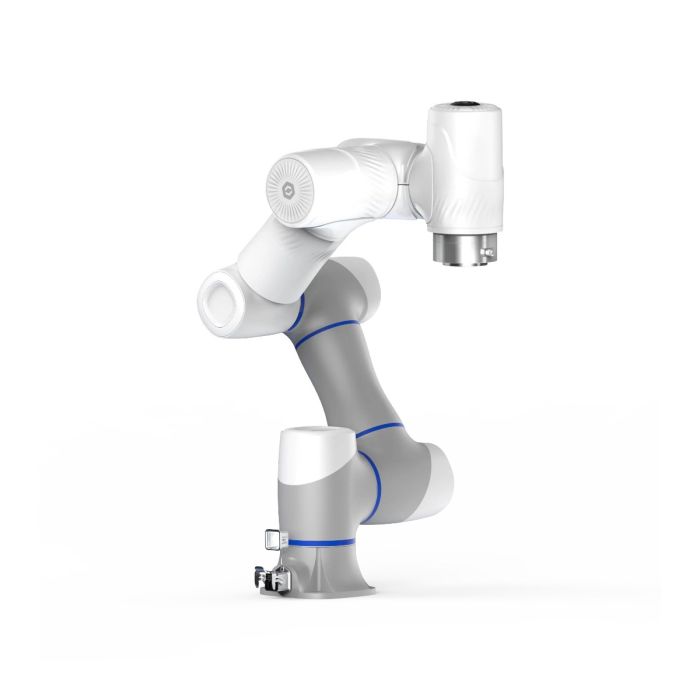
Dobot CRA Collaborative Robot (CR3A)
In stock
- BRAND:
- DOBOT
- PART #:
- 1200000186
- ORIGIN:
- China
- AVAILABILITY:
- SUBJECT TO AVAILABILITY
- SKU:
- Dobot-CR3A
Dobot CRA Collaborative Robot (CR3A)
A robot that shares a bench with people has to be compact enough to trust and exact enough to be useful. The Dobot CRA Collaborative Robot (CR3A) is built around that balance: a small arm with a 620 mm working radius, a 3 kg payload and a repeatability of ±0.02 mm, aimed at work that is too repetitive for people and too small for a full industrial cell.
The product is available through this page, by quotation.
Background
Dobot and the CRA series
The CR3A carries the DOBOT brand and belongs to the CRA collaborative robot line. Collaborative robots, or cobots, are arms designed to be installed close to operators, often without the heavy fencing associated with traditional industrial robots. The exact safety arrangement still depends on the application and on a risk assessment for each site. Buyers who want to compare it with other arms from the same maker can browse the Dobot category, or look at the wider Cobots range.
The CR3A is offered in two editions: the AC Edition (Standard) and the DC Edition (Mobile). Both names appear in the manufacturer's material, and both are covered by the quotation for this page.
Positioning and key technology
The CR3A sits at the small end of the collaborative robot scale. A 3 kg maximum payload suits light parts, grippers, small tools and sensors rather than heavy loads. Three design choices define it.
First, the arm uses a dual-channel end effector design, which the manufacturer describes as industry-first. It can connect directly to multiple end tools, so a gripper and a second device can be fitted without extra adapters.
Second, it has 24 digital IO ports with support for both PNP and NPN switching. That matters in a plant where sensors, feeders and fixtures come from different suppliers and follow different wiring conventions.
Third, it supports the Profinet and Ethernet/IP communication protocols and connects with PLCs. A cell that already runs on a PLC can therefore treat the arm as one more station rather than a separate island.
Both the robot body and the control box are rated IP54. The body is made of aluminum alloy and ABS plastic.
Technical Specifications
| Specification | Value |
|---|---|
| Maximum payload | 3 kg |
| Working radius | 620 mm |
| Maximum linear speed | 2 m/s |
| Repeatability | ±0.02 mm |
| Protection rating (robot body and control box) | IP54 |
| Power | 120W |
| Working environment temperature | 0 ~ 50 °C |
| Cable length to controller | 5 m |
| Materials | Aluminum alloy, ABS plastic |
| Digital I/O | 24 digital IO ports, PNP and NPN switching |
| Industrial communication | Profinet, Ethernet/IP |
| End effector design | Dual-channel |
| Editions | AC Edition (Standard), DC Edition (Mobile) |
Specifications as published by the manufacturer; confirmed against the datasheet at quotation.
The manufacturer has not published the tool flange dimensions, the base footprint, the controller dimensions or the controller weight; they are confirmed at quotation.
What makes the CR3A different from a conventional industrial arm?
The first difference is scale and intent. A conventional industrial arm is usually chosen for reach, payload and cycle time, and it is then surrounded by guarding. The CR3A is chosen for a different reason: it is a compact arm meant to fit into spaces where people already work, and to take over a repeatable task at a station without rebuilding the station around it.
The second difference is how it connects. With 24 digital IO ports that accept both PNP and NPN switching, the wiring of existing sensors and devices is less likely to force a redesign. Profinet and Ethernet/IP support means the arm can speak to a PLC in the language many factories already use.
The third difference is the tooling interface. The dual-channel end effector design lets the arm connect directly to more than one end tool, which is useful when a task combines, for example, gripping and a second function at the same wrist.
Finally, the IP54 rating applies to both the robot body and the control box, not only to the arm. A buyer who has to place the controller near the work, rather than in a clean cabinet, will value that. The 5 m cable between the arm and its controller gives some freedom in where each part is placed.
What is the difference between the AC Edition and the DC Edition?
The manufacturer lists two editions: the AC Edition, labeled Standard, and the DC Edition, labeled Mobile. The labels suggest a fixed-station version and a version intended for mobile use, but the sources do not describe the technical differences between them, and none of the figures above is assigned to one edition over the other.
For that reason, please state the edition you have in mind when you request a quotation. The differences, and the figures that apply to each edition, are confirmed in the quotation against the datasheet.
Who is the Dobot CR3A for?
The CR3A suits several kinds of buyers, and the common thread is a task that is small, repeatable and close to people.
Small and mid-sized manufacturers will find it a practical first robot. A 3 kg payload and a 620 mm working radius cover many bench-scale tasks such as handling light parts, feeding a machine or placing components.
Integrators and automation contractors can use the Profinet and Ethernet/IP support, together with the 24 digital IO ports, to fit the arm into cells that already have a PLC.
Training centers, technical schools and workshops in the Caribbean and elsewhere can use a collaborative arm to teach programming, tool handling and safe human-robot work, while the 0 ~ 50 °C working temperature range gives room for warm shop floors.
Laboratories and light-assembly teams that need repeatable positioning will note the ±0.02 mm repeatability.
Buyers whose work requires a heavier payload or a longer reach should discuss the application with us before deciding, because the CR3A is a compact arm. Those looking for humanoid or legged platforms instead of an arm can look at our Dobot category for other products.
What is the Dobot CR3A used for?
- Pick and place. Moving light parts from one position to another with repeatable accuracy.
- Machine tending. Loading and unloading small parts at a machine, with the digital IO connecting to the machine's signals.
- Light assembly. Positioning components, fitting parts or driving small tools at a workstation.
- Inspection and testing. Presenting parts to sensors or test fixtures in a repeatable way.
- PLC-controlled cells. Working as a station inside a line that communicates over Profinet or Ethernet/IP.
- Education and training. Teaching robot programming and collaborative work in schools, labs and training centers.
Pricing and Availability
The CR3A is sold by quotation. Tell us the edition, the application and the quantity, and we will prepare an offer for your project. Delivery, customs and support are arranged together with the quotation, so that you know the whole scope before you commit. The Dobot CRA Collaborative Robot (CR3A) is available on this page.
Frequently Asked Questions
What payload and reach does the CR3A offer?
The maximum payload is 3 kg and the working radius is 620 mm.
How accurate is it?
The repeatability is ±0.02 mm, and the maximum linear speed is 2 m/s.
Is it protected against dust and water?
The robot body and the control box both achieve an IP54 protection rating. The working environment temperature is 0 ~ 50 °C.
Can it connect to my PLC?
Yes. The CR3A supports Profinet and Ethernet/IP communication protocols and connects with PLCs. It also has 24 digital IO ports supporting PNP and NPN switching.
Can I mount more than one tool?
The CR3A uses a dual-channel end effector design that can connect directly to multiple end tools.
Which editions are offered?
The AC Edition (Standard) and the DC Edition (Mobile). Tell us which one you need so that the quotation covers it.
Where can I buy the Dobot CRA Collaborative Robot (CR3A) and what does it cost?
You can obtain it through this page, by quotation. We do not print prices here; request a quotation with your edition and application, and the offer will include delivery, customs and support arrangements.
Summary
The Dobot CRA Collaborative Robot (CR3A) is a small arm meant for people-scale work: a 3 kg payload, a 620 mm working radius, ±0.02 mm repeatability and IP54 protection on both body and control box. Its 24 digital IO ports, Profinet and Ethernet/IP support and dual-channel end effector design let it fit into real cells rather than stand alone. If you are weighing it for your plant, workshop or classroom, this page is the starting point.


