
Dobot CRA Collaborative Robot (CR20A)
In stock
- BRAND:
- DOBOT
- PART #:
- 1200000192
- ORIGIN:
- China
- AVAILABILITY:
- SUBJECT TO AVAILABILITY
- SKU:
- Dobot-CR20A
Dobot CRA Collaborative Robot (CR20A)
Most collaborative robots are built to work gently beside a person at a bench. The Dobot CRA Collaborative Robot (CR20A) is built for the other end of the factory floor, where the loads are heavy, the reach is long and the shift does not stop. It is the high payload model of the CRA family, made for work that people have traditionally done with their backs.
The product is available through this page, by quotation.
Background
Dobot and the CRA lineage
Dobot is a robotics brand with a broad catalog, and its collaborative arms are gathered in the Cobots category of this store, with the wider range listed under Dobot. The CR20A belongs to the CRA Series, and the sources name it as the High Payload Model of that series. They also name two related lines: the CRAF Series, which carries a torque sensor, and the CRA-IP68 Series. This page covers the CR20A only, and every figure below belongs to the CR20A.
For a buyer, the lineage matters because a collaborative robot is rarely a single purchase. It becomes a platform that a plant learns, programs and then repeats in other cells. Choosing an arm from a family with named variants gives a plant a path to follow if its needs change later.
Positioning and key technology
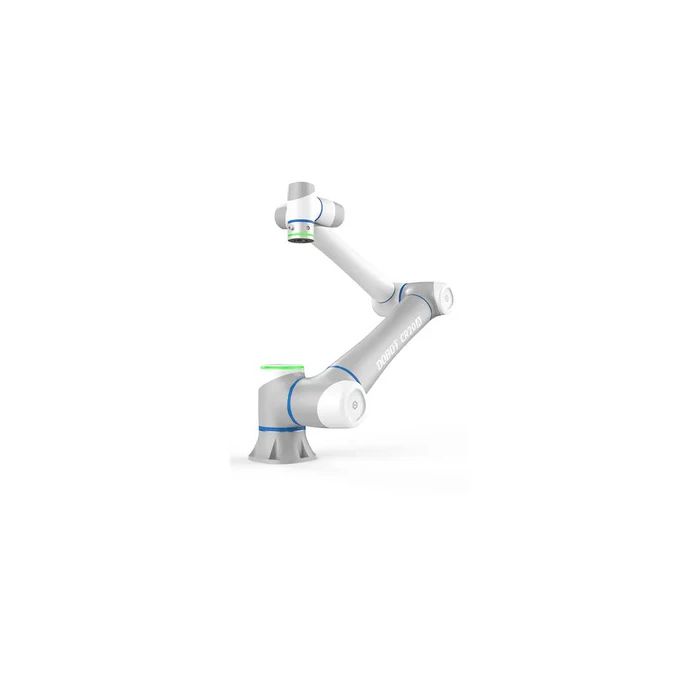
The CR20A is positioned for heavy-duty tasks. Its working radius reaches far enough to serve a pallet, a conveyor or a welding fixture from one mounting point. The maker describes an industry-first dual-channel end effector design, which can directly connect to multiple end tools. A visual status indicator at the base shows the state of the arm at a glance.
Safety and stability features are part of the design. An electromagnetic brake protection reduces the end tool drop distance at power failure, and an alarm sounds when the arm is overloaded. An advanced motion control algorithm reduces residual vibrations by 50% during high-speed emergency stops, so the arm settles faster after a hard stop.
On the connectivity side, the arm supports Profinet and Ethernet/IP. It has 24 digital IO ports with support for PNP and NPN switching, which makes it easier to connect to the sensors, grippers and controllers already found on a line.
Technical Specifications
| Specification | Value |
|---|---|
| Model | CR20A (High Payload Model) |
| Maximum payload | 20 kg |
| Working radius | 1,700 mm |
| Maximum speed of TCP | 2,000 mm/s |
| Repeatability | ±0.05 mm |
| Weight | 73 kg |
| Range of motion J1/J2/J4/J5/J6 | ±360° |
| Tool I/O power | 24V, Rated 2A, Max 3A |
| End I/O ports | 2 connectors, RS485/AI, 2 x DO, 2 x DI |
| Digital IO ports | 24, with PNP and NPN switching |
| Communication protocols | Profinet, Ethernet/IP |
| IP rating | IP54 |
| Noise | ≤ 70 dB |
| Working environment temperature | 0° ~ 50° C |
| Installation orientation | Upright |
| Cable length to controller | 6 m |
| Materials | Carbon steel, aluminum alloy, ABS plastic |
Specifications as published by the manufacturer; confirmed against the datasheet at quotation.
The manufacturer has not published the power consumption, the controller dimensions, the controller weight, the contents of the box, the safety certifications, the number of axes or the joint torque; they are confirmed at quotation.
What makes the CR20A different from a light-duty cobot?
The first difference is load. A maximum payload of 20 kg, together with a working radius of 1,700 mm, puts the CR20A in the class of work that small cobots cannot take on. Picking heavy cartons, lifting a welding torch with its cable, or placing parts into a press all ask for both strength and reach, and this arm offers both in one body.
The second difference is speed and precision together. The maximum speed of the TCP is 2,000 mm/s, and repeatability is ±0.05 mm. A fast arm that cannot return to the same point is of little use in palletizing or welding, so having the two figures side by side is what makes the arm practical for production.
The third difference is how the arm behaves when something goes wrong. The electromagnetic brake protection limits how far the end tool drops at power failure, an alarm sounds on overload, and the motion control algorithm cuts residual vibration by 50% in high-speed emergency stops. These features suit a heavy arm, because a heavy arm that stops badly is a heavy problem.
How does the CR20A connect to the rest of the cell?
A robot is only as useful as its connections. The CR20A supports Profinet and Ethernet/IP, two protocols widely used in industrial automation. Its 24 digital IO ports handle both PNP and NPN switching, so a plant does not have to change its existing sensors to suit the arm.
At the wrist, the end I/O offers 2 connectors with RS485/AI, 2 x DO and 2 x DI, and the tool power is 24V, rated 2A and up to 3A. The dual-channel end effector design allows several end tools to be connected directly, which helps when a task needs a gripper and a second tool on the same arm. The controller connects through a 6 m cable, so the cabinet can sit away from the work area.
Who is the Dobot CRA Collaborative Robot (CR20A) for?
The CR20A is for plants that need a collaborative robot with real muscle. Automotive suppliers, home appliance makers, logistics operators and metal processing shops are the industries the manufacturer names, and they share a common problem: repetitive handling of heavy items.
Integrators will value the protocol support and the generous digital IO, which shorten the work of tying the arm into an existing line. Plant engineers who want to automate palletizing at the end of a line, or welding in a fixed cell, will find the reach and payload fit those jobs. Training centers and technical institutes that teach industrial automation can also use an arm of this class to show students real production tasks.
Buyers who need a lighter arm for small parts, or who are looking at other series such as the CRAF with its torque sensor or the CRA-IP68, should ask us about those versions when requesting a quotation. You can also browse the full Cobots category to compare what is on offer.
One point on the environment: the CR20A is rated IP54, works in a range of 0° ~ 50° C and is installed upright. It suits indoor industrial settings, and the site conditions should be checked against those figures before ordering.
What is the Dobot CRA Collaborative Robot (CR20A) used for?
- Heavy-duty picking. The 20 kg payload and long reach allow the arm to lift weighty items from bins, conveyors and racks.
- Packing. The arm places goods into cases and cartons in logistics and home appliance lines.
- Palletizing. A working radius of 1,700 mm lets one arm build a full pallet from a single position.
- Welding. Accurate repeatability and a stable stop make the arm a candidate for welding cells in metal processing and automotive work.
- Multi-tool handling. The dual-channel end effector design connects several end tools directly, so one arm can do more than one job.
- Line integration. Profinet, Ethernet/IP and 24 digital IO ports connect the arm to the equipment around it.
Pricing and Availability
We do not print prices on this page. Please request a quotation for the Dobot CRA Collaborative Robot (CR20A) and tell us about your application, so that we can match the offer to your project. Delivery, customs and support are arranged together with the quotation. The Dobot CRA Collaborative Robot (CR20A) is available on this page.
Frequently Asked Questions
What is the maximum payload of the CR20A?
The maximum payload is 20 kg. The working radius is 1,700 mm.
How accurate is the CR20A?
Repeatability is ±0.05 mm, and the maximum speed of the TCP is 2,000 mm/s.
Which communication protocols does it support?
It supports Profinet and Ethernet/IP. It also has 24 digital IO ports with PNP and NPN switching.
What happens if power fails?
The electromagnetic brake protection reduces the end tool drop distance at power failure. An alarm also sounds when the arm is overloaded.
What are its environmental limits?
The IP rating is IP54 and the working environment temperature is 0° ~ 50° C. The arm is installed upright, and noise is ≤ 70 dB.
How long is the cable to the controller?
The cable between the arm and the controller is 6 m long, so the controller can be placed away from the work area.
Where can I buy the Dobot CRA Collaborative Robot (CR20A) and what does it cost?
You can buy it through this page by requesting a quotation. We do not list a price here; the cost depends on your project and is given in the quotation.
Summary
The CR20A is a collaborative robot that does not shy away from heavy work. It carries 20 kg, reaches 1,700 mm, moves at up to 2,000 mm/s and repeats to ±0.05 mm, while its brake protection, overload alarm and vibration control are designed to keep that strength under control. It connects to the plant through Profinet, Ethernet/IP and 24 digital IO ports, and it is aimed at picking, packing, palletizing and welding. If heavy tasks on your line are ready for automation, this page is the starting point.


