
Dobot CRA Collaborative Robot (CR16A)
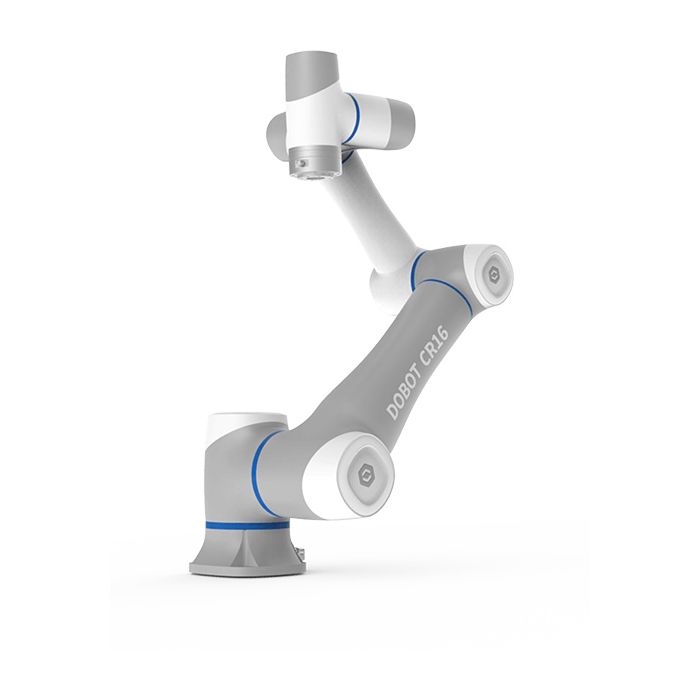
In stock
- BRAND:
- DOBOT
- PART #:
- 1200000191
- ORIGIN:
- China
- AVAILABILITY:
- SUBJECT TO AVAILABILITY
- SKU:
- Dobot-CR16A
Dobot CRA Collaborative Robot (CR16A)
Heavy loads and shared workspaces rarely sit comfortably together. Strong arms usually live behind fences, and friendly arms usually lift very little. The Dobot CRA Collaborative Robot (CR16A) is built to narrow that gap: a 16 kg maximum payload and a 1000 mm working radius, in a collaborative arm from the CRA series that carries ISO safety certifications.
The Dobot CRA Collaborative Robot (CR16A) is available through this page, by quotation.
Background
Dobot and the CRA series
Dobot is a robotics brand that builds collaborative arms alongside other robotic platforms. The CRA series is its line of collaborative robots, and the CR16A is the member of that line designed for heavier work. The CR16AL is also named as a related model in the sources, but no figures for it are available to us, so every figure on this page belongs to the CR16A alone.
Across the series, Dobot uses a stand-alone safety controller rated PLd Cat.3 with more than 20 safety functions. The CRA series is certified with ISO 13849-1, ISO 10218-1 and ISO/TS 15066. Each robot is calibrated with a laser calibration system, which gives an absolute positioning accuracy of under 0.4 mm.
Where the CR16A sits in the line
The CR16A takes the series platform and aims it at heavy-duty picking, packing, palletizing and welding. These are tasks found in the automotive, home appliance, logistics and metal processing industries. Two design choices stand out: an industry-first dual-channel end effector design that connects directly to multiple end tools, and an electromagnetic brake that reduces how far the tool drops when power fails.
The arm is made of aluminum alloy and ABS plastic, and it can be installed at any angle. That matters on a mobile base, on a pedestal, or on a ceiling frame. It is offered in an AC Edition (Standard) and a DC Edition (Mobile).
Technical Specifications
| Specification | Value |
|---|---|
| Maximum payload | 16 kg |
| Working radius | 1000 mm |
| Weight | 40 kg |
| Repeatability | ±0.03 mm |
| Maximum linear speed | 2 m/s |
| Maximum joint speed | J1 / J2 150°/s; J3 180°/s; J4 / J5 / J6 223°/s |
| Range of motion | J1/J2/J4/J5/J6 ±360°; J3 ±160° |
| End-effector I/O ports | 2 x AI, 2 x DO, 2 x DI (multiplexed with RS485) |
| Digital I/O | 24 digital IO ports, PNP and NPN switching |
| Communication protocols | Profinet and Ethernet/IP |
| IP rating | IP54 (robot body and control box) |
| Noise | ≤ 70 dB |
| Working environment temperature | 0° ~ 50° C |
| Power | 350W |
| Installation orientation | Any angle |
| Cable length to controller | 5 m |
| Materials | Aluminum alloy, ABS plastic |
| Editions | AC Edition (Standard), DC Edition (Mobile) |
| Software | DobotStudio Pro, with Blockly and LUA script programming |
| Safety certifications (CRA series) | ISO 13849-1, ISO 10218-1, ISO/TS 15066 |
| Absolute positioning accuracy (CRA series) | Under 0.4 mm |
Specifications as published by the manufacturer; confirmed against the datasheet at quotation.
The manufacturer has not published the control box dimensions, the control box weight, the flange tool I/O voltage, the rated supply voltage or the contents of the box; they are confirmed at quotation.
What makes the CR16A different from a general-purpose cobot?
The first difference is the end of the arm. The CR16A uses a dual-channel end effector design, so several end tools can be connected directly. A cell that needs a gripper and a second device, such as a sensor or a welding accessory, does not have to route everything through one channel. The end-effector ports offer 2 x AI, 2 x DO and 2 x DI, multiplexed with RS485. The controller adds 24 digital IO ports that support both PNP and NPN switching, so it can work with a wide range of existing sensors and tooling.
The second difference is how the arm talks to the plant. It supports Profinet and Ethernet/IP and connects with a PLC. For a factory that already runs on a PLC, this means the robot can join the line as another station instead of living as an island.
The third difference is the load itself. A 16 kg maximum payload with a 1000 mm working radius places the arm in heavy-duty territory for a collaborative robot. The repeatability of ±0.03 mm means that this reach does not come at the expense of consistent placement. Joint speeds reach 223°/s on J4, J5 and J6, and the linear speed tops out at 2 m/s.
How does the electromagnetic brake protect the tool and the product?
A power cut is the moment a heavy payload becomes a liability. The CR16A has an electromagnetic brake that reduces the distance the end tool drops when power fails. For the CRA series, Dobot states that the brake engages within 18 ms and keeps the position within 1 mm. In practice, this helps guard against damage to equipment or to the product being handled.
This sits alongside the stand-alone safety controller and the series certifications. The robot body and control box are both rated IP54, and the arm is specified for an environment of 0° ~ 50° C with noise of 70 dB or less.
Who is the Dobot CRA Collaborative Robot (CR16A) for?
Manufacturers in automotive, home appliances and metal processing will find the payload and reach suited to loading, handling and welding tasks. Logistics operators can use it for packing and palletizing, where heavier cartons and a longer reach matter more than raw speed.
Integrators will value the Profinet and Ethernet/IP support, the PNP and NPN digital IO and the dual-channel tool connection, because these cut the amount of custom interfacing a cell requires. Teams with mixed skills can program with DobotStudio Pro, using Blockly for simple sequences and LUA script programming for more advanced applications.
Buyers who want a mobile platform should look at the DC Edition (Mobile), while fixed installations suit the AC Edition (Standard). If the project is still at the exploring stage, our Cobots category shows the wider range of collaborative arms, and the Dobot page lists the other products from the brand.
What is the Dobot CRA Collaborative Robot (CR16A) used for?
- Heavy-duty picking. Lifting and moving heavier parts within a 1000 mm working radius.
- Packing. Placing products into cartons and cases at a steady, repeatable pace.
- Palletizing. Stacking loads where payload and reach both count.
- Welding. Carrying welding tools with the arm mounted at any angle that the cell requires.
- Machine tending in metal processing. Moving workpieces between stations in metal-working lines.
- PLC-connected production stations. Joining an existing line through Profinet or Ethernet/IP.
Pricing and Availability
We do not print prices on this page. A quotation is the way to proceed: tell us about your application, the edition you prefer and the tooling you plan to attach, and we will respond with a quotation. Delivery, customs and support are arranged together with the quotation. The Dobot CRA Collaborative Robot (CR16A) is available on this page.
Frequently Asked Questions
What is the maximum payload of the CR16A?
The maximum payload is 16 kg, with a working radius of 1000 mm.
How precise is the arm?
Repeatability is ±0.03 mm. For the CRA series, each robot is calibrated with a laser system for an absolute positioning accuracy of under 0.4 mm.
What protection rating does it have?
The robot body and the control box are both rated IP54. The working environment temperature is 0° ~ 50° C.
Which communication protocols does it support?
It supports Profinet and Ethernet/IP and connects with a PLC. It also has 24 digital IO ports with PNP and NPN switching.
How is the CR16A programmed?
The CRA series uses DobotStudio Pro, which offers Blockly programming and LUA script programming.
Which editions are available?
The CR16A comes as an AC Edition (Standard) and a DC Edition (Mobile). Tell us which suits your project when you request a quotation.
Where can I buy the Dobot CRA Collaborative Robot (CR16A) and what does it cost?
You can buy it through this page by requesting a quotation. We do not publish a price here; the quotation covers the edition, delivery, customs and support.
Summary
The Dobot CRA Collaborative Robot (CR16A) answers a familiar tension: the wish for a robot that lifts real loads and still works in shared space. It offers a 16 kg payload, a 1000 mm reach, ±0.03 mm repeatability, IP54 protection, a brake that limits tool drop at power failure, and a CRA series with ISO safety certifications. Add the dual-channel end effector, the PNP and NPN digital IO and Profinet and Ethernet/IP, and it fits into working cells without a lot of extra effort. For a quotation or to confirm the details left open above, this page is the starting point.


