
Dobot CRA Collaborative Robot (CR12A)
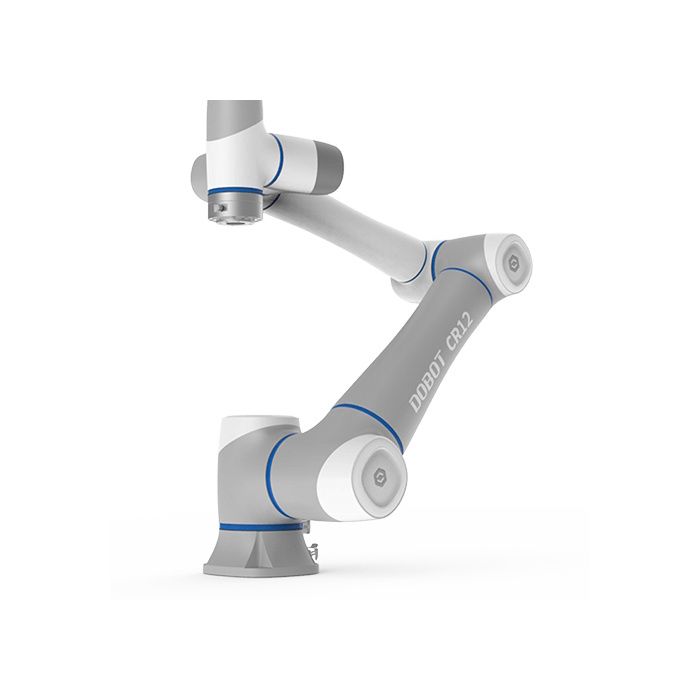
In stock
- BRAND:
- DOBOT
- PART #:
- 1200000190
- ORIGIN:
- China
- AVAILABILITY:
- SUBJECT TO AVAILABILITY
- SKU:
- Dobot-CR12A
Dobot CRA Collaborative Robot (CR12A)
A robot arm that can work beside people is only useful if it also earns its place on the production line. The Dobot CRA Collaborative Robot (CR12A) is built around that balance: a long reach and a heavy-duty payload rating, wrapped in a safety system designed for shared workspaces. For plants, workshops and integrators around the Caribbean, it offers a practical route into collaborative automation without caging the work area.
The Dobot CRA Collaborative Robot (CR12A) is available through this page, by quotation.
Background
Dobot and the CRA Series
Dobot is a robotics manufacturer whose catalog runs from desktop arms and educational platforms to industrial collaborative robots and humanoid research machines. Its CRA Series is the industrial cobot line, and it is offered in a range of models: CR3A, CR5A, CR7A, CR6AL, CR10A, CR12A, CR16A, CR16AL, CR20A and CR30A. The CR12A sits in the middle of the family, where a cobot stops being a light assembly helper and starts handling real workpieces. You can browse the wider range in the Dobot category.
Across the family, the manufacturer applies the same design philosophy: an aluminum alloy and ABS plastic body, a stand-alone safety controller, and programming through DobotStudio Pro. That shared foundation matters for anyone planning more than one cell, because training and software habits carry over from one model to the next.
Where the CR12A sits in the range
The CR12A pairs a 12kg payload rating with a working radius of 1200mm. That combination suits tasks in which the tool or the part is heavy and the arm needs to reach across a pallet, a machine table or a conveyor. The CR12A draws 350W and weighs 39.5 kg, light enough to be repositioned between workstations with suitable lifting equipment. For other collaborative arms in the store, see the Cobots category.
Technical Specifications
| Specification | Value |
|---|---|
| Model | CR12A |
| Payload (max workload) | 12kg |
| Max working radius | 1200mm |
| Repeatability | ±0.03mm |
| Absolute positioning accuracy | Under 0.4 mm |
| Maximum TCP speed | 2m/s |
| Joint speed J4/J5/J6 | 223°/s |
| Weight | 39.5 kg |
| Power consumption | 350W |
| Noise | ≤ 70 dB |
| Cable length to control box | 5m |
| Materials | Aluminum alloy, ABS plastic |
| Installation orientation | Any angle |
| Digital I/O | 24 DI and DO interfaces, PNP and NPN switching |
| Communication | Modbus TCP/RTU, EtherNet/IP, PROFINET |
| Safety controller | Stand-alone, PLd Cat.3, 20+ safety functions |
| Certification | CRA certified with ISO 13849-1, ISO 10218-1 and ISO/TS 15066 |
| Power-outage brake | Electromagnetic brake engages within 18 ms, position held within 1 mm |
| Programming | DobotStudio Pro with Blockly and LUA script |
Specifications as published by the manufacturer; confirmed against the datasheet at quotation.
The manufacturer has not published the payload-to-reach curve, the joint torque, the controller dimensions, the base footprint, the ambient humidity range or the service life; they are confirmed at quotation.
What makes the CR12A safe to work beside?
Safety is the reason a cobot exists, and the CR12A addresses it in the controller rather than only in the housing. The robot uses a stand-alone safety controller rated PLd Cat.3 with more than 20 safety functions. The CRA Series is certified with ISO 13849-1, ISO 10218-1 and ISO/TS 15066, the standards that cover safety-related control systems, industrial robot safety and collaborative operation.
Power loss is a real risk in any workshop, and the CR12A handles it deliberately. If power fails unexpectedly, the electromagnetic brake engages within 18 ms and the arm holds its position within 1 mm. That protects the tool, the workpiece and the equipment around the cell from a falling or drifting arm. Noise is rated at ≤ 70 dB, so the arm can run in a shared area without adding much to the sound of the shop floor. As with any collaborative application, a site risk assessment still decides the final cell layout, because the tool and the workpiece change the hazard.
How accurate and how connected is it?
Repeatability is ±0.03mm, which describes how consistently the arm returns to a taught point. Each robot is also calibrated with a laser calibration system, giving an absolute positioning accuracy of under 0.4 mm. The two numbers answer different questions: repeatability matters for taught, repetitive paths, while absolute accuracy matters when positions come from software or a vision system rather than from hand teaching.
On the connectivity side, the arm offers 24 DI and DO interfaces with both PNP and NPN switching, so it can connect to a wide mix of sensors, grippers and fixtures without adapters. Communication runs over Modbus TCP/RTU, EtherNet/IP and PROFINET, which covers the protocols most commonly met on factory networks. The five-meter cable to the control box gives some freedom in placing the controller away from the work area. The arm can be installed at any angle, so floor, wall, ceiling and tilted mounts are all options for fitting the cell around the part flow.
Programming is done in DobotStudio Pro. Operators who are new to robots can build sequences with Blockly, while developers can write more complex logic in LUA script. This gives a single platform that serves both the technician on the line and the integrator behind the project.
Who is the Dobot CRA Collaborative Robot (CR12A) for?
The CR12A is aimed at buyers whose parts or tools are too heavy for a small cobot but who still want to avoid a traditional fenced industrial robot. Manufacturers with palletizing, machine tending, or packing lines will find the payload and reach a natural match. Fabrication shops can use it for repetitive handling beside operators, and integrators can use it as a standard building block for customer cells.
Distributors and system builders around the Caribbean may value the shared platform: the same software and safety concept apply across the CRA Series, so a project can start with one arm and grow into several. Buyers whose loads are lighter may find a smaller model in the series, such as the CR7A, better suited, and those who need more capacity can look at the larger models such as the CR16A. Universities and training centers that want industrial-grade hardware, rather than a desktop arm, can also use the CR12A to teach real production practice.
What is the Dobot CRA Collaborative Robot (CR12A) used for?
- Machine tending: loading and unloading parts at a machine, with the arm working beside the operator instead of behind a guard.
- Palletizing and depalletizing: stacking boxes and bags where the reach and payload are the deciding factors.
- Packaging and packing: picking products from a conveyor and placing them into cartons or trays.
- Assembly assistance: holding, positioning and fastening parts alongside a human worker.
- Material handling between stations: moving workpieces from one process to the next in small and medium plants.
- Training and development: teaching automation with industrial hardware, using Blockly and LUA script.
Pricing and Availability
Prices depend on the configuration, the application and the destination, so each project is quoted individually. Send us your request and we will prepare a quotation for the Dobot CRA Collaborative Robot (CR12A). Delivery, customs and support are arranged together with the quotation. The Dobot CRA Collaborative Robot (CR12A) is available on this page.
Frequently Asked Questions
What payload and reach does the CR12A have?
The CR12A is rated for a 12kg payload with a maximum working radius of 1200mm.
Is the CR12A certified for collaborative use?
The CRA Series is certified with ISO 13849-1, ISO 10218-1 and ISO/TS 15066. The robot uses a stand-alone PLd Cat.3 safety controller with more than 20 safety functions.
What happens if the power fails?
The electromagnetic brake engages within 18 ms and holds the arm position within 1 mm. This protects the equipment and the product.
Which software is used to program it?
The CR12A is programmed with DobotStudio Pro. It supports Blockly for simple sequences and LUA script for more advanced applications.
Which industrial protocols does it support?
It supports Modbus TCP/RTU, EtherNet/IP and PROFINET, and offers 24 DI and DO interfaces with PNP and NPN switching.
Can the arm be mounted at any angle?
Yes, the installation orientation is any angle, so floor, wall and ceiling mounting are possible.
Where can I buy the Dobot CRA Collaborative Robot (CR12A) and what does it cost?
You can request it through this page. The price is given in a quotation prepared for your application and destination.
Summary
The Dobot CRA Collaborative Robot (CR12A) answers a simple question: how do you bring a strong arm close to people without losing control of safety? It combines a 12kg payload, a 1200mm working radius and ±0.03mm repeatability with a certified safety concept, a fast power-outage brake and common industrial communication protocols. For a team planning collaborative automation, this page is the starting point.


