
Dobot ATOM-W Wheeled Humanoid Robot
In stock
- BRAND:
- DOBOT
- PART #:
- ATOM-W
- ORIGIN:
- China
- AVAILABILITY:
- SUBJECT TO AVAILABILITY
- SKU:
- Dobot-ATOM-W
Dobot ATOM-W Wheeled Humanoid Robot
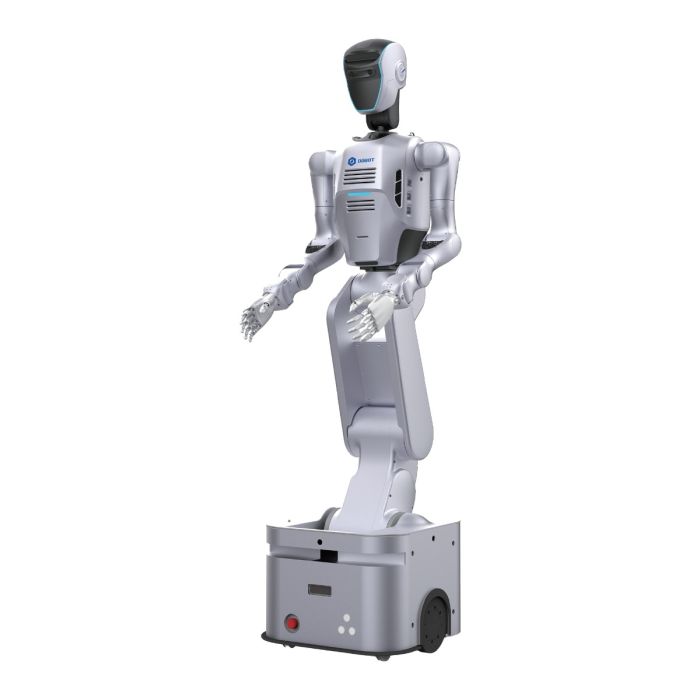
Most humanoid robots ask a building to change for them: wider doors, smoother floors, a lot of patience. The Dobot ATOM-W Wheeled Humanoid Robot asks the other way around. It puts a humanlike upper body on a wheeled chassis that can pass through corridors as narrow as 500 mm, so the robot adapts to the space instead of the space adapting to the robot.
The Dobot ATOM-W Wheeled Humanoid Robot is available through this page, by quotation.
Background
Dobot and the humanoid line
DOBOT is a robotics company known for collaborative arms and desktop manipulators. Over the years its work has moved from single arms toward complete embodied platforms: machines that see, reason and act in spaces built for people. The ATOM-W belongs to that line and sits alongside other humanoid platforms from the same maker. You can compare it with them in the Humanoids category.
What links these machines is a shared idea. A robot that works in human spaces needs hands that can do careful work, a body that fits the space, and software that can interpret a task instead of replaying a script. The ATOM-W applies that idea to a wheeled format.
Positioning and key technology
The ATOM-W pairs 7-DOF bionic dual arms with a wheeled chassis. Each arm has seven degrees of freedom, the same count as a human arm from shoulder to wrist, which gives it room to reach around obstacles and approach objects from different angles. The arms achieve a repeatability of ±0.05 mm, with a payload-to-weight ratio above 0.5.
On the software side, the robot uses a VLA architecture, which enables end-to-end autonomous reasoning and operation. In plain terms, vision, language and action are handled together, so the robot works from what it sees and what it is asked to do rather than from a rigid sequence of programmed steps.
Wheels are a deliberate choice. A wheeled base is a practical way to move a humanoid upper body across flat indoor floors, and it is the reason this model sits in the Wheeled Humanoids category rather than among the walking machines.
Technical Specifications
| Specification | Value |
|---|---|
| Available versions | Standard Version and Edu Version |
| Net weight | 60 kg |
| Arms | 7-DOF bionic dual arms |
| Arm repeatability | ±0.05 mm |
| Arm payload-to-weight ratio | Greater than 0.5 |
| Minimum corridor width | As narrow as 500 mm |
| Chassis speed | 1.5 m/s |
| Audio | 360° microphone and 2 calibrated speakers |
| AI architecture | VLA architecture, end-to-end autonomous reasoning and operation |
| Data collection | Immersive VR data collection suite, embodied data toolchain, Companion App for data management and visualization |
Specifications as published by the manufacturer; confirmed against the datasheet at quotation.
The manufacturer has not published the runtime per charge, the charging time, the IP rating, the operating temperature, the connectivity, the maximum payload of both arms combined or the chassis payload capacity; they are confirmed at quotation.
What makes the ATOM-W different from a walking humanoid?
The difference is in how the robot gets from one place to another. A walking humanoid has to balance on its legs through every step, which is impressive but demanding. The ATOM-W rolls on a chassis at 1.5 m/s, and it keeps its body compact enough to pass through corridors as narrow as 500 mm. For work that happens on indoor floors, such as moving between stations, rooms or work cells, a wheeled base is a direct and practical answer.
The upper body is where the humanlike capability sits. The dual arms are designed for precise work, with a repeatability of ±0.05 mm. That figure matters when a task involves placing, aligning or handling small items, because repeatable motion is what makes a result consistent from one cycle to the next.
If your plans call for a different body format, the wider Humanoids category shows the other platforms from Dobot so you can compare before you request a quotation.
How does the ATOM-W learn new tasks?
A humanoid is only as useful as the skills it can be taught. The ATOM-W comes with an immersive VR data collection suite, an embodied data toolchain and a Companion App for data management and visualization. An operator can demonstrate a task in virtual reality, the demonstration is recorded as data, and the Companion App is used to manage and review what has been collected.
That data feeds the VLA architecture, which enables end-to-end autonomous reasoning and operation. For a research group or a training program, this is the heart of the product: a full loop from demonstration to data to behavior, kept within one set of tools.
The audio hardware supports interaction. A 360° microphone listens from all directions, and two calibrated speakers let the robot respond. That suits settings where people speak to the robot, such as classrooms, demonstration areas and reception points.
Who is the Dobot ATOM-W Wheeled Humanoid Robot for?
Universities and technical schools are a natural audience. The Edu Version sits alongside the Standard Version, and the VR data collection suite and data toolchain give students and researchers a practical way into embodied AI work. Students can collect data, observe how a model behaves and discuss the results on real hardware.
Research laboratories and innovation centers form a second group. They need a platform with precise arms and a software stack that supports data collection, and the ATOM-W offers both in a body that moves through ordinary corridors.
Businesses exploring service or light-handling tasks in indoor spaces are a third group. A wheeled humanoid can serve as a pilot platform for testing whether a humanlike robot fits a given workflow before a wider rollout. Teams in the Caribbean that run hotels, campuses, labs or showrooms with tight corridors will find the 500 mm passage figure a useful starting point for checking their own floor plans.
Choosing between the Standard Version and the Edu Version is best done together with us: tell us your use case and we will go through the options with you. For a wider view, browse the Wheeled Humanoids category.
What is the Dobot ATOM-W Wheeled Humanoid Robot used for?
- Embodied AI research. Teams test vision, language and action models on a platform built around a VLA architecture.
- Teaching and training. Classes use the robot to show how perception, reasoning and manipulation work together.
- Demonstration data collection. Operators record tasks through the immersive VR suite and manage them in the Companion App.
- Precise manipulation trials. The dual arms, with ±0.05 mm repeatability, are used to test careful handling and placement tasks.
- Indoor navigation pilots. The wheeled chassis moves through narrow corridors, which helps evaluate a humanoid in real buildings.
- Interactive showcases. The 360° microphone and two calibrated speakers support spoken interaction at exhibitions and reception areas.
Pricing and Availability
We do not list prices on this page. Quotation is the way to proceed: tell us which version you are considering and how you plan to use the robot, and we will prepare an offer. Delivery, customs and support are arranged together with the quotation, so you see the whole picture before you commit. The Dobot ATOM-W Wheeled Humanoid Robot is available on this page.
Frequently Asked Questions
Which versions of the ATOM-W are offered?
The ATOM-W comes in a Standard Version and an Edu Version. Tell us your use case and we will help you choose.
How precise are the arms?
The 7-DOF bionic dual arms achieve a repeatability of ±0.05 mm, with a payload-to-weight ratio above 0.5.
Can it work in narrow spaces?
Yes. The robot passes through corridors as narrow as 500 mm.
How fast does the chassis move?
The chassis speed is 1.5 m/s.
How is the robot taught new tasks?
It includes an immersive VR data collection suite, an embodied data toolchain and a Companion App for data management and visualization. These work with its VLA architecture for autonomous reasoning and operation.
What is the battery life and the IP rating?
Both are listed among the open points under the specification table. Ask us when you request a quotation.
Where can I buy the Dobot ATOM-W Wheeled Humanoid Robot and what does it cost?
You can request it through this page. The cost is provided in a quotation prepared for your version and your project, so no price is shown here.
Summary
The ATOM-W takes a simple position: rather than rebuild the space around a robot, give the robot a body that fits the space. It combines 7-DOF dual arms with ±0.05 mm repeatability, a wheeled chassis that handles corridors as narrow as 500 mm, a VLA architecture, and a data collection toolchain with a Companion App. If this robot matches your lab, classroom or indoor pilot, this page is the starting point.


